Skip to content
Herbs & Cultures

Tradition in South America

Kamëntšá and Inga medicine

In the Sibundoy valley in southern Colombia for centuries; a living tradition

Image of Ayahuasca
Ayahuasca, Banisteriopsis caapiFrançois Delonnay/Archivo Centro Takiwasi · CC BY-SA 4.0

History

The Sibundoy valley lies at more than two thousand metres in the Andes of the Putumayo department, in southern Colombia. To the east the mountains drop steeply to the Amazon lowland. Two peoples have lived side by side there for centuries. The Kamëntšá, also called Camsá, speak a language related to no other. The Inga speak Inga Kichwa, a form of Quechua. That language may have come with the Incas or later with the missionaries, and the Inga see themselves as related to the Incas.

From the beginning of the twentieth century to the end of the 1960s Capuchin missionaries governed the valley. They took much of the land of the Kamëntšá and Inga, made them work for the mission and fought their customs. Yet the knowledge of the healers survived.

The healers of Sibundoy are called taitas. Throughout Colombia they are known as travelling herbalists who sell plants and treat patients in the markets of Bogotá, Pasto and Quito. From the 1940s the botanist Richard Evans Schultes worked in the valley with the Kamëntšá taita Salvador Chindoy. His relative Pedro Chindoy also became known far beyond the valley.

Key ideas

For the taitas, the knowledge of plants comes from the plants themselves. Salvador Chindoy said that everything he knew about medicinal plants he had learned in the visions they gave him. Plants such as yagé and the borracheros are therefore called 'doctors': whoever takes them in the right way is taught by them.

With these plants a taita finds out why someone is ill and sees what is hidden: who caused the illness, or where something was lost. Illness can come from the body, but also from envy, sorcery or a disturbed relationship with others or with the earth. People say that whoever can heal can also make ill, and so a taita is respected and sometimes feared.

Restoring balance is also a matter for the community. On Bëtscnaté, 'the great day', the Kamëntšá ask one another's forgiveness, settle quarrels and thank Mother Earth for the harvest.

Knowledge and its transmission

A taita learns for years from an older healer. He learns the plants, the chants and the diets, and takes the 'doctors' under his teacher's guidance. When healing, the taita shakes a leaf bundle or rattle over the patient, blows tobacco smoke over the body and strokes the illness out, while he sings.

Women often know the most wild medicinal plants. They gather them for the healer or for the household, and someone with a small wound will go to a herbwoman sooner than to a taita. Sometimes that herbwoman is the taita's wife.

The taitas of Sibundoy grow their own forms of Brugmansia, found only in the valley: shrubs with narrow, deformed or 'eaten' leaves, such as kinde borrachero and munchiro borrachero. They are grown only from cuttings and are the property of the healers. The strongest form is culebra borrachero, which was once described as a separate genus, Methysticodendron. They also use Iochroma as a purgative and intoxicant, and Desfontainia when they 'want to dream'. According to the taitas, the strongest of these plants are used less than before, because they are hard on body and mind.

From the lowland come yagé, chiricaspi and guayusa, which the taitas of Sibundoy and Mocoa call a cure-all. The lowland Inga drink yoco every morning.
Texts and figures

The knowledge is oral and passed from teacher to apprentice. Outsiders only wrote about it in the twentieth century. Schultes published on the plants of Sibundoy from the 1940s, and his student Melvin Bristol wrote a dissertation on the ethnobotany of the valley in 1965 and a study of its Brugmansia forms in 1969. With the chemist Robert Raffauf, Schultes described some fifteen hundred plants of the northwest Amazon in The Healing Forest (1990), and in Vine of the Soul (1992) he showed the work of the healers in photographs.

In 1999 forty well-known healers from seven peoples met in Yurayaco, in Caquetá. They drew up a declaration and a code of ethics for the Indigenous medicine of the Andean foothills in the Colombian Amazon. The code was signed in 2000, and that meeting gave rise to UMIYAC, the union of Indigenous yagé healers.

Today

More than seven thousand Kamëntšá live today, most of them in the valley. The Inga live in Sibundoy and Santiago and further across Putumayo, Caquetá and Nariño. Both languages are still spoken, but are under pressure from Spanish.

Bëtscnaté, also called Clëstrinye or the carnival of forgiveness, is celebrated every year on the Monday before Ash Wednesday, with music, dance, colourful clothing and the well-known wooden masks of the Kamëntšá.

Outsiders' interest in yagé is growing. Some healers work with tourists, but UMIYAC warns against false healers and the sale of ceremonies, and wants the knowledge to stay with the peoples themselves. Organisations such as the Amazon Conservation Team help the peoples protect their land and their plant knowledge.

Nature in the tradition

The valley is a high, fertile basin with fields of maize, beans, potatoes and peas, surrounded by mountain forest and páramo. A remarkable number of plants grow only here, and Schultes called Sibundoy perhaps the place with the most known psychoactive plants in the world.

Brugmansias and Iochroma grow near the houses. From the high moors comes Hedyosmum, of which the taitas make a sweat-inducing tea. From the warm lowland around Mocoa come yagé, the chagropanga leaves that go with it, chiricaspi, guayusa and yoco. Near Mocoa guayusa trees from a Jesuit plantation still stand, 250 to 300 years old.

Approaching it with respect

The yagé ceremonies belong to the Kamëntšá, the Inga and their neighbours. We describe here what is known about their medicine, but give no instructions for a ceremony. UMIYAC asks outsiders not to copy or sell their ceremonies.

Brugmansia and the borracheros of Sibundoy are highly poisonous: the difference between an effective and a lethal amount is small. That is why we give no preparation for them, nor for Iochroma. The forms the taitas grow are their property.

DMT, the active substance in the chacruna and chagropanga that go with yagé, is on List I of the Dutch Opium Act.

From the kitchen

Recipes with herbs from this tradition

There is no recipe from this tradition on the site yet. These recipes do use herbs it knows.

Registry

Herbs in this tradition

  • Caution

    South America · Herb · № 901

    Ayahuasca

    Banisteriopsis caapi

    A giant liana up to thirty metres long. The stem contains harmine, harmaline and tetrahydroharmine, which inhibit the enzyme MAO. This makes the DMT from plants such as chacruna active by mouth. The drink brings visions, and usually vomiting and diarrhoea, which the tradition regards as cleansing.

    Herbal knowledge of the Amazon+3
  • Caution

    South America · Herb · № 926

    Chiricaspi

    Brunfelsia grandiflora

    A shrub of the nightshade family up to three metres tall, with fragrant flowers that fade from purple to white. Contains scopoletin, among others, and compounds that cause convulsions in animals. Gives a feeling of cold and tingling, and in larger amounts dizziness and paralysis.

    Herbal knowledge of the Amazon+1
  • Caution

    South America · Herb · № 876

    Floripondio (angel's trumpet)

    Brugmansia spp. (o.a. B. arborea, B. sanguinea)

    A shrub or small tree with large hanging trumpet flowers. All parts contain tropane alkaloids such as scopolamine and atropine, which cause confusion and hallucinations.

    Kallawaya healing knowledge+2
  • Caution

    South America · Herb · № 879

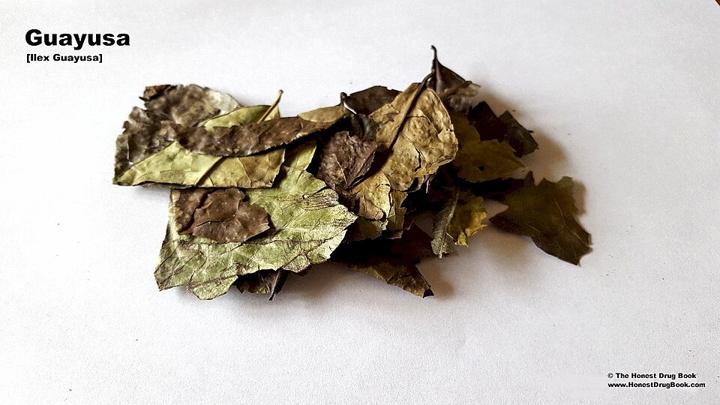
    Guayusa

    Ilex guayusa

    A relative of yerba mate; the leaf contains a lot of caffeine and is stimulating.

    Kallawaya healing knowledge+2
  • Caution

    South America · Herb · № 983

    Iochroma

    Iochroma fuchsioides

    A shrub of the nightshade family with clusters of tubular orange-red flowers. Withanolides, substances also found in ashwagandha, have been isolated from it. Why the plant acts as an intoxicant has not been explained.

    Kamëntšá and Inga medicine
  • Caution

    South America · Herb · № 980

    Yoco

    Paullinia yoco

    A woody liana of the soapberry family, related to guarana. The bark contains caffeine and theobromine; 0.1 to 3.6 percent caffeine has been measured, most in the inner bark of the stem. It is one of the few plants whose bark, rather than its seed or leaf, gives a caffeine drink.

    Kamëntšá and Inga medicine