 Caution
Central America and the Caribbean · Food · № 818
Annatto (achiote)
Bixa orellana
The red seeds are used as a colouring and spice; traditionally also as a remedy.
Maya healing knowledge+4
Tradition in South America
Roots in the Moche culture (100–800); a living tradition

Northern Peru runs from the coastal desert around Trujillo, Chiclayo and Piura through dry forest and mountains into the Amazon. Few regions in the world have such a rich medicinal flora. The Peruvian anthropologist Lupe Camino called the north part of the 'health axis' of the Andes, an area from southern Ecuador to northern Bolivia where healers have long gathered and traded plants.
The tradition is old. Archaeologists have found remains of the San Pedro cactus at sites that are thousands of years old. The Moche, who lived on this coast between about 100 and 800, depicted healers on their pottery, as well as the San Pedro and the seeds of cabalonga and of ishpingo. Remains of such plants have been found in the tomb of the Lord of Sipán, a Moche ruler.
Moche pottery also shows a mysterious, comma-shaped fruit with a large calyx, which researchers call ulluchu. It hangs from the belts of warriors and messengers and floats around priests and sacrificial scenes, and real fruits have been found in graves. Nobody knows for certain which plant it is. Bussmann and Sharon think of a Guarea, an Amazonian tree whose seeds contain poisonous alkaloids, and suspect that the Moche used them in sacrifices and perhaps as a snuff. That is a hypothesis not yet confirmed by chemical analysis. The name is uncertain too: the archaeologist Rafael Larco Hoyle used it in the 1930s, but it does not appear in the dictionaries of Mochica.
After the Spanish conquest, Indigenous medicine blended with Catholicism and with Spanish ideas about illness. In the 1780s Bishop Baltasar Martínez Compañón of Trujillo had everything in his diocese described and painted, including the useful plants. According to the botanist Rainer Bussmann and the anthropologist Douglas Sharon, about 40 per cent of those plants are still sold in the coastal markets. A third is now used only in the Amazon, and the rest fell out of use. At the same time many new plants were added. In their view, healers in Peru could experiment more freely than in Ecuador, where traditional medicine was persecuted for a long time.
Curanderos and curanderas, male and female healers, treat body and soul together. Many complaints that bring people to them are called in Spanish susto or espanto (fright), mal aire or mal viento (bad air), mal ojo (the evil eye), envidia (envy) and daño (harm through sorcery). According to Bussmann and Sharon, more than a quarter of all the plant uses they recorded concern such 'magical' complaints.
Plants have a character of their own: they are hot or cold, and some are strong or even dangerous. Plants from the high mountains, especially from around the sacred lakes, are considered particularly powerful. The best known are Las Huaringas near Huancabamba, where healers and patients travel.
In their work healers use a mesa, an altar laid out on a cloth. On it lie shells, stones, staffs and ancient pottery, next to crosses and images of saints. The old Andean world and Christianity stand side by side: the prayers call on Christ and the saints, but also on the mountains, the apus, and the lakes.
A healing often begins with a limpia, a cleansing: the healer sweeps the patient with plants, an egg or a guinea pig and sprays him with holy water and perfume. From the guinea pig the healer then reads what ails the patient. A ceremony is often followed by a baño de florecimiento, a 'flowering bath' with flowers and fragrant herbs. Patients sometimes take home a seguro: a small bottle with herbs, perfume and personal items that protects them and brings luck.
Healers rarely work with a single plant. Bussmann and Sharon recorded 974 different mixtures, usually of two to seven plants. For ordinary complaints, such as coughs or kidney problems, healers often use the same mixtures. For spiritual complaints each healer has a recipe of his or her own, which is closely guarded. Most remedies are boiled in water. In laboratory tests, extracts in alcohol were often far more toxic than those in water: in many cases the traditional preparation is the safer one. In the same tests, plants that healers use against infections inhibited bacteria far more often than plants without such a use: according to Bussmann and Sharon, about three quarters against one third. Plants used mainly in seguros rarely did.
Many plant names reflect history. About two thirds of the names are Spanish. The rest come from Quechua, such as cuti cuti, or from the extinct Mochica language, such as espingo.
The knowledge is passed on orally, from healer to apprentice and within families. Spanish chroniclers such as Nicolás Monardes, José de Acosta and Bernabé Cobo described the useful plants of Peru. Later came the botanists Hipólito Ruiz and José Pavón and the Italian Antonio Raimondi.
In the 1970s the anthropologist Douglas Sharon worked with the curandero Eduardo Calderón from Trujillo. His book Wizard of the Four Winds (1978) and the film Eduardo the Healer made northern curanderismo known around the world. Later, with Bussmann, he described 510 medicinal plants from the markets of Trujillo and Chiclayo, with about 2,500 uses. In their book Medicinal Plants of the Andes and the Amazon (2015) they stress that the knowledge remains the property of the healers and vendors who shared it.
Peru increasingly recognises traditional medicine. In 1991 a National Institute of Traditional Medicine was set up, with the physician Fernando Cabieses as its first director. Since 1999 the social security system EsSalud has had centres for complementary medicine, including one in Trujillo, where doctors prescribe medicinal plants. In 2022 the Ministry of Culture declared the traditional use of San Pedro in the north to be cultural heritage.
In the markets of Trujillo and Chiclayo, such as the Mercado Mayorista and the Mercado Modelo, dozens of stalls sell medicinal plants. Small stalls mostly carry ordinary herbs such as chamomile, horsetail and eucalyptus. Large stalls specialise in everything healers need, from 'magical' plants to perfumes and amulets. According to Bussmann and Sharon, the trade in these markets brings in some 1.2 million dollars a year.
The tradition changes with the times. Healers take up new plants, such as noni, and some now also use ayahuasca from the Amazon. Many people combine herbs with conventional medicines.
There are also concerns. Plants are often sold as powder, so no one can see which species it is. Different species are sold under one name, and sometimes a completely different plant is sold as 'cat's claw'. Some species are overharvested, such as cat's claw, huamanripa and hercampuri. The land where the plants grow is disappearing through the growth of cities, large sugar and rice plantations and mining in the mountains, including near the sacred lakes.
The markets sell plants from every corner of the country. From the coastal desert and dry forest come palo santo, whose wood is burned as incense, and tara, whose pods are used to gargle for sore throats. Molle (pirul) is a tree used for rheumatism and coughs and in cleansings. The pods of the algarrobo are boiled into a sweet syrup given as a tonic and for coughs.
From the mountains come bitter plants such as hercampuri, corpus way and other gentians, used for liver, gallbladder and blood sugar complaints. They include pasuchaca, one of the best-selling remedies for diabetes, the 'blood-cleansing' canchalagua and the root of rhatany, which is rich in tannins. Huamanripa serves for coughs and asthma, muña for stomach ache and wind, and manayupa for inflammation. The leaves of yacón are drunk for diabetes, and the Peruvian elder (sauco) for fever and coughs. Giant horsetail is among the best-selling remedies for bladder and kidney complaints, as are achiote and chanca piedra, the 'stonebreaker'.
From the Amazon come cat's claw, sangre de grado, guayusa, matico and the fragrant mucura, used in flowering baths. The bark of chuchuhuasi and the parasitic huanarpo are steeped in wine or cane spirit as a strengthening drink, and the fragrant seeds of ishpingo go into baths. Coca, cinchona bark, maca and tobacco also belong to Peruvian herbal knowledge.
Many everyday remedies came with the Spaniards: chamomile (manzanilla), the best-selling herb on the markets, rue (ruda), wormwood (ajenco), lemon balm (toronjil), rosemary (romero), fennel (hinojo), plantain (llantén) and eucalyptus.
Some plants are sacred or dangerous and belong only with experienced healers: the San Pedro cactus, floripondio or misha, and the poisonous cabalonga.
San Pedro and floripondio are at the heart of the night-time ceremonies. The card for San Pedro describes how the tradition prepares the cactus, with the risks and the legal status; for floripondio and cabalonga we deliberately do not, because the effective and the lethal amounts lie close together. Mescaline, the active substance in San Pedro, is banned in many countries; in the Netherlands it is on List I of the Opium Act. Ceremonial tourism puts pressure on the tradition. Curanderos from the north have expressed their concern in a joint statement about foreigners collecting wild San Pedro.
The knowledge in this story was written down by researchers, but it belongs to the healers and vendors who shared it. Peru has a law protecting the collective knowledge of Indigenous peoples, and a commission against biopiracy that challenges unjustified patents, for example on maca.
Preferably buy plants from cultivated or sustainably harvested sources, and be careful with powders of unknown composition.
From the kitchen
 South AmericaMuña teaThe minty tea of the Andes, for after a meal.DigestionMuña2 cups · 10 minutes
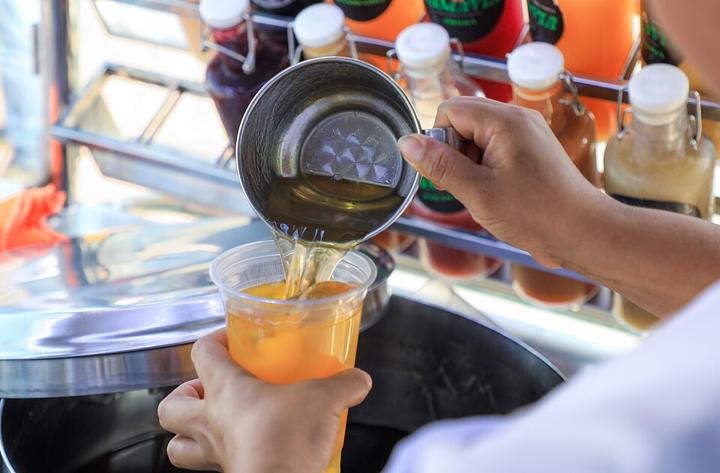 MINISTERIO DE LA PRODUCCIÓN - PRODUCE · public domainSouth AmericaEmolienteThe warm herbal drink poured from a cart on every street corner in Peru.EverydayBarley · Flax · Giant horsetailAbout 1.5 litres · 45 minutes
Registry
CautionCentral America and the Caribbean · Food · № 818
Bixa orellana
The red seeds are used as a colouring and spice; traditionally also as a remedy.
 Caution
South America · Food · № 916
Neltuma pallida (syn. Prosopis pallida)
A thorny tree of the pea family, related to mesquite, with sweet pods full of sugars. With its deep roots the tree holds the dry forest together.
 Caution
Europe · Herb · № 63
Artemisia absinthium
One of the most bitter herbs; traditionally used to stimulate appetite and digestion and against intestinal worms. Clinical evidence is limited.
 Caution
South America · Herb · № 896
Ambrosia peruviana
An aromatic, hairy ragweed. In its native range it is used as a painkilling, anti-inflammatory, deworming and antiseptic remedy; good research is lacking.
 Caution
South America · Herb · № 901
Banisteriopsis caapi
A giant liana up to thirty metres long. The stem contains harmine, harmaline and tetrahydroharmine, which inhibit the enzyme MAO. This makes the DMT from plants such as chacruna active by mouth. The drink brings visions, and usually vomiting and diarrhoea, which the tradition regards as cleansing.
 Caution
South America · Herb · № 886
Cascabela thevetia (syn. Thevetia peruviana)
A shrub with yellow trumpet flowers, related to oleander. All parts, especially the seeds, contain cardiac glycosides that act on the heart.
 Caution
South America · Herb · № 911
Schkuhria pinnata
A small, finely branched annual herb of the daisy family with tiny yellow flowers. It tastes bitter. There is laboratory research on compounds that act on blood sugar, but studies in people are lacking.
 Caution
South America · Herb · № 891
Baccharis genistelloides (en B. trimera)
A perennial with flat, winged stems and hardly any leaves. One of the best-studied Baccharis species; it contains flavonoids that may be anti-inflammatory. Clinical evidence is lacking.
 Caution
South America · Herb · № 919
Phyllanthus niruri (en P. stipulatus, P. urinaria)
A small herb with rows of fine leaflets and tiny fruits beneath them. In experiments it inhibited the formation of kidney stone crystals and acted as a diuretic; small studies in people do not yet give clear evidence.
 Caution
South America · Herb · № 890
Baccharis latifolia (en verwante soorten, o.a. B. pentlandii)
A fast-growing, densely branched shrub with glossy, sticky leaves. Little is known from research about its effect in people.
 Caution
South America · Herb · № 917
Maytenus macrocarpa (syn. Monteverdia macrocarpa); in Noord-Peru ook Heisteria acuminata
A large tree with thick, reddish-brown bark. The bark contains triterpenes and sesquiterpenes, among other compounds; extracts were anti-inflammatory in experiments. Studies in people are lacking.
 Caution
 Caution
Europe · Herb · № 85
Melissa officinalis
Traditionally used for restlessness, sleep problems and a nervous stomach; externally for cold sores. Small studies suggest a mild calming effect, but evidence is limited.
 Caution
South America · Herb · № 378
Aloysia citrodora
Traditionally attributed effects: relaxing, helps you fall asleep.
 Caution
South America · Herb · № 183
Erythroxylum coca
The leaf contains a small amount of cocaine and other alkaloids. Chewing it or drinking it as tea is used in the Andes against hunger, fatigue and altitude sickness; evidence for the latter is limited. Cocaine, the first local anaesthetic and today mainly an addictive drug, was isolated from the leaf.
South America · Herb · № 913
Gentianella bicolor
A small, very bitter herb of the gentian family, related to hercampuri. Gentians contain bitter compounds that stimulate digestion. Clinical studies are lacking.
 Caution
Oceania · Herb · № 172
Eucalyptus globulus
Eucalyptus oil is used for coughs and blocked noses with colds and externally for muscle pain; the European Medicines Agency recognises these as traditional uses. Strong clinical evidence is limited.
 Caution
South America · Herb · № 876
Brugmansia spp. (o.a. B. arborea, B. sanguinea)
A shrub or small tree with large hanging trumpet flowers. All parts contain tropane alkaloids such as scopolamine and atropine, which cause confusion and hallucinations.
 Caution
South America · Herb · № 879
Ilex guayusa
A relative of yerba mate; the leaf contains a lot of caffeine and is stimulating.
 Caution
South America · Herb · № 881
Gentianella alborosea (en G. nitida)
A small, very bitter herb of the gentian family. It is sold for liver, gallbladder and cholesterol complaints and for weight loss; good research is lacking.
 Caution
South America · Herb · № 887
Laccopetalum giganteum
A giant buttercup with a rosette of thick leaves and large greenish-yellow flowers. Its compounds and effects have barely been studied.
 Caution
South America · Herb · № 914
Corynaea crassa
An unusual parasitic plant without chlorophyll that lives on the roots of trees and shrubs; only a club-shaped flower spike appears above ground. Little is known about its effect in people.
 Caution
South America · Herb · № 918
Nectandra spp. (en verwante laurierachtigen, o.a. Ocotea en Aiouea)
Trees of the laurel family with fragrant seeds and bark. Little is known about the substances in the seeds and their effect in people.
 Caution
Europe · Herb · № 19
Matricaria chamomilla (Duitse kamille)
Flowers are used in teas and topical or oral products. Reliable evidence is insufficient for most claimed conditions.
 Caution
South America · Herb · № 33
Uncaria tomentosa
There is no conclusive scientific evidence that cat's claw helps any health condition.
 Caution
South America · Herb · № 31
Cinchona spp. (o.a. C. officinalis, C. pubescens)
The bark contains quinine and other alkaloids. Quinine became an important antimalarial, but using the bark yourself is unsafe and is not malaria treatment.
 Caution
South America · Food · № 32
Lepidium meyenii
A root crop eaten as food. Claims about fertility and energy are unproven.
 Caution
South America · Herb · № 883
Desmodium molliculum
A low plant of the pea family. Traditionally used for inflammation and wounds; research is limited.
 Caution
South America · Herb · № 880
Petiveria alliacea
A herb with a strong garlic smell. It has been studied for anti-inflammatory and antimicrobial effects; clinical evidence is lacking.
CautionSouth America · Herb · № 816
Minthostachys mollis
A mint-like plant used in the Andes for stomach complaints and wind.
 Caution
South America · Herb · № 882
Bursera graveolens
A tree of the frankincense and myrrh family, with strongly scented wood that contains essential oil.
South America · Herb · № 912
Geranium ayavacense en Geranium sessiliflorum
Low, rosette-forming cranesbills with a thick root. They contain tannins. Whether the tea lowers blood sugar has not been properly studied in people.
 Caution
South America · Herb · № 885
Piper aduncum
A shrub of the pepper family with rough, fragrant leaves. The leaf was traditionally used to stop bleeding; research is limited.
 Caution
South America · Herb · № 884
Sambucus peruviana
A tree with white flower umbels and dark berries, related to the European elder. Flowers and leaves are considered sweat-inducing and anti-inflammatory.
CautionSouth America · Herb · № 898
Myroxylon balsamum (var. pereirae)
A large tree whose resin, the balsam, smells of vanilla and cinnamon. The balsam contains cinnamic acid, benzyl benzoate and vanillin, among other compounds, and is used in perfume, food and ointments for skin and wounds.
 Caution
Central America and the Caribbean · Herb · № 822
Schinus molle
A tree with aromatic leaves and pink berries, used in cleansing rituals and as a folk remedy.