 Caution
Africa · Herb · № 413
Pellitory root
Anacyclus pyrethrum
Traditionally attributed effects: promotes salivation, strengthens the nerves; for toothache and caries, sore throat, tonsillitis, epilepsy, rheumatism.
Ayurveda+3
Tradition in Europe
12th century (c. 1098–1179); the Physica was written between 1151 and 1158
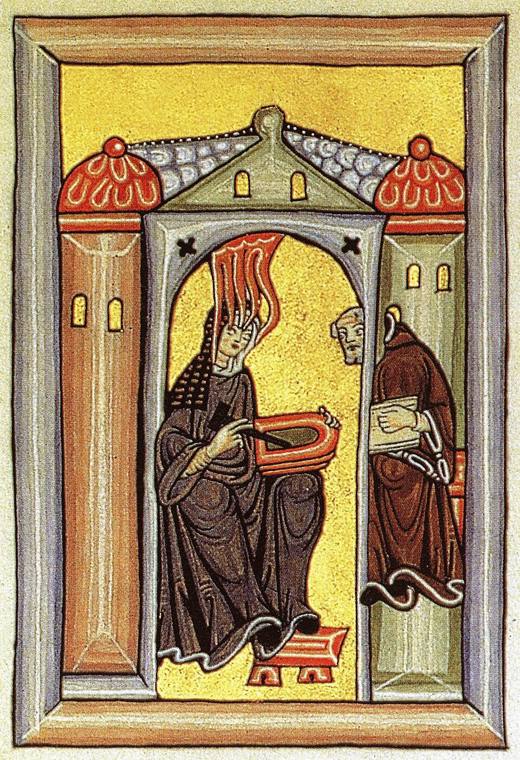
Hildegard was born in 1098 in Bermersheim near Alzey, into a noble family. At the age of eight she was entrusted to the Benedictine monastery on the Disibodenberg, where she grew up in the care of Jutta of Sponheim. In 1115 she took her vows. After Jutta’s death, around 1136, she became magistra: the leader of the community of sisters.
From 1141 she wrote down her visions in the Scivias. Around 1150 she founded her own convent with about twenty sisters on the Rupertsberg near Bingen, and in 1165 a second one in Eibingen, across the Rhine. She wrote theology, composed music, corresponded with popes and emperors and made preaching tours. For a woman in the twelfth century that was exceptional.
In the same years her writings on nature and medicine came into being. Hildegard died on 17 September 1179. For centuries she was venerated as a saint without formal canonisation. That only followed in 2012, and on 7 October of that year Pope Benedict XVI proclaimed her a Doctor of the Church.
The key word in Hildegard’s thought is viriditas, greening power: the life force that makes everything grow and flourish, from plants to the human soul. For her, health is the flourishing of that greening power, and illness its withering.
She worked within the medical framework Europe had inherited from antiquity: four elements and four humours, with qualities such as warm, cold, dry and moist. To this she added a theological explanation of her own. Through Adam’s fall the humours in man became unbalanced, and with that illness came into the world. In her writings she also describes temperaments of men and women, which determine how someone falls ill and what helps.
Another key concept is discretio, the right measure. In the spirit of the Benedictine rule, Hildegard warns against every extreme, in eating, fasting, working and sleeping. Moderation is for her already a form of medicine in itself.
Medieval monasteries were centres of medical knowledge. The Rule of Benedict required care for the sick; monasteries had an infirmary and a herb garden, and monks and nuns copied Latin medical texts. Hildegard drew on that learned tradition, but also on the folk knowledge of her region. Her texts often give German plant names alongside Latin ones.
Her works survive in manuscripts copied after her death. Causae et curae has even come down to us in only one thirteenth-century manuscript. Researchers therefore discuss how much of the text comes directly from Hildegard and what later copyists changed.
Today’s Hildegard medicine is largely a twentieth-century elaboration. The Austrian physician Gottfried Hertzka made her known to a wide public from the 1970s, and later authors built on his work. That modern form makes choices, adds material and differs in places from what is in the medieval texts.
Her work on nature and medicine consists of two parts. The Physica, also called Liber simplicis medicinae, has nine books: on plants (the largest part), elements, trees, stones, fish, birds, four-footed animals, reptiles and metals. For each remedy Hildegard describes its qualities and use.
Causae et curae deals with the origin of the world and of illness, with the structure of the human body and the temperaments, and contains recipes and treatments.
She also wrote three great visionary works: Scivias, the Liber vitae meritorum and the Liber divinorum operum. Her music is collected in the Symphonia, and she wrote the Ordo virtutum, a musical play about the virtues.
Since 2012 Hildegard has been one of the Doctors of the Catholic Church, one of the few women among them. In Eibingen near Rüdesheim a Benedictine abbey of nuns bearing her name still exists.
Beyond that she has become a popular figure. There are shops, cookbooks and cures that invoke her, with spelt as the main ingredient and herbs such as galangal, pellitory and fennel. Her music is also widely performed and recorded.
Historians stress that her medicine belongs to the knowledge of the twelfth century. It is valuable as cultural and religious heritage, but not a proven method of treatment, and not all remedies in her texts are safe.
In the Physica Hildegard describes hundreds of plants. For each she says whether it is warm or cold and what it is good for. Some plants she praises lavishly. Spelt (dinkel) is for her the best grain, which gives good spirits. Fennel she calls wholesome and gladdening. Galangal, sage and quendel (wild thyme) also fare well.
Her view of nature covers more than plants. Gemstones, metals and animals all have a place in the Physica within one order created by God, in which man is the centre and everything is connected with everything else.
Read Hildegard as a voice from the twelfth century, in which theology and medicine could not be separated. Her texts are not a manual for today.
Be critical of modern “Hildegard products”: quality and promises vary greatly, and what is on the label does not always come from her own work. Consult a doctor about complaints.
From the kitchen
Registry
CautionAfrica · Herb · № 413
Anacyclus pyrethrum
Traditionally attributed effects: promotes salivation, strengthens the nerves; for toothache and caries, sore throat, tonsillitis, epilepsy, rheumatism.
 Caution
Asia · Herb · № 119
Alpinia galanga
A relative of ginger traditionally used for nausea, wind and sluggish digestion. Clinical evidence is limited.
CautionAsia · Herb · № 832
Alpinia officinarum
An aromatic rhizome traditionally used for digestive complaints.
 Caution
Europe · Herb · № 44
Lavandula angustifolia
A fragrant plant used in bath products, perfume, and aromatherapy. Evidence for medical effects is preliminary.
 Caution
Europe · Herb · № 590
Mentha pulegium
Traditionally attributed effects: stimulating, astringent, promotes menstruation, induces sweating; brings on delayed menstruation, calms the stomach, lowers sudden high fever.
 Caution
Europe · Herb · № 45
Salvia officinalis
A culinary herb. A few small studies suggest possible effects on memory and blood lipids, but evidence is limited.
 Caution
Europe · Food · № 833
Triticum spelta
A grain for bread and porridge; nutritionally similar to wheat.
 Caution
Europe · Herb · № 72
Foeniculum vulgare
The seed is traditionally used for wind, bloating and cramps. There are some small studies, but evidence is limited.
 Caution
Europe · Herb · № 838
Thymus serpyllum
An aromatic herb traditionally used for coughs and digestive complaints.