 Caution
Europe · Herb · № 57
Agrimony
Agrimonia eupatoria
An astringent, tannin-rich herb traditionally used for diarrhoea, sore throats and minor wounds. Good human research is lacking.
Western herbal medicine+2
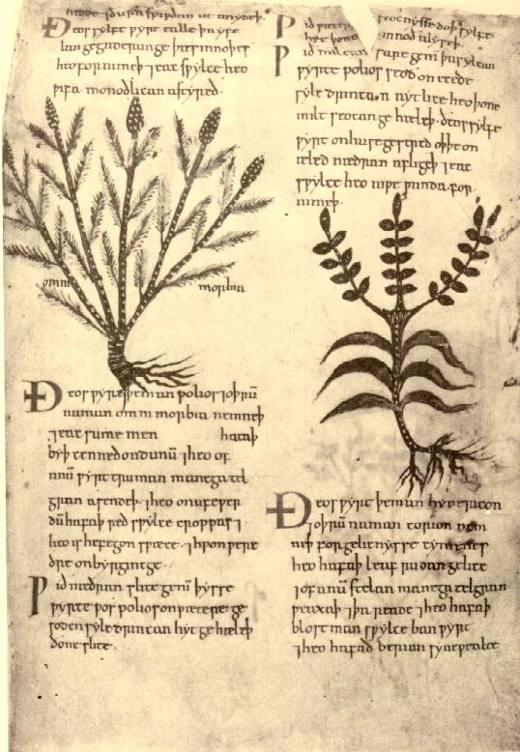
From Anglo-Saxon England, roughly from the fifth century to the Norman Conquest in 1066, a remarkable number of medical texts survive in the vernacular: Old English. That is exceptional in Europe, where learned texts were usually in Latin.
The best-known work is Bald’s Leechbook, the “physician’s book of Bald”, from the middle of the tenth century. A note at the end says that Bald was the owner and that a scribe, Cild, wrote the book for him. It is kept in the British Library.
Other sources are the Lacnunga, a collection of remedies and charms, and the Old English Herbarium, a translation of a late Latin herbal. Together they give a rich picture of care in early medieval England.
Anglo-Saxon medicine mixed different worlds. There is classical knowledge from Latin sources, there are Christian prayers, and there are charms going back to older, pagan ideas.
Illness could be caused by elves, who shot invisible arrows: ylfa gescot, “elf-shot”. “Flying venom” and worms were also seen as causes.
That is why herbs were often combined with words. A remedy worked better if you sang while making it, picked it at a particular hour, or said a prayer.
A physician was called læce in Old English, which also means “leech”. A medicine was a læcedom.
Knowledge was kept in monasteries and by learned people, but also by ordinary healers who knew the herbs around them. The texts show that there was exchange: the Leechbook even contains remedies said to have been sent by the Patriarch of Jerusalem to King Alfred.
The recipes are practical: they name ingredients, quantities and preparation.
Bald’s Leechbook has three parts: the first on external ailments from head to feet, the second on internal ailments, and the third, possibly a separate text, with more remedies and charms.
The Lacnunga contains the famous Nine Herbs Charm, a poem in which nine herbs are invoked against poison and disease, including mugwort, plantain, chamomile, nettle, chervil and fennel.
In 2015 researchers at the University of Nottingham tested an eye salve from Bald’s Leechbook, made of garlic, onion or leek, wine and ox gall. In the laboratory the salve killed the resistant bacterium MRSA.
Anglo-Saxon medicine no longer exists as a tradition, but it attracts a lot of attention. Researchers search old recipes for new remedies against bacteria that are resistant to antibiotics.
The research on Bald’s eye salve showed that old knowledge can be valuable, though a result in the laboratory does not yet mean that a remedy works in people.
For linguists and historians the texts are a treasure of Old English words and ideas.
The Anglo-Saxons mainly used plants from their surroundings: mugwort, plantain, nettle, betony, fennel and chervil.
Many remedies came from the onion family. They also used wine, honey, butter, vinegar and animal products.
The Old English Herbarium also describes plants from the Mediterranean that did not grow in England, taken over from Latin sources.
Read the recipes as history. Do not try them yourself: the eye salve, for example, can cause serious damage to the eye if it is not made sterile and correctly.
The mixture of herbs and charms shows how people in an uncertain world sought care and protection.
From the kitchen
There is no recipe from this tradition on the site yet. These recipes do use herbs it knows.
 Body careChamomile cleanser for dry or mature skinA gentle cleanser for dry skin.Dry or sensitive skinChamomile · Alfalfa · Pot marigold (calendula)EuropeAsiaAfricaAbout 1.5 litres, for a week · 30 minutes
 Body careCooling chamomile after-sun sprayA cold spray for skin that has had too much sun.After sunChamomile · AppleEurope235 ml · 30 minutes
 Asia · Chinese kitchenBraised sesame beef with fennelBeef in a crust of toasted sesame, seasoned with fennel seed.DigestionFeeling coldSesame · Fennel4 people · Preparation 20 min (plus 2 hours standing), cooking 40 min
Registry
CautionEurope · Herb · № 57
Agrimonia eupatoria
An astringent, tannin-rich herb traditionally used for diarrhoea, sore throats and minor wounds. Good human research is lacking.
 Caution
Europe · Food · № 84
Malus domestica
A fruit rich in fibre such as pectin; grated apple is an old home remedy for mild diarrhoea. No specific medicinal effect has been proven.
 Caution
Europe · Herb · № 93
Betonica officinalis (syn. Stachys officinalis)
Traditionally used for tension headaches and nervousness. Modern clinical research is lacking.
 Caution
Europe · Herb · № 64
Artemisia vulgaris
Traditionally used as a digestive bitter and to bring on delayed periods. Clinical evidence is largely lacking.
 Caution
Europe · Food · № 48
Urtica dioica
A food and fiber plant with a long tradition in folk medicine. Medical claims are not established.
 Caution
Europe · Herb · № 112
Glechoma hederacea
Traditionally used for blocked noses, sinus complaints and coughs. There is hardly any clinical research.
CautionEurope · Herb · № 19
Matricaria chamomilla (Duitse kamille)
Flowers are used in teas and topical or oral products. Reliable evidence is insufficient for most claimed conditions.
 Caution
Europe · Herb · № 834
Anthriscus cerefolium
A mild, aniseed-like kitchen herb, traditionally used as a cleansing spring herb and for digestive complaints.
 Caution
Africa · Food · № 12
Allium sativum
A food with a long history of use. Supplement research suggests only limited effects and does not establish a treatment.
 Caution
Europe · Food · № 264
Allium ampeloprasum var. porrum
A vegetable with fibre, vitamin K and sulphur compounds, related to onion and garlic. Leek soup is an old home remedy for colds and hoarseness.
 Caution
Asia · Food · № 240
Allium cepa
Traditionally attributed effects: stimulating, diuretic, expectorant, skin-irritant, aphrodisiac, antiseptic; for cough, haemorrhoids, jaundice, indigestion, insect bites, boils, wounds, chilblains and sore joints.
 Caution
Europe · Herb · № 72
Foeniculum vulgare
The seed is traditionally used for wind, bloating and cramps. There are some small studies, but evidence is limited.
 Caution
Europe · Herb · № 86
Plantago major
The leaf is traditionally bruised and applied to insect bites, small wounds and grazes, and taken as tea for coughs. Clinical evidence is limited.