Skip to content
Herbs & Cultures

Tradition in Europe

Avicenna's Canon in European universities

Completed in 1025; used in Europe into the 18th century

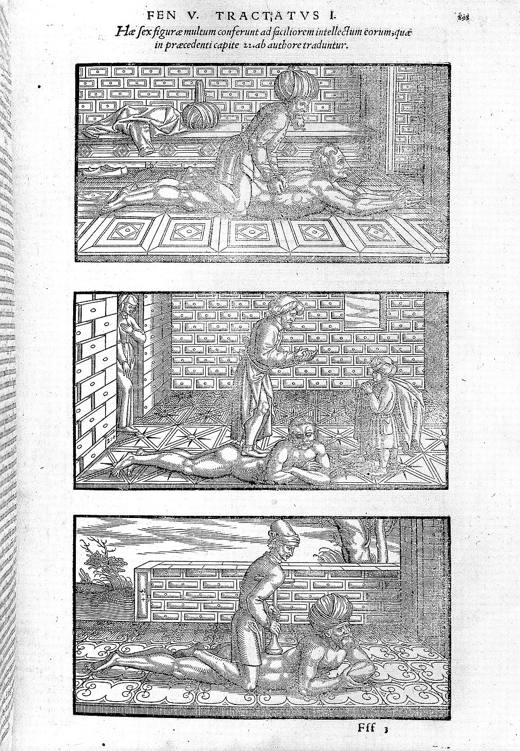
Woodcuts from a printed Latin edition of Avicenna's Canon, the textbook of Europe's medical faculties.
Woodcuts from a printed Latin edition of Avicenna's Canon, the textbook of Europe's medical faculties. Wellcome Collection · CC BY 4.0

History

Ibn Sina, known in Europe as Avicenna, was born in 980 near Bukhara, in present-day Uzbekistan. He was a prodigy: as a young man he was already working as a physician at court. He wrote on philosophy, mathematics, astronomy and medicine, and died in 1037 in Hamadan, in present-day Iran.

Around 1025 he completed the Canon of Medicine, al-Qanun fi al-Tibb. In five books he brought together the Greek medicine of Hippocrates and Galen with Persian, Arab and Indian knowledge and with his own observations.

In the twelfth century Gerard of Cremona translated the Canon into Latin in Toledo. From the thirteenth century European scholars used the work, and from the fourteenth century it was on the curriculum of universities. In 1472 the first printed Latin edition appeared, and in Padua the Canon was still taught in 1715.
Key ideas

The Canon builds on the doctrine of the four humours and the temperaments. Ibn Sina worked out that doctrine very systematically, with attention to the causes, signs and treatment of diseases.

He also placed new emphasis on observation and experiment. He formulated seven rules for testing the effect of a drug, among them: test the drug on two opposite conditions, and experiment on the human body, because a test on animals does not tell everything.

Ibn Sina also wrote about contagion, about the importance of clean air and water, and about the influence of the mind on the body.

Knowledge and its transmission

At European universities, such as Montpellier, Bologna, Padua and Paris, the Canon was one of the most important textbooks. Students read it in Latin and learned the principles of medicine from it.

The Canon was so authoritative that for a long time it was not questioned. In the sixteenth century resistance arose. According to tradition, the physician Paracelsus burned a copy in Basel in 1527, to show that physicians should look for themselves instead of following old books.

Through the work of Vesalius, Harvey and others the Canon slowly lost its place, but it continued to be read as background for a long time.

Texts and figures

The Canon has five books. The first deals with principles. The second is a materia medica with some eight hundred simple remedies, arranged alphabetically. The third deals with diseases by part of the body, the fourth with diseases affecting the whole body, and the fifth with compound remedies.

Hundreds of manuscripts and dozens of printed editions of the Latin Canon appeared. In 1593 a printed Arabic edition was also published in Rome.

Ibn Sina also wrote the Kitab al-Shifa, the “Book of Healing”, which despite its title is about philosophy and science.

Today

In the Islamic world Ibn Sina is still revered as one of the greatest scholars. In Unani medicine in South Asia the Canon is still a foundational work.

For historians the Canon is a key work: it shows how the knowledge of classical antiquity reached Europe via the Islamic world.

His ideas on testing drugs are sometimes seen as an early step towards clinical research.

Nature in the tradition

The materia medica in the Canon describes hundreds of plants, minerals and animal remedies, with their temperament and effect.

Many remedies come from the Middle East and Asia, such as saffron, cinnamon, rose, black seed, senna, liquorice and chamomile.

Remedies were often combined into syrups, pastes and pills.

Approaching it with respect

The Canon shows how much Europe owes to Persian and Arab scholars. European medicine is not built on Greco-Roman roots alone.

As history the Canon is fascinating. As medical advice it is outdated.

From the kitchen

Recipes with herbs from this tradition

There is no recipe from this tradition on the site yet. These recipes do use herbs it knows.

Registry

Herbs in this tradition

  • Caution

    Asia · Herb · № 137

    Chinese rhubarb

    Rheum palmatum

    The root (da huang) contains anthraquinones, making it a strong laxative. In small amounts its tannins have the opposite, binding effect. Its mechanism is well understood.

    Chinese medical traditions+4
  • Caution

    Europe · Herb · № 85

    Lemon balm

    Melissa officinalis

    Traditionally used for restlessness, sleep problems and a nervous stomach; externally for cold sores. Small studies suggest a mild calming effect, but evidence is limited.

    Monastic and folk knowledge+7Folklore
  • Caution

    Asia · Herb · № 119

    Galangal

    Alpinia galanga

    A relative of ginger traditionally used for nausea, wind and sluggish digestion. Clinical evidence is limited.

    Ayurveda+6
  • Caution

    Europe · Herb · № 19

    Chamomile

    Matricaria chamomilla (Duitse kamille)

    Flowers are used in teas and topical or oral products. Reliable evidence is insufficient for most claimed conditions.

    Monastic and folk knowledge+7Folklore
  • Caution

    Asia · Food · № 38

    Cinnamon

    Cinnamomum verum

    A spice made from inner bark. Research on health effects is preliminary; cinnamon is not a treatment.

    Ayurveda+8Folklore
  • Caution

    Africa · Herb · № 464

    Colocynth

    Citrullus colocynthis

    Traditionally attributed effects: drastically laxative and diuretic; in large doses emetic and highly irritant; for ascites, jaundice, urinary diseases, rheumatism, bile complaints, intestinal parasites, constipation, oedema; seed oil for snake and scorpion bites.

    Ayurveda+3
  • Caution

    Europe · Herb · № 97

    Dandelion

    Taraxacum officinale

    The leaf is mildly diuretic; the bitter root was used for the liver and digestion. NCCIH notes there is little human research.

    Avicenna's Canon in European universities+6Folklore
  • Caution

    Asia · Herb · № 133

    Psyllium

    Plantago ovata

    The seed husks form a mucilaginous gel: an established bulk-forming fibre for constipation and mild diarrhoea that can also modestly lower LDL cholesterol.

    Ayurveda+3
  • Caution

    Europe · Herb · № 89

    Rose and rose hip

    Rosa spp.

    Rose hips are rich in vitamin C; a hip powder has been studied for osteoarthritis with modest results. Rose water and oil are used in skin care and as fragrance.

    Avicenna's Canon in European universities+6Folklore
  • Caution

    Asia · Herb · № 345

    Saffron

    Crocus sativus

    Traditionally attributed effects: stimulating, aphrodisiac, stomachic, pain-relieving, antispasmodic, calming, promotes menstruation; for absent menstruation, fever, hysteria, melancholy, leucorrhoea, haemorrhoids; paste for bruises, nerve and rheumatic pain.

    Ayurveda+4
  • Caution

    Africa · Herb · № 117

    Senna

    Senna alexandrina

    Leaves and pods contain sennosides, a stimulant laxative that works for short-term constipation. It is used in modern over-the-counter laxatives.

    Ancient Egyptian medicine+5
  • Caution

    Asia · Herb · № 18

    Licorice root

    Glycyrrhiza glabra

    A root with long use in several traditions; high-quality evidence does not support most health claims.

    Ayurveda+9Folklore
  • Caution

    Asia · Herb · № 363

    Black seed

    Nigella sativa

    Traditionally attributed effects: aromatic, diuretic and sudorific, promotes bile, stomachic, stimulating, carminative, expels worms, promotes menstruation and milk flow, antibacterial.

    Ayurveda+3