Asia · Food · № 730
Tangerine peel (chen pi)
Citrus reticulata
Traditionally attributed effects: the ripe peel (chen pi) moves the qi of spleen and lung and dissolves phlegm; the green peel (qing pi) moves liver qi.
Tradition in Asia
Medical compendium compiled in Korea in 1613

Korean medicine, hanbang or hanui, has roots in Chinese medicine, but over the centuries developed into a tradition of its own. As early as the Goryeo period Korea became known for its ginseng, which was exported to China and Japan.
In the fifteenth century Korean physicians deliberately looked for their own, native remedies, the hyangyak. In 1433 the Hyangyak Jipseongbang appeared, a large work on remedies from Korea itself.
The most important work is the Donguibogam, the “Precious Mirror of Eastern Medicine”. King Seonjo commissioned the court physician Heo Jun (1539–1615) in 1596. After the Japanese invasions and much hardship, Heo Jun completed the work in 1610, and in 1613 it was printed. UNESCO added it to the Memory of the World register in 2009.
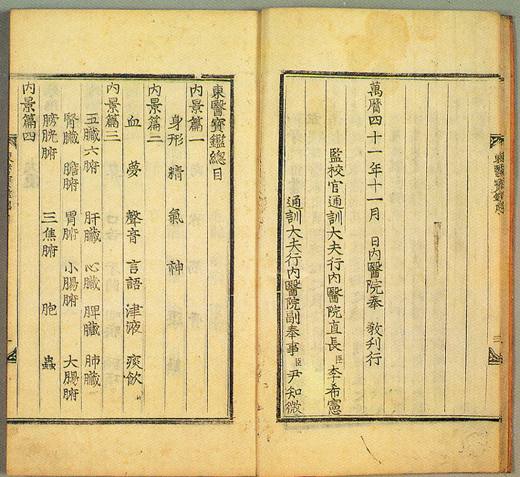
Hanbang shares many concepts with Chinese medicine: yin and yang, qi, the five phases and the organs. But the Donguibogam emphasised preventing illness and nurturing life, and less curing illness after the fact.
A uniquely Korean contribution is Sasang medicine, the “four-constitution theory” of Lee Je-ma from 1894. According to this theory every person belongs to one of four constitutions: taeyang, soyang, taeeum or soeum. It determines which illnesses you get, which food suits you and which remedies help you.
In this way treatment is tailored to the person, not only to the illness.
For a long time knowledge was passed on at court and in families. Court physicians such as Heo Jun were carefully trained and selected through examinations.
Today Korea is one of the few countries with two equal medical professions. Doctors of Korean medicine, hanuisa, follow a six-year university programme and have their own state examination.
There are Korean medicine hospitals and clinics, and Korean medicine is partly covered by national health insurance.
The Donguibogam has 25 volumes and is divided into five chapters: internal medicine, external conditions, miscellaneous diseases, remedies and acupuncture. It was also widely read and reprinted in China and Japan.
The Hyangyak Jipseongbang of 1433 described native Korean remedies. Lee Je-ma’s Dongui Suse Bowon of 1894 laid the foundation of Sasang medicine.
UNESCO describes the Donguibogam as an encyclopaedia of medical knowledge still used in Korea today.
In South Korea Korean medicine is a full part of healthcare, with universities, hospitals and research institutes. Many Koreans visit a hanuisa for acupuncture, herbal remedies or dietary advice.
Ginseng is a major export product, and Korean red ginseng, which is steamed and dried, is known worldwide.
The tradition also lives on in daily life, in soups and teas with herbs.
Ginseng is the best-known Korean plant. It grows best in cool mountains and is cultivated for years before the root is harvested.
Other important remedies are liquorice, astragalus, jujube, ginger and kudzu. Korean cooking holds much knowledge of food as medicine, as in samgyetang, chicken soup with ginseng.
The Donguibogam describes hundreds of remedies, many of them from Korea itself.
Korean medicine is a learned tradition with its own identity. It is not simply a copy of Chinese medicine.
Ginseng can interact with medicines such as blood thinners and diabetes drugs, and can affect blood pressure. Consult a doctor.
From the kitchen
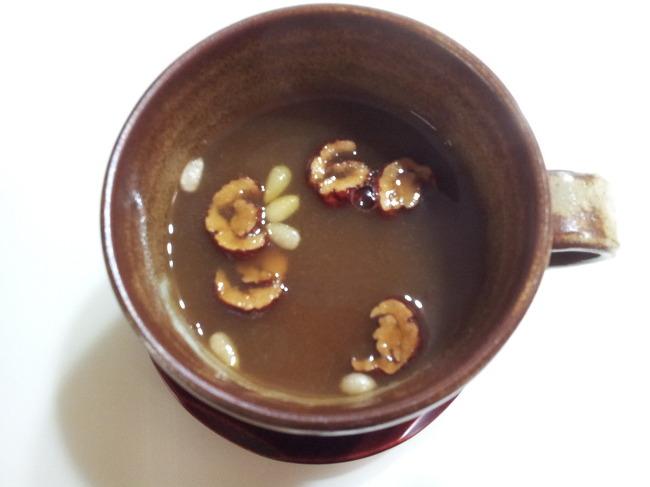
가을들녁 · CC BY 2.0 KRAsiaDaechu-cha, jujube teaA sweet, dark tea of dried jujubes, simmered until almost syrupy.Rest and sleepTiredness and strengthJujube (red date) · Ginger4 cups · 1 hourRegistry
Asia · Food · № 730
Citrus reticulata
Traditionally attributed effects: the ripe peel (chen pi) moves the qi of spleen and lung and dissolves phlegm; the green peel (qing pi) moves liver qi.
Asia · Herb · № 656
Perilla frutescens
Traditionally attributed effects: warms in colds from cold, helps digestion and soothes cough with phlegm.
Asia · Herb · № 275
Pinellia ternata
Traditionally attributed effects: cough-suppressing, expectorant, against vomiting, anticatarrhal.
Asia · Mushroom · № 146
Wolfiporia cocos
One of the most widely used remedies in Chinese medicine, for fluid retention, poor digestion and restless sleep. Clinical research on fu ling alone is scarce.
Asia · Food · № 545
Raphanus sativus
Traditionally attributed effects: seeds and leaves diuretic, laxative, dissolve stones; juice against scurvy; for painful and difficult urination, stones, urinary diseases, haemorrhoids, stomach ache; syrup for hoarseness, whooping cough and chest complaints.
Asia · Herb · № 673
Rehmannia glutinosa
Traditionally attributed effects: raw it cools the blood and nourishes yin; prepared (steamed with wine) it nourishes the blood and the kidney yin.
Asia · Food · № 267
Oryza sativa
Traditionally attributed effects: easily digestible, the basis of healing food; good for skin and hair.
Asia · Herb · № 650
Saposhnikovia divaricata
Traditionally attributed effects: expels wind; for muscle pain, painful diarrhoea, rheumatic complaints and cramps.
Asia · Herb · № 592
Schisandra chinensis
Traditionally attributed effects: tonic, astringent, stimulating, adaptogen; supports exhausted adrenals (fatigue), promotes sleep and well-being, protects the liver.
Asia · Mushroom · № 145
Lentinula edodes
An edible mushroom. Lentinan from shiitake is researched and used in oncology in Japan; there is little evidence for ordinary shiitake as an 'immune booster'.
Asia · Herb · № 367
Eleutherococcus senticosus
Traditionally attributed effects: adaptogen, increases interferon production; especially for herpes simplex, strengthens the immune system against colds and flu; further for high blood pressure, kidney disease, diabetes, insomnia, arthritis.
Asia · Herb · № 749
Polygonatum sibiricum
Traditionally attributed effects: strengthens spleen and kidneys, moistens the lungs and replenishes the essence.
Asia · Herb · № 644
Ligusticum chuanxiong (syn. L. striatum)
Traditionally attributed effects: promotes circulation, helps with menstrual complaints and as a restorative tonic after childbirth, and is said to lower high blood pressure; warming.
Asia · Herb · № 313
Ophiopogon japonicus
Traditionally attributed effects: promotes the secretion of body fluids, tonic, calming, cough-suppressing, lowers blood sugar, antibacterial.
Asia · Herb · № 640
Polygonatum odoratum
Traditionally attributed effects: nourishes the stomach and promotes the production of body fluids; for fatigue, poor appetite, weak digestion and exhaustion.
Asia · Herb · № 767
Ziziphus jujuba var. spinosa
Traditionally attributed effects: nourishes heart yin and calms the mind in insomnia and restlessness; curbs night sweats.
Asia · Herb · № 651
Atractylodes macrocephala
Traditionally attributed effects: strengthens the spleen and regulates the stomach; for diarrhoea and fluid retention, and traditionally to help prevent miscarriage.
Asia · Herb · № 128
Morus alba en M. nigra
The leaf (sang ye) is being studied for post-meal blood sugar and is used in Chinese medicine for coughs and fevers; bark, twigs and berries each have their own use too. Evidence is preliminary.
Asia · Herb · № 18
Glycyrrhiza glabra
A root with long use in several traditions; high-quality evidence does not support most health claims.
Asia · Herb · № 728
Atractylodes lancea
Traditionally attributed effects: dries dampness and strengthens the spleen; expels wind, cold and dampness.