Skip to content
Herbs & Cultures

Tradition in Asia

Sowa Rigpa: Tibetan medicine

Developed from the 8th century; the Four Tantras revised in the 12th century

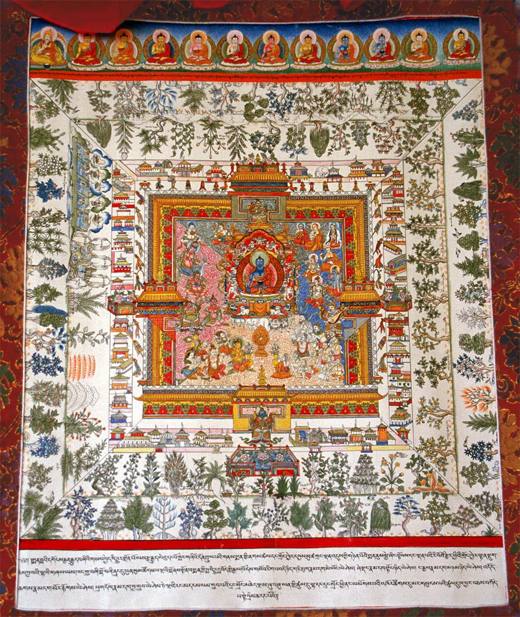
The first of Sangye Gyatso's medical paintings (1653–1705): the palace of the Medicine Buddha, surrounded by medicinal plants.
The first of Sangye Gyatso's medical paintings (1653–1705): the palace of the Medicine Buddha, surrounded by medicinal plants. Sangye Gyatso · public domain

History

Sowa Rigpa, the “science of healing”, is the traditional medicine of Tibet, the Himalaya and Mongolia. It took shape in the eighth century, when King Trisong Detsen invited physicians from India, China, Persia and other lands to Tibet.

According to tradition its founder is Yuthok Yonten Gonpo the Elder, an eighth-century physician. His descendant Yuthok the Younger revised the Gyushi, the “Four Tantras”, the principal work of Tibetan medicine, in the twelfth century.

In 1696 the medical college of Chakpori was founded in Lhasa. In the seventeenth century the regent Desi Sangye Gyatso had a series of medical paintings made that explain the teaching in images. After 1959 Chakpori was destroyed. In 1961 the Men-Tsee-Khang was founded in exile in Dharamsala, and it continues the tradition.
Key ideas

Sowa Rigpa is deeply connected with Buddhism. The three “mental poisons”, desire, hatred and ignorance, underlie three bodily forces, the nyepa: lung (wind), tripa (bile) and beken (phlegm). Health is their balance.

Everything is built from five elements: earth, water, fire, wind and space. Diet, behaviour, season and remedies can restore or disturb the balance.

An important figure is the Medicine Buddha, Sangye Menla, who is depicted with blue skin and holds a fruit of the myrobalan in his hand, the “king of medicines”.

Knowledge and its transmission

A Tibetan physician is called an amchi or menpa. The training is long: students learn the Four Tantras by heart, learn to recognise and process plants, and accompany an experienced physician for years.

In diagnosis the physician looks at the tongue and eyes, feels the pulse in a special way and examines the urine: its colour, smell, froth and how it changes as it cools.

In 2010 India officially recognised Sowa Rigpa as a medical system, alongside Ayurveda, Unani and Siddha.

Texts and figures

The Gyushi, the Four Tantras, is the principal work. It consists of 156 chapters and deals with the body, illnesses, diagnosis, treatment and the ethics of the physician.

The medical paintings of Desi Sangye Gyatso, made for his 1688 commentary the Blue Beryl, are a unique teaching tool. They show the body, plants and the teaching in hundreds of small images.

In 2018 UNESCO recognised the lum bath, a healing bath of Sowa Rigpa, as intangible heritage.

Today

Sowa Rigpa is practised in Tibet and other parts of China, in Ladakh and other Himalayan regions of India, in Nepal, Bhutan and Mongolia, and in the Tibetan diaspora.

The Men-Tsee-Khang in Dharamsala trains physicians and has clinics throughout India. In Bhutan traditional medicine is part of national healthcare.

There is growing international interest, and scientific research into some remedies.

Nature in the tradition

Tibetan remedies are almost always mixtures, sometimes of dozens of ingredients, made into pills. Plants from the high mountains and from India play a large role.

Myrobalan (arura) is regarded as the most important remedy. Saffron, cloves, nutmeg and cinnamon also occur often.

A special category are the “precious pills”, rinchen rilbu, which also contain processed metals and gemstones.

Approaching it with respect

Sowa Rigpa is inseparable from Tibetan Buddhism and from Tibetan identity, which is under pressure.

Some precious pills contain processed mercury (tsotel). According to the tradition, processing makes it harmless, but that is scientifically disputed. Be careful and consult a doctor.

From the kitchen

Recipes with herbs from this tradition

There is no recipe from this tradition on the site yet. These recipes do use herbs it knows.

Registry

Herbs in this tradition

  • Caution

    Asia · Herb · № 418

    Agarwood

    Aquilaria agallocha

    Traditionally attributed effects: stimulating, strengthens the heart, tonic, carminative, promotes bile; for skin diseases, gout and rheumatism, vomiting, snake bites, pain from wounds, bronchitis in children, headache, dizziness.

    Ayurveda+3
  • Caution

    Asia · Herb · № 349

    Amla

    Phyllanthus emblica

    Traditionally attributed effects: fresh fruit cooling, diuretic, laxative, stomachic; bark astringent; for lung and eye inflammation, hair growth, asthma, bronchitis, bile complaints, bleeding, diarrhoea, dysentery, anaemia, jaundice.

    Ayurveda+2
  • Caution

    Asia · Herb · № 401

    Indian atees

    Aconitum heterophyllum

    Traditionally attributed effects: bitter tonic, astringent, fever-reducing, stomachic, aphrodisiac; for weakness after fever, diarrhoea, dysentery, cough, indigestion; in children against cough, colds, fever and vomiting.

    Ayurveda+1
  • Caution

    Asia · Herb · № 563

    Bibhitaki

    Terminalia bellerica

    Traditionally attributed effects: astringent, tonic, expectorant, laxative (unripe fruit), cleansing.

    Ayurveda+2
  • Caution

    Asia · Herb · № 137

    Chinese rhubarb

    Rheum palmatum

    The root (da huang) contains anthraquinones, making it a strong laxative. In small amounts its tannins have the opposite, binding effect. Its mechanism is well understood.

    Chinese medical traditions+4
  • Caution

    Asia · Herb · № 558

    Chiretta

    Swertia chirata

    Traditionally attributed effects: bitter tonic, stomachic, expels worms, laxative, cleansing, antidiarrhoeal, antipyretic; for intermittent fever, skin diseases, intestinal worms, asthma, hiccups and vomiting, gout; scorpion stings.

    Ayurveda+2
  • Caution

    Asia · Mushroom · № 147

    Caterpillar fungus (cordyceps)

    Ophiocordyceps sinensis (syn. Cordyceps sinensis)

    A fungus that parasitises caterpillars. Used in Tibetan and Chinese medicine for fatigue, lung complaints and low libido. Studies are small and there is no convincing evidence.

    Chinese medical traditions+2
  • Caution

    Asia · Herb · № 731

    Costus root (mu xiang)

    Dolomiaea costus (syn. Saussurea lappa, Aucklandia lappa)

    Traditionally attributed effects: moves the qi in spleen, stomach, intestine, liver and gallbladder; helps digest tonics.

    Ayurveda+3
  • Caution

    Asia · Herb · № 495

    Asafoetida

    Ferula foetida

    Traditionally attributed effects: stimulating, carminative, antispasmodic, expectorant, mildly laxative, expels worms, promotes menstruation, stimulates nerves and lungs.

    Ayurveda+3
  • Caution

    Asia · Food · № 269

    Barley

    Hordeum vulgare

    Traditionally attributed effects: astringent, light; good for skin and hair.

    Ayurveda+4Folklore
  • Caution

    Asia · Food · № 343

    Pomegranate

    Punica granatum

    Traditionally attributed effects: root and stem bark astringent and strongly expel tapeworm; flowers and peel astringent and stomachic; juice cooling.

    Ayurveda+3
  • Caution

    Asia · Herb · № 344

    Cardamom

    Elettaria cardamomum

    Traditionally attributed effects: aromatic, pungent, strengthens the heart, stomachic, laxative, diuretic, carminative; for asthma, bronchitis, haemorrhoids, bladder complaints, flatulence, cramps from laxatives, dizziness, indigestion, vomiting.

    Ayurveda+2
  • Caution

    Asia · Herb · № 139

    Haritaki and triphala

    Terminalia chebula

    Haritaki is used in Ayurveda as a rejuvenating remedy and gentle laxative. Triphala, a blend of three fruits, is the best-known Ayurvedic formula for digestion. Clinical research is limited.

    Ayurveda+3
  • Caution

    Asia · Herb · № 415

    Himalayan angelica

    Angelica glauca

    Traditionally attributed effects: strengthens the heart, stimulating; for flatulence, constipation and indigestion.

    Ayurveda+1
  • Caution

    Asia · Herb · № 457

    Deodar

    Cedrus deodara

    Traditionally attributed effects: wood carminative, induces sweating and urination; bark strongly astringent and fever-reducing; for fever, diarrhoea and dysentery, lung and urinary complaints, rheumatism, haemorrhoids, kidney stones; oil for skin diseases and ulcers.

    Ayurveda+1
  • Caution

    Asia · Herb · № 436

    Tree turmeric

    Berberis aristata

    Traditionally attributed effects: tonic, stomachic, astringent, antipyretic, induces sweating, cleansing; for malaria and intermittent fever (comparable to quinine), washing ulcers, eye diseases, haemorrhoids, swollen glands; laxative for children.

    Ayurveda+1
  • Caution

    Asia · Herb · № 469

    Gold thread

    Coptis teeta

    Traditionally attributed effects: bitter tonic, fever-reducing; stimulates appetite, restores digestion, against flatulence, for jaundice, weakness, recovery after fever; eye ointment for conjunctivitis; in China against diabetes.

    Ayurveda+1
  • Caution

    Asia · Herb · № 548

    Indian madder

    Rubia cordifolia

    Traditionally attributed effects: promotes menstruation, astringent, diuretic, cleansing, decongestant, tonic; for paralysis, jaundice, urinary tract obstruction, menstrual disorders, mastitis, too little lochia.

    Ayurveda+2
  • Caution

    Asia · Herb · № 130

    Spikenard (jatamansi)

    Nardostachys jatamansi

    Used in Ayurveda as a calming remedy for insomnia and restlessness. There is mostly animal research; clinical evidence is lacking.

    Ayurveda+4
  • Caution

    Asia · Herb · № 402

    Sweet flag

    Acorus calamus

    Traditionally attributed effects: carminative, tonic, stimulating; restores throat and voice (singers), improves concentration/clear thinking, for flatulence and heartburn.

    Ayurveda+4
  • Caution

    Asia · Food · № 38

    Cinnamon

    Cinnamomum verum

    A spice made from inner bark. Research on health effects is preliminary; cinnamon is not a treatment.

    Ayurveda+8Folklore
  • Caution

    Asia · Herb · № 143

    Kutki

    Picrorhiza kurroa

    A very bitter herb used in Ayurveda and Tibetan medicine for liver complaints, fever and digestive problems. Research is mainly in animals.

    Ayurveda+3
  • Caution

    Asia · Food · № 42

    Clove

    Syzygium aromaticum

    A spice. Clove oil containing eugenol may help with toothache; other claims are unproven.

    Ayurveda+5Folklore
  • Caution

    Asia · Herb · № 129

    Nutmeg

    Myristica fragrans

    A spice used in small amounts in Ayurveda and Arabic medicine for diarrhoea, nausea and insomnia. There is no good clinical evidence.

    Ayurveda+6Folklore
  • Caution

    Asia · Herb · № 437

    Pashanbheda

    Bergenia ligulata

    Traditionally attributed effects: diuretic, soothing, astringent, tonic; known for dissolving kidney stones; for fever, diarrhoea, lung complaints, eye inflammation, teething in children.

    Ayurveda+1
  • Caution

    Europe · Herb · № 366

    Rhodiola

    Rhodiola rosea

    Roseroot is sold as an adaptogen for tiredness and stress. Some studies find a small effect on stress-related fatigue, but they are small and of varying quality. There is no evidence that it prevents colds.

    Western herbal medicine+1
  • Caution

    Asia · Herb · № 345

    Saffron

    Crocus sativus

    Traditionally attributed effects: stimulating, aphrodisiac, stomachic, pain-relieving, antispasmodic, calming, promotes menstruation; for absent menstruation, fever, hysteria, melancholy, leucorrhoea, haemorrhoids; paste for bruises, nerve and rheumatic pain.

    Ayurveda+4
  • Caution

    Asia · Herb · № 140

    Sandalwood

    Santalum album

    Used in Ayurveda as a 'cooling' remedy for skin irritation and urinary complaints; the oil is used in aromatherapy. Clinical evidence is limited.

    Ayurveda+6Folklore
  • Caution

    Asia · Herb · № 570

    Timur pepper

    Zanthoxylum alatum

    Traditionally attributed effects: tonic, stomachic, carminative, aromatic; for fever, indigestion, cholera and toothache.

    Ayurveda+1
  • Caution

    Asia · Herb · № 18

    Licorice root

    Glycyrrhiza glabra

    A root with long use in several traditions; high-quality evidence does not support most health claims.

    Ayurveda+9Folklore
  • Caution

    Asia · Herb · № 411

    Black cardamom

    Amomum subulatum

    Traditionally attributed effects: stomachic, carminative, stimulates the heart, expectorant; for digestive complaints, liver congestion, tooth and gum complaints, kidney stones (with melon seed), inflamed eyelids; flavouring.

    Ayurveda+2