Skip to content
Herbs & Cultures

Tradition in North America

Anishinaabe medicine

Around the Great Lakes; the Midewiwin is centuries old and still alive

Image of Maple
Maple, Acer spp.Johann Georg Sturm (Painter: Jacob Sturm ) · Public domain

History

Anishinaabe is the name of a family of peoples around the Great Lakes: the Ojibwe, who in the United States are also called Chippewa, the Odawa, the Potawatomi, the Mississauga, the Nipissing and the Algonquin. The Ojibwe, Odawa and Potawatomi together formed the Council of Three Fires, in which the Ojibwe were the 'keepers of the faith'.

According to tradition, which is also recorded on birch-bark scrolls, the Anishinaabeg once lived on the Atlantic coast, at the mouth of the St Lawrence. Seven prophets, the seven fires, foretold their future. A shell, the miigis, showed them the way west, to 'the place where food grows on the water'. They found that place at the lakes where wild rice grows.

In the eighteenth and nineteenth centuries the Anishinaabeg made treaties with the British, Canadians and Americans. Many Potawatomi were driven west. Children had to go to boarding schools, where their language was forbidden.

Key ideas

A spirit or power is called manidoo. It lives in animals, plants, stones, wind and water, and can appear in a dream or vision. Whoever picks a plant first lays down tobacco in thanks.

Densmore described the life the Midewiwin asks of its members as an upright life: lying, stealing and liquor are forbidden, and membership protects no one from the consequences of his deeds. Members sometimes sit by the water for hours, singing and drumming, in the hope that the spirits will teach them something. In the stories Nanabozho, with his grandmother, plays a large part; according to Densmore he is also connected with the Midewiwin.

Densmore tells how the medicine bi'jikiwuk came about. A member of the Midewiwin dreamed of horned animals that came up out of the water and taught him to make the medicine. To make them come back, he made a song, which he sang into old age whenever he dug the roots or prepared the medicine. Others learned the song from him, and it is still sung when the medicine is made.

Knowledge and its transmission

Densmore distinguished two kinds of healing. The members of the Midewiwin heal with herbs and songs. Besides them there are the jaasakiid, seers who speak with the spirits in a shaking tent. Someone can be both, but they are different callings.

The Midewiwin has degrees: four, and more in some regions. At the first degree a new member learns in the woods the names and uses of a few simple herbs, which he carries in his medicine bag. In the higher degrees he learns the properties of rare herbs. A sick person can be taken into the Midewiwin in order to be healed. The old woman Mi'jakiya'cig ('clear sky') told Densmore that she was very ill as a young woman. Her parents gave a feast, a Mide man smoked the tobacco her father had brought and asked the spirits to prolong her life. There was singing and dancing, and she recovered.

Main'gans showed Densmore how he made bi'jikiwuk. The main ingredient was the root of Seneca snakeroot. With it came, in equal parts, the roots of fringed sage, ground plum and prairie rose. In a pail with about a litre of hot water he laid a little spoonful of the mixture at the east, south, west and north sides, and divided a scant spoonful of the snakeroot over them. The medicine was taken four times a day, a little at first and then more, up to a birch-bark measure of about a tablespoon. He also took a little spoonful of the dry powder, without water. Bi'jikiwuk was taken as a stimulant and for fits, and used externally to stop bleeding from wounds. Warriors carried it on the warpath.

Mi'nisino'wuck, the 'island herb', came originally from an island in Lake Superior and also stops bleeding. According to Na'waji'bigo'kwe it arose in the dream of a man who saw a thunderbird.

Texts and figures

Part of the knowledge is kept on wiigwaasabakoon, birch-bark scrolls with drawings, which the Midewiwin keeps. They help to remember songs, ceremonies and the route of the great migration. A Potawatomi elder used the scrolls to date the founding of the Council of Three Fires.

Walter Hoffman described the Midewiwin in 1891. From 1907 Frances Densmore recorded hundreds of songs among the Ojibwe of Minnesota, with the stories that went with them, in Chippewa Music (1910 and 1913). Later she wrote Uses of Plants by the Chippewa Indians (1928). Anishinaabe writers such as Basil Johnston (Ojibway Heritage, 1976) and Edward Benton-Banai (The Mishomis Book, 1979) have described the teachings themselves.

Today

Anishinaabeg live in Ontario, Manitoba, Saskatchewan and Quebec, and in Minnesota, Wisconsin, Michigan and North Dakota. They are one of the largest Indigenous peoples of North America. The Midewiwin still exists and takes in new members.

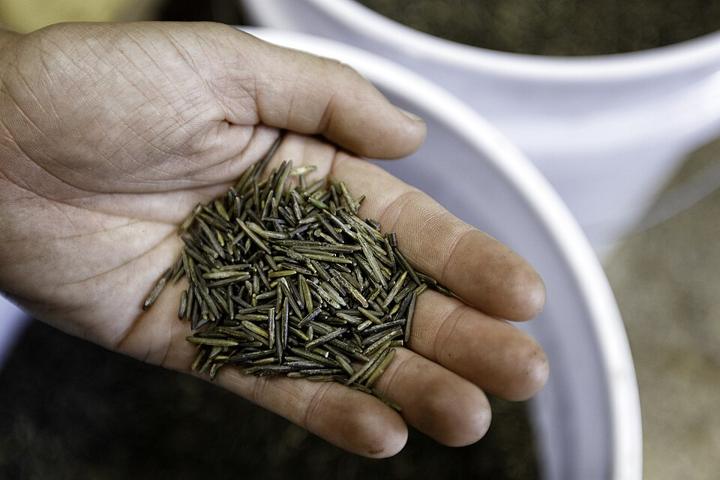
Every autumn wild rice is harvested by canoe: one person poles the boat along, the other knocks the heads empty over the bottom with sticks. In spring the maple is tapped. In 2018 the White Earth Nation gave manoomin rights of its own, such as the right to exist and flourish, and in 2021 it filed a lawsuit on behalf of the rice against an oil pipeline. Ojibwe is taught to children again in language nests and immersion schools.

Nature in the tradition

The Anishinaabeg live with forest, lake and, in the west, prairie. Wild rice, manoomin, is the sacred food. From the maple they boil sugar. From birch they make canoes, baskets and the scrolls of the Midewiwin.

Tobacco, sweetgrass, sage and cedar, the arborvitae, are called the four sacred medicines. The resin of balsam fir and the buds of balsam poplar go into salves for wounds. The inner bark of aspen helps with fever, the root of wild geranium with diarrhoea, and evening primrose with bruises.

On the western prairie grow the plants of bi'jikiwuk: Seneca snakeroot, fringed sage, ground plum and prairie rose. Wild bergamot and horseweed also appear in Densmore's notes.

Approaching it with respect

The Midewiwin is a closed society. Densmore wrote down what members wanted her to hear, and she knew herself that much was not told to her. We write nothing here about love medicines, curses and poisons, which she also mentions, nor about the medicine wa'bino'wuck, of which she wrote that it 'would either kill or cure'.

The knowledge belongs to the people who shared it, such as Main'gans, Na'waji'bigo'kwe and Mi'jakiya'cig, and to their communities. Do not harvest Seneca snakeroot in the wild: the root has long been sold and is overharvested in many places. Buy wild rice preferably from Anishinaabe harvesters.

From the kitchen

Recipes from this tradition

Registry

Herbs in this tradition

  • Caution

    North America · Herb · № 574

    Balsam poplar

    Populus balsamifera

    Traditionally attributed effects: buds: stimulating, tonic, diuretic, soothing, expectorant; bark: expectorant, laxative; for skin problems (eczema, psoriasis), dry cough, constipation, kidney/bladder support, rheumatism and gout.

    Indigenous healing traditions of North America+3
  • Caution

    North America · Herb · № 573

    Balsam fir

    Abies balsamea

    Traditionally attributed effects: stimulating, antiseptic, pain-relieving; for respiratory infections, cough and sore throat, cystitis and enteritis, aid to quitting smoking; externally for burns, wounds, haemorrhoids, muscle pain.

    Indigenous healing traditions of North America+3
  • Caution

    North America · Herb · № 959

    Horseweed

    Erigeron canadensis (syn. Conyza canadensis)

    An annual of the daisy family with an upright, hairy stem and countless small white flower heads. Contains volatile oil, tannins and flavonoids; the oil was once used as 'oil of erigeron' for bleeding and diarrhoea.

    Lakota medicine+1
  • Caution

    North America · Herb · № 188

    Maple

    Acer spp.

    Maple syrup is the boiled-down sap of the sugar maple. It consists mainly of sugar and some minerals, such as manganese; it is a sweetener, not a medicine.

    Indigenous healing traditions of North America+3Folklore
  • Caution

    North America · Herb · № 274

    American cranesbill

    Geranium maculatum

    Traditionally attributed effects: astringent, stops bleeding, tonic.

    Indigenous healing traditions of North America+4
  • Caution

    North America · Food · № 962

    Ground plum

    Astragalus crassicarpus

    A low legume with purple-pink flowers and thick, round pods that lie on the ground like small plums. Only the young pods are edible.

    Lakota medicine+1
  • Caution

    North America · Herb · № 192

    Aspen

    Populus tremuloides

    Traditionally attributed effects: astringent, fever-reducing, tonic, anti-inflammatory, pain-relieving (salicylates); restores the sensitive bladder (incontinence), calms the bowels in stress diarrhoea, heals wounds, lowers fever, relieves headache.

    Indigenous healing traditions of North America+4Folklore
  • Caution

    North America · Herb · № 956

    Fringed sage

    Artemisia frigida

    A low, silver-grey, strongly scented wormwood shrub. Contains a volatile oil with camphor and cineole and, like other wormwoods, thujone.

    Lakota medicine+1
  • Caution

    Europe · Herb · № 89

    Rose and rose hip

    Rosa spp.

    Rose hips are rich in vitamin C; a hip powder has been studied for osteoarthritis with modest results. Rose water and oil are used in skin care and as fragrance.

    Avicenna's Canon in European universities+6Folklore
  • Caution

    North America · Herb · № 964

    Seneca snakeroot

    Polygala senega (syn. Senega officinalis)

    A low milkwort with white flower spikes. The root contains saponins that loosen phlegm and promote coughing; it is in the European Pharmacopoeia as a cough remedy.

    Anishinaabe medicine+1
  • Caution

    Central America and the Caribbean · Herb · № 819

    Tobacco

    Nicotiana rustica

    A ceremonial plant of many Indigenous peoples of the Americas. Tobacco is addictive and harmful to health.

    Maya healing knowledge+10
  • Caution

    North America · Herb · № 171

    Evening primrose

    Oenothera biennis

    The seed oil contains gamma-linolenic acid and is sold for eczema, premenstrual symptoms and hot flushes. NCCIH reports it does not help eczema and that evidence for other conditions is insufficient.

    Indigenous healing traditions of North America+4
  • Caution

    North America · Herb · № 824

    Sweetgrass

    Hierochloe odorata

    A sweet-scented grass that is burned in ceremonies.

    Indigenous healing traditions of North America+2
  • Caution

    North America · Herb · № 190

    Arborvitae

    Thuja occidentalis

    Traditionally attributed effects: expels worms, astringent, antimicrobial, anti-inflammatory, stimulates muscles, antiseptic.

    Indigenous healing traditions of North America+4Folklore
  • Caution

    North America · Herb · № 961

    Wild bergamot

    Monarda fistulosa

    A mint with lilac flowers and strongly scented leaves, related to Oswego tea. The volatile oil is rich in carvacrol and thymol, which are antiseptic.

    Lakota medicine+1
  • Caution

    North America · Food · № 965

    Wild rice

    Zizania palustris (en Z. aquatica)

    An aquatic grass, not true rice. The long, dark grain contains more protein and fibre than white rice.

    Anishinaabe medicine