Skip to content
Herbs & Cultures

Tradition in South America

Kallawaya healing knowledge

Andes; knowledge passed across generations

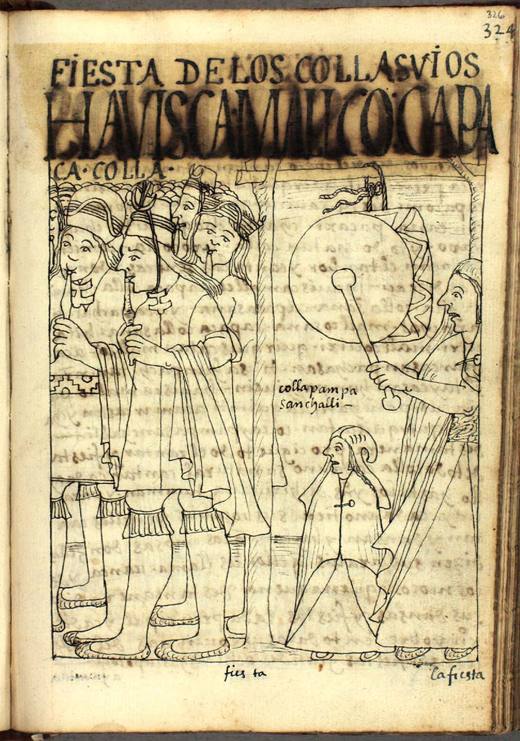
A feast in Collasuyu, the southern part of the Inca empire where the Kallawaya also lived; Guamán Poma de Ayala, c. 1615.
A feast in Collasuyu, the southern part of the Inca empire where the Kallawaya also lived; Guamán Poma de Ayala, c. 1615. Felipe Guamán Poma de Ayala · public domain

History

The Kallawaya live in Bautista Saavedra Province, north of La Paz in Bolivia, in the valleys of the Apolobamba range around the small town of Charazani, at roughly 2,700 to 5,000 metres. Throughout the Andes they are known as travelling healers. According to UNESCO their roots go back to before the Incas, to the Tiwanaku and Mollo cultures.

The oldest trace is a tomb at Niño Korin, close to Charazani, from the Tiwanaku period, roughly 600 to 1000 AD. It held snuff trays, tubes interpreted as enema syringes, a mortar and bundles of guayusa leaf that still contained caffeine after all those centuries. That leaf does not grow in the Andes but in the Amazon lowlands. According to the anthropologist Joseph Bastien the tomb also held a skull with three drilled holes around which the bone had grown back: the patient had survived the operation.

Under the Incas the Kallawaya held a special place. According to the chronicles they carried the Inca's litter, and the chronicler Guaman Poma drew them doing so at the start of the seventeenth century.

The historian Thierry Saignes searched the archives of La Paz, Sucre and Seville for their past. In his view the Kallawaya formed a chiefdom of their own before the Incas, on the eastern flank of the Andes, from the Carabaya and Apolobamba ranges to the warm hills towards the Amazon. Carabaya and Callawaya are two spellings of the same name; the Spaniards later split the area into a Peruvian and a Bolivian half. A Kallawaya chief, Ari Capaquiqui, is said to have found the Inca the way to the lowlands of the 'Chunchos' and was allowed to travel in a litter himself in return. Strikingly, no chronicler mentions the Kallawaya as healers. Only in 1766 did the canon Martín Landaeta describe men from Charazani who crossed the whole viceroyalty with sacks of resins, incense and medicinal herbs. Saignes therefore thinks the travelling healers arose only in colonial times, perhaps not until the eighteenth and nineteenth centuries.

In 1889 the department of La Paz sent a list of the plants of the 'Callahuaya' to the World's Fair in Paris. Around 1900 healers from Chajaya and Curva travelled on foot, by train and by boat as far as Argentina, Chile, Ecuador and Peru, and according to tradition some treated workers for malaria and yellow fever during the building of the Panama Canal. The French ethnographer Louis Girault heard that these were seven men from Khanlaya, who travelled through Peru and Ecuador and by steamer along the Colombian coast to Panama and stayed a few months. Stories that Kallawaya healed people in Tokyo, Paris or Rome, even a pope, his informants called inventions, although they did not mind them going round. As doctors and pharmacies spread during the twentieth century, the healers were opposed: some were arrested, others dismissed as witch doctors.

In 2003 UNESCO proclaimed the "Andean cosmovision of the Kallawaya" a masterpiece of intangible heritage, and in 2008 it was inscribed on the representative list.

Key ideas

The Kallawaya see people as part of a greater whole, with Pachamama, the earth, and the mountain spirits. Health means balance between people, community and that sacred world. Illness arises when that balance is disturbed, for example when you do not feed the earth, break a taboo or live in discord with your neighbours.

Joseph Bastien described how in the Kallawaya village of Kaata the mountain itself is seen as a body: the high pastures are the head, the potato fields halfway down the heart and belly, the maize fields at the bottom the legs. Water flows from top to bottom and returns through underground streams. The Kallawaya see the human body in the same way: as a system of channels through which air, blood and fat flow. In the centre, the sonco, they come together and are 'distilled', and then go on to the rest of the body. What is left over, such as sweat, urine, bile and phlegm, has to leave the body, or it becomes harmful. That is why sweat baths, emetics, enemas and diuretics belong to their medicine.

Plants and illnesses are classed as hot, warm, fresh or cold, and also as poisonous or ritual. A cold illness, such as a cold or rheumatism, calls for a hot remedy, and a hot one, such as fever or a liver complaint, for a cold remedy. This resembles the Greek theory of the humours, which came with the Spaniards, but according to Bastien the Kallawaya are concerned less with balance and more with flow.

That is why rituals belong to the medicine. A healer makes offerings to Pachamama, with coca leaves, llama fat and other gifts, to restore the balance. After a great fright, susto, a person can lose part of their life force, the ajayu; the healer calls it back at the place where it happened.

The German anthropologist Ina Rösing, who lived in the region for years from 1983 onwards, stresses reciprocity. Whoever asks something of the earth, the mountains or the offering place by the hut, the cabildo, must also give something. Whoever forgets this builds up an offering debt. That is not a sin but a shortfall in giving, and it can bring illness and setbacks, sometimes even because of something an ancestor failed to do. The offerings reach the holy places through Ankari, a wind that as messenger and servant carries off the smoke of the offering fire. He is called upon in almost every prayer.

The Kallawaya see grief as something that clings to people, their hut and their animals, and that draws new misfortune, almost like a contagion. After a death a family therefore has a cleansing done, the llaki wijch'una, literally 'throwing away grief'. The misfortune is symbolically washed off and handed to a river or a crossroads. Rösing noted that such a ritual does much of what Western grief therapists advise: putting the sorrow into words, doing something together, and giving the bereaved a place in the village again.

Louis Girault, who gathered plants with Kallawaya healers from 1956 to 1965, describes how they classify an unknown plant: they chew it briefly. If it is very bitter, it is warm; if the taste is fairly neutral, it is temperate; if it is rather sweet, it is fresh. Temperate plants only work in a mixture, as a middle way between warm and fresh ones. Besides that, nearly every plant is male (orkko) or female (china). A male plant is sturdy and rough, a female one fine and graceful, with longer, darker or hairier leaves, and counts as the stronger. In a male plant a fresh effect is mild and a warm one fierce; in a female plant it is the other way round.

The healer Severino Vila classes not only illnesses and plants as warm or fresh, but people too. A warm person is restless and fiery, a cold person calm and sleepy, so the same complaint calls for a different remedy in one than in the other. A remedy must be neither too warm nor too fresh: he mixes them 'half and half', so that they soften each other.

Knowledge and its transmission

According to UNESCO the travelling healers are exclusively men. Women play a large part in rituals, care for pregnant women and children, and weave textiles with meaningful motifs. According to Bastien they also gather and dry the herbs and know a great deal about them. In Kaata there are women diviners who take misfortune away from a person and give it to the river.

Each village has long had its own trade, and the villages exchange services and goods. Chajaya and Curva are the villages of the herbal healers, Kaata that of the diviners. Men from Upinhuaya fetched resin from the rainforest and sold it as incense, and people from Calaya traded in coca.

According to Girault the true healers come from six villages around Charazani: Curva, Chajaya, Khanlaya, Huata Huata, Inka and Chari; they never came from Charazani itself or from Amarete. In the 1960s he counted some 230 of them in all. Even then 'new Kallawaya' were going about, from other regions and even from Peru, who mostly read cards. The true healers called them swindlers, who sometimes killed people with poisonous herbs.

Knowledge passes from father to son, from uncle to nephew or from godfather to godchild. An apprentice travels for years with an experienced healer, sometimes up to eight years, and learns the plants, the complaints and the treatment on the road. Bastien counted around a hundred plants, minerals and animal remedies in the daily use of an experienced healer; famous healers of the nineteenth century are said to have known three hundred.

Girault describes how a boy, from the age of eight or ten, travelled with masters from his own village, for a few months or a few years, and then sat a kind of examination before the village council. Whoever later knew enough could become a maestro or watapurichi and received a heart-shaped meteorite stone, koillur rumi, which he wore round his neck as protection. Each village had its own travel territory, and anyone who broke the elders' rules could be severely punished. Around 1910 the healers of Chajaya left for Chile in March, for Peru in June and for Ecuador, Colombia and Panama in July, and were back by New Year; those of Curva sometimes stayed away for two or three years. A healer knew on average 300 to 350 plants; Girault worked with Lucas Ortiz from Chajaya, who could name more than 600. On the road Ortiz would sometimes have the car stop, walk straight to a plant and pick it, while carrying on the conversation.

The Kallawaya have their own professional language, Machaj Juyai, spoken only in healing and in rituals. Linguists find many words from the extinct Puquina language in it, with a grammar from Quechua, and also words from Aymara and other languages. The language is severely endangered. Girault wrote down more than 4,500 of its words and saw that it also has words for farming, livestock and family life, and is therefore more than a secret jargon.

To find out what is wrong with someone, healers cast coca leaves or lay out cards, feel the pulse and look at the urine. Some diviners rub a guinea pig over the body and then read its entrails. In this way quarrels, guilt and broken taboos are also brought up.

How such an offering goes was described by Gerardo Fernández Juárez with Severino Vila in La Paz. A mesa is a meal for the spirits, and each guest gets what he likes. For Gloria, the heaven of the saints and of lightning, Severino makes six or twelve little nests of white cotton on white paper, each turned anticlockwise. Into each nest go carnation petals, a sugar lump, a 'mystery' (a sugar tablet with a picture of a saint, the moon or a cross), llama fat, incense, little lead figures and a scrap of gold or silver leaf. At each nest he calls on a saint, such as Santiago, San Juan or the Virgin of Copacabana, and sprinkles it with sweet wine. Then he holds the mesa over the patient's head, who breathes on it three times, and lets it burn quietly on charcoal. This mesa helps against fright from lightning and nosebleeds that come from it.

The mesa for Pachamama is more lavish. On a bed of coca leaves go carnations, coloured llama wool, q'uwa (a fragrant herb of the high plateau), sugar figures of an 'uncle' and an 'aunt' (the devilish lords of the mines), a toad and a snake, llama fat, incense and copal. On top lies a llama foetus, rubbed with fat and loaded with gold and silver leaf, like a pack animal full of riches. Severino offers it to all the mountains, from Akamani to Illimani, and the mesa burns with alcohol and beer in tall flames. When the egg in it bursts with a bang, the offering has been well received. The mesa for the chullpa, the ancestors in the old graves, is plain: coca, sheep's wool, kantuta, quinoa, an egg for Ankari and a sheep or pig foetus, with raw fat instead of llama fat. At a grave in Chajaya Severino buried this mesa among the bones.

Against bad luck from witchcraft Severino has a bath boiled of retama and twelve kinds of thorny plants, the ch'api mesa. The patient washes with it and the bathwater is taken to a crossroads. Rösing saw something similar after a death. The healer ties left-spun thread around the mourners' necks, wrists and ankles and lays little nests of wool on their chests, which soak up the grief. At the river he breaks the threads, the mourners wash with a brew of thorns and put on clean clothes, and they walk back by another path without looking round.

Girault also had 150 amulets explained to him, mostly carved from white stone, berenguela. Each sign has a fixed meaning. A triangle protects against misfortune and evil beings; a hand with coins in the palm attracts money; a pair of lovers helps in love; a bull or llama brings a good harvest or herd, and ribbed surfaces stand for fields. A hand with one bracelet is for married people, with two bracelets for women. Small stone 'mesas' with a house, livestock and fields are buried by the house with coca, llama fat and wine for prosperity. Figures of black stone serve to do harm, as do the black mesas, which send evil back to whoever caused it or are aimed at an enemy; we do not describe those here.
Texts and figures

The knowledge is oral and kept alive in practice. According to UNESCO the Kallawaya pharmacopoeia includes about 980 plant species, one of the richest herbal medicines in the world. About thirty of them came from other continents, such as chamomile, rosemary and eucalyptus.

An early list is the Clasificación de las plantas medicinales usadas en la farmacopea Callahuaya, printed in La Paz in 1889 for the World's Fair in Paris. Later the Bolivian Enrique Oblitas Poblete, himself of Kallawaya descent, and the French researcher Louis Girault, in Kallawaya, guérisseurs itinérants des Andes (1984), compiled large catalogues of plants and practices.

Between 1956 and 1965 Girault gathered with his informants, among them Lucas Ortiz, Sebastián Álvarez and Humberto Rodas, a herbarium of 873 species, which the Peruvian botanist Emma Cerrate identified in Lima; it is now in the natural history museum in Paris. He died in La Paz in 1975, and friends published his notes in 1984 with the French research institute ORSTOM, now IRD, together with a history by Thierry Saignes. The book is freely available online. It shows that the plant names have an order of their own, as with Linnaeus: a base name for a group, such as chilka for eight species of Baccharis, and a qualifying word for the species, such as china and orkko, kita (wild) or yunka (from the warm lowlands).

Joseph Bastien described the thinking about mountain and body in Kaata in Mountain of the Condor (1978). In Healers of the Andes (1987) he followed three well-known healers and described 88 plants and their use; that knowledge comes from the healers themselves. A Spanish version of his plant data was distributed among village health workers in Bolivia in 1983.

Ina Rösing described more than two hundred healing rituals from 1983 onwards in the German series Mundo Ankari. An English summary appeared in 2010 as White, grey and black Kallawaya healing rituals. She divides the rituals by their direction: white is for something, such as health or a good harvest; grey is something away or back, such as grief or misfortune; black is against someone. Gerardo Fernández Juárez recorded in Testimonio Kallawaya (1997) the words of Severino Vila from Charazani, who has healed in La Paz for thirty years, with his recipes and his offering tables.

In 2013 Bolivia passed a law on traditional, ancestral medicine. It recognises and regulates the work of traditional healers, including the Kallawaya.

Today

The Kallawaya tradition is alive but under pressure. UNESCO names the loss of the traditional way of life and the lack of legal protection against pharmaceutical companies as threats.

Since the middle of the twentieth century many healers have moved to La Paz, Cochabamba and other cities, where they have a practice. They keep their land in the village and come back for the festivals and to gather plants. Family in the village supplies the herbs; family in the city helps with lodging, schooling and contacts.

In 1984 the Bolivian society for traditional medicine, SOBOMETRA, was founded, partly by Kallawaya healers. In the same years doctors and anthropologists in Oruro organised workshops where doctors, nurses, midwives and healers learned from each other. A nurse retold an Aymara legend there: the condor saves the dried-out mountain Sajama with a drink of water, sugar, salt and baking soda, the recipe for the oral rehydration solution against dehydration from diarrhoea.

As early as 1974 Girault saw that many Kallawaya were giving up their craft. They became goldsmiths or traders in La Paz, Lima or Córdoba, lawyers or civil servants, and a few naturopaths or pharmacists. In 1928 the Kallawaya of Chajaya had founded a primary school at their own expense. Saignes wrote in 1983 that the 'Kallawaya myth' was gaining new strength just as the last initiated healers disappeared, fed by Western interest in the exotic.

In 2006 young healers founded the organisation Kallawayas sin Fronteras, to pass the knowledge on between generations and to have healers registered.

Rösing is critical of the UNESCO recognition of 2003. The whole cosmovision was recognised, but in practice it was narrowed to the male herbal healer, often from the city. Women healers and the shared rituals of the villages dropped out of view. A bronze statue of a healer went up on the square of Charazani, tourists came for photos, and villages and city healers fell out over who the 'real' Kallawaya are. The anthropologist Jonathan Alderman also sees two sides: the recognition strengthened the Kallawaya's self-confidence, but it also fixed how Kallawaya medicine is supposed to be.

In La Paz some forty Kallawaya healers of SOBOMETRA work around Calle Sagárnaga, near Plaza San Francisco. The society was recognised by presidential decree in 1984 and confirmed by the ministry in 1987. It examines healers, and some unions of Aymara yatiri in El Alto carry its stamp on their members' cards. There is rivalry between Kallawaya and yatiri: yatiri call the Kallawaya 'platudos', who only work for money, and Kallawaya see the yatiri as healers of lower rank. According to health teams in La Paz, people choose practically: for herbs they go to a Kallawaya, for a serious matter in which the Aymara spirits play a part to a yatiri.

Nature in the tradition

The Kallawaya use plants from every climate zone of the Andes: from the cold high plateau to the warm valleys and the rainforest. They also use minerals and animal remedies. According to Bastien they pick by hand, thank Pachamama and leave enough standing for the plant to grow back. Dried herbs are ground and wrapped in small woven cloths, each with its own pattern, so they can be told apart in the bag.

Coca is sacred in the Andes and the household remedy of every family. Bilyea was, according to Bastien, the most highly praised plant, and chilca the favourite remedy of the healer Florentino Alvarez for rheumatism and fractures. Muña and wakataya are used for stomach complaints, and chinchircuma, with its orange hummingbird flowers, for cough. Mullaca 'regulates' the blood, and khanapaco is one of the few plants that all healers call 'cold'.

From the high plateau come the resinous tola and the extremely slow-growing cushion plant yareta; from the warm lowlands cinchona bark against malaria and quina quina. Some remedies are highly poisonous and used only externally, such as markhu, kimsa k'uchu, floripondio, wild tobacco and sabadilla against lice.

The Kallawaya also took up plants from elsewhere: from Europe, for example, rue, fennel and garlic, and from neighbouring countries boldo and yerba mate.

Severino Vila calls matiku, kalawala and mulli warm and plantain temperate. Plants of the high plateau often count as fresh and those of the warm Yungas as warm, but colour, shape and use also decide how a remedy counts. From the high plateau comes chachakuma, of which he distinguishes a male and a female.

Girault noted rules for gathering. One picks from the east side, never lets a plant simply drop to the ground, and does not throw what is left after use where people walk. After digging up a root one fills in the hole, 'so that foxes do not make a den in it'. Kalawala, which climbs along rocks, is picked at full or new moon; if the lizard sutu kollu appears, one waits until it has gone, for it brings luck. Anyone who finds a colleague at a gathering place greets him and leaves, and later swaps half of his harvest for other herbs: among themselves Kallawaya never sell herbs for money. A herb is used for only a year; after that its strength is gone.

Girault's lists also give wira wira, a woolly herb for cough, sutuma for sore throat and bronchitis, kiswara, the tree of the high plateau, and chuki kanlla, whose smoke is inhaled for headache. Pinku pinku, an Andean ephedra, goes into bandages around fractures; children chew turpay for strong teeth; kjaru makes a bath against rheumatism, and the beans of tarwi are rinsed for days before they are fit to eat. He also names wamanpinta, the resin of the keuña, pacha lloke for bleeding, maca, kinchamali, taya, wantura, wallua and horsetail.

Approaching it with respect

The knowledge of the Kallawaya belongs to their community. UNESCO explicitly warns of the lack of protection against pharmaceutical companies. According to Bastien Kallawaya healers passed dozens of plants to Bolivian pharmaceutical companies without receiving anything in return, and many therefore no longer work with such companies. He argues that a community that discovered a remedy should share in what it earns.

Objects, too, left their land. The finds from the healer's tomb at Niño Korin were looted in 1970 and sold to the ethnographic museum in Gothenburg. After a request from Bolivia for their return, a Swedish research project began in 2006, for which the Kallawaya healer Walter Quispe also came to Gothenburg.

Many remedies of the Kallawaya pharmacopoeia are poisonous; this site deliberately gives no preparation for those plants. Coca is a traditional and legal remedy in the Andes, but banned in many other countries, including the Netherlands. Visitors to the Andes can drink coca tea but may not take the leaves home. And a yareta can be thousands of years old: do not pick or buy it.

From the kitchen

Recipes from this tradition

Registry

Herbs in this tradition

  • Caution

    South America · Herb · № 898

    Balsam of Peru

    Myroxylon balsamum (var. pereirae)

    A large tree whose resin, the balsam, smells of vanilla and cinnamon. The balsam contains cinnamic acid, benzyl benzoate and vanillin, among other compounds, and is used in perfume, food and ointments for skin and wounds.

    Kallawaya healing knowledge+1
  • Caution

    South America · Herb · № 1009

    Pinku pinku

    Ephedra americana

    A leafless shrub with green, jointed stems, related to the Chinese ma huang. Ephedra species contain ephedrine, which widens the airways but also raises heart rate and blood pressure; how much this species contains has been little studied.

    Kallawaya healing knowledge
  • Caution

    Central America and the Caribbean · Herb · № 822

    Pirul (Peruvian pepper tree)

    Schinus molle

    A tree with aromatic leaves and pink berries, used in cleansing rituals and as a folk remedy.

    Curanderismo+2
  • Caution

    South America · Herb · № 1014

    Queñua

    Polylepis (o.a. P. besseri en P. tarapacana)

    Gnarled trees and shrubs of the rose family with reddish-brown bark that peels in thin layers and protects against the cold. Nothing has been studied about its effect in people.

    Kallawaya healing knowledge
  • Caution

    South America · Herb · № 871

    Quinchamalí

    Quinchamalium chilense

    A semi-parasitic herb with orange-yellow flowers in heads. Traditionally for wounds and colds; research is lacking.

    Kallawaya healing knowledge+1
  • Caution

    South America · Herb · № 915

    Rhatany (ratania)

    Krameria lappacea (syn. Krameria triandra)

    A low shrub that is partly parasitic on the roots of other plants. The red root is rich in tannins and is therefore astringent. In Europe rhatany root is listed in the pharmacopoeia and used in mouthwashes and gum remedies.

    Kallawaya healing knowledge+1
  • Caution

    South America · Herb · № 888

    Giant horsetail

    Equisetum giganteum

    A large horsetail, rich in silica. Traditionally used as a diuretic, like European field horsetail; good evidence is lacking.

    Kallawaya healing knowledge+1
  • Caution

    South America · Herb · № 1012

    Roq'e

    Colletia spinosissima

    A thorny shrub with green thorns set crosswise and hardly any leaves. It lives together with nitrogen-fixing Frankia bacteria. The bark contains saponins; little has been studied about its effect in people.

    Kallawaya healing knowledge
  • Caution

    Europe · Herb · № 2

    Rosemary

    Salvia rosmarinus (syn. Rosmarinus officinalis)

    An aromatic culinary herb with carnosic acid and rosmarinic acid. A few small studies point to a slight effect of the scent on alertness; that it improves memory has not been shown. The leaf is used for digestive complaints.

    Monastic and folk knowledge+4Folklore
  • Caution

    South America · Herb · № 900

    Sabadilla

    Schoenocaulon officinale

    A lily-like plant with highly poisonous seeds containing alkaloids such as veratridine and cevadine. Pharmacists around the world made louse treatments and insecticides from them.

    Kallawaya healing knowledge
  • Caution

    Central America and the Caribbean · Herb · № 819

    Tobacco

    Nicotiana rustica

    A ceremonial plant of many Indigenous peoples of the Americas. Tobacco is addictive and harmful to health.

    Maya healing knowledge+10
  • Caution

    South America · Herb · № 877

    Tara

    Tara spinosa (syn. Caesalpinia spinosa)

    A thorny tree with red pods that are very rich in tannins. In laboratory tests, extracts of the pods inhibited several bacteria.

    Kallawaya healing knowledge+1
  • Caution

    South America · Food · № 1011

    Tarwi

    Lupinus mutabilis

    A lupin with white to purple flowers and protein-rich, oily beans. The raw beans are bitter from lupin alkaloids, which are removed by days of soaking and rinsing.

    Kallawaya healing knowledge
  • Caution

    South America · Herb · № 892

    Tola

    Parastrephia quadrangularis (syn. Lepidophyllum quadrangulare, P. lepidophylla)

    A resinous shrub up to two metres tall with small, scale-like leaves; typical of the dry high plateau.

    Kallawaya healing knowledge
  • Caution

    Central America and the Caribbean · Food · № 157

    Tomato

    Solanum lycopersicum

    A fruit-vegetable with vitamin C and lycopene. Research on lycopene and heart or prostate health is mostly observational and not conclusive.

    Maya healing knowledge+4Folklore
  • Caution

    South America · Herb · № 1013

    Turpay

    Nototriche (o.a. N. mandoniana en N. porphyrantha)

    A small, cushion-forming mallow that grows flat against the ground, with a thick taproot. Mallows contain soothing mucilage; these species themselves have hardly been studied.

    Kallawaya healing knowledge
  • Caution

    Europe · Herb · № 72

    Fennel

    Foeniculum vulgare

    The seed is traditionally used for wind, bloating and cramps. There are some small studies, but evidence is limited.

    Greco-Roman medicine+9Folklore
  • Caution

    Europe · Food · № 654

    Watercress

    Nasturtium officinale

    Traditionally attributed effects: rich in vitamin C, beta-carotene and vitamin E; used to support detoxification, cool body heat and support the lungs.

    Kallawaya healing knowledge+1
  • Caution

    Europe · Herb · № 86

    Greater plantain

    Plantago major

    The leaf is traditionally bruised and applied to insect bites, small wounds and grazes, and taken as tea for coughs. Clinical evidence is limited.

    Monastic and folk knowledge+9Folklore
  • Caution

    Europe · Herb · № 242

    Rue

    Ruta graveolens

    Traditionally attributed effects: antiseptic, stimulating, promotes menstruation, expectorant, antispasmodic, expels worms (children); strengthens capillaries (rutin); for hysteria, flatulence and colic, incipient paralysis, indigestion; oil diuretic and skin-irritant.

    Greco-Roman medicine+6Folklore
  • Caution

    South America · Herb · № 1005

    Wira wira

    Achyrocline satureioides (en verwante wollige composieten, o.a. Culcitium canescens)

    A woolly, bitter-aromatic plant up to a metre tall with yellow flower heads. Contains flavonoids such as quercetin and luteolin; in the laboratory the extract acts against some viruses, but research in people is lacking.

    Kallawaya healing knowledge
  • Caution

    South America · Herb · № 893

    Yareta

    Azorella compacta (en verwante soorten)

    An evergreen cushion plant that grows over the ground like a green boulder. It grows about one and a half centimetres a year; some plants are estimated to be over 3,000 years old. The plant contains a sticky resin.

    Kallawaya healing knowledge
  • Caution

    South America · Food · № 15

    Yerba mate

    Ilex paraguariensis

    The leaves contain caffeine, theobromine and polyphenols; the drink is stimulating and dispels tiredness, like coffee or tea. It is a beverage and social drink, not a medicine.

    Kallawaya healing knowledge+1