 Caution
Europe · Herb · № 298
Greater celandine
Chelidonium majus
Traditionally attributed effects: diuretic, cleansing, stimulates the liver, anti-inflammatory.
Greco-Roman medicine+1
Tradition in Europe
Written works from the 5th century BCE
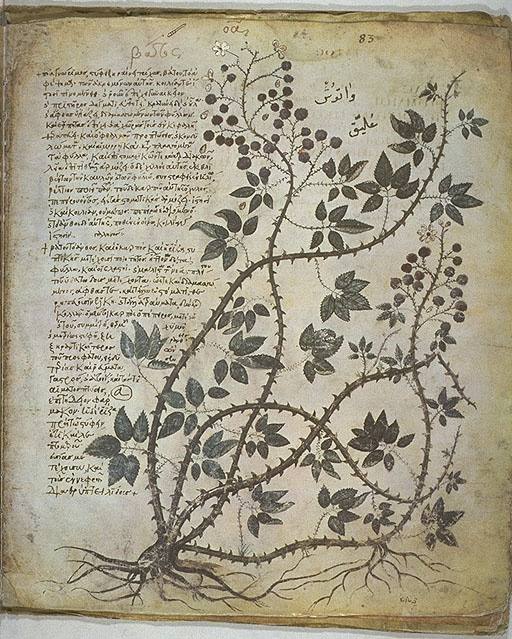
Greek medicine began not with physicians but with gods. In sanctuaries of Asclepius, such as at Epidaurus and on the island of Kos, the sick slept a night in the temple, hoping the god would heal them or give advice in a dream.
In the fifth century BCE a different approach arose on Kos, associated with the name of Hippocrates (c. 460–370 BCE). The so-called Hippocratic writings, some sixty texts by different authors, seek the cause of illness not with the gods, but in the body, diet, climate and way of life.
Others later built on this. In the fourth century BCE Theophrastus wrote the first great work on plants. In the first century CE the Greek army physician Dioscorides described some six hundred plants and their uses in De materia medica. Galen (129–c. 216), a physician from Pergamon who worked in Rome, brought everything together in a vast body of work that would shape European and Islamic medicine for more than fifteen hundred years.
The core of classical medicine is the doctrine of the four humours: blood, phlegm, yellow bile and black bile. They belong to the four elements and the four qualities: warm, cold, dry and moist. Health is a good mixture of the humours, krasis; illness is a disturbance of it.
Galen developed this into a theory of temperaments. Depending on which humour dominates, a person is sanguine, phlegmatic, choleric or melancholic. We still use those words.
Treatment followed nature. The body has its own healing power, and the physician supports it with diet, rest, exercise, baths and remedies. Diet, diaita, was the first medicine.
Physicians learned the craft in families, in schools such as those of Kos and Knidos, or with a master. In Alexandria in the third century BCE the human body was even studied by dissection.
The Hippocratic Oath, with promises to do the patient no harm and to keep confidentiality, shows that physicians saw themselves as a profession with its own ethics.
Alongside the learned physicians there were root-cutters, rhizotomoi, who dug up and sold roots and plants, often with their own rituals and secrets.
The Hippocratic writings deal with, among other things, the nature of man, airs, waters and places, epidemics and the oath. They mark the beginning of Western medical literature.
Dioscorides’ De materia medica remained the most important work on medicinal plants for centuries. A beautifully illustrated manuscript of it, the Vienna Dioscorides of 512, is on UNESCO’s Memory of the World register.
Pliny the Elder’s Naturalis Historia and Celsus’ De medicina are also important sources. Galen wrote hundreds of works; many have survived through Arabic translations.
The doctrine of the humours has been replaced by modern medicine, but the influence of classical medicine is everywhere. Medical terms come from Greek and Latin, physicians often take an oath based on the Hippocratic one when they graduate, and the rod of Asclepius with its snake is the symbol of medicine.
The emphasis on lifestyle, diet and preventing illness is topical again.
Many plants from Dioscorides are still used, and some have been studied and found to contain active substances.
Classical medicine used hundreds of plants from the Mediterranean. Olive oil was the basis of ointments and cooking. Bay laurel was sacred to Apollo, the father of Asclepius. Mint, fennel, rue, garlic and wormwood were common.
Some plants were dangerous. Hemlock was the poison with which the philosopher Socrates was put to death in 399 BCE. Mandrake was used as a painkiller and sleeping draught, and many legends surrounded it. The opium poppy provided opium.
A famous vanished plant is silphium from Cyrene, in present-day Libya, which was so sought after that it died out in antiquity.
From the kitchen
Registry
CautionEurope · Herb · № 298
Chelidonium majus
Traditionally attributed effects: diuretic, cleansing, stimulates the liver, anti-inflammatory.
 Caution
Europe · Herb · № 98
Thymus vulgaris
Traditionally used for coughs and bronchitis; thymol from the oil inhibits bacteria and fungi in the laboratory. There are some studies of thyme-based cough syrups.
 Caution
Europe · Herb · № 72
Foeniculum vulgare
The seed is traditionally used for wind, bloating and cramps. There are some small studies, but evidence is limited.
 Caution
Asia · Food · № 801
Ficus carica
Traditionally attributed effects: dried figs make Chinese soups naturally sweet, such as the watercress and spare-rib soup and the eight-treasure soup; they are regarded as moistening for lung and bowel.
 Caution
Europe · Herb · № 242
Ruta graveolens
Traditionally attributed effects: antiseptic, stimulating, promotes menstruation, expectorant, antispasmodic, expels worms (children); strengthens capillaries (rutin); for hysteria, flatulence and colic, incipient paralysis, indigestion; oil diuretic and skin-irritant.
 Caution
Africa · Herb · № 547
Ricinus communis
Traditionally attributed effects: oil mildly laxative; leaf juice emetic in poisoning, leaf decoction laxative, promotes milk and menstruation; compress on boils and swellings, for flatulence in children; root decoction for lumbago, rheumatism and sciatica.
 Caution
Europe · Herb · № 554
Solanum nigrum
Traditionally attributed effects: cleansing, calming, induces sweating and urination, expectorant; for oedema, chronically enlarged liver, jaundice, chronic skin diseases, coughing up blood, haemorrhoids, kidney and bladder inflammation, gonorrhoea, eye diseases; pain-relieving wash.