 Caution
Europe · Herb · № 230
Cinquefoil
Potentilla reptans
The tannin-rich herb was used as a mouthwash and for diarrhoea. A medicinal effect has not been studied.
Folk magic and herbal magicFolklore
Tradition in Europe
Centuries-old folk customs; present-day herbal magic mainly since the 20th century
All over Europe, folk belief gave plants special powers. They protected house and livestock, brought love, warded off thunderstorms and evil forces. These customs are often very old and were later linked to Christian feasts.
A fine example from the Low Countries is the kruidwis, the herb bundle. On the Feast of the Assumption, 15 August, bundles of herbs and grains are blessed in Dutch and Belgian Limburg. The bundle, with mugwort and wormwood among other things, was kept at home and thrown on the fire during thunderstorms, as protection against lightning.
Midsummer night, St John’s Eve on 24 June, was also a time for herbs. St John’s wort was picked and hung above the door against misfortune. In the nineteenth century folklorists collected such customs, and in the twentieth century a modern herbal magic arose, especially in pagan movements.
In folk belief plants have a power of their own, which you can use if you know how. What matters is the moment of picking, such as on a holy day or at full moon, the right words, and the purpose.
Plants protect: rowan above the stable door against witches, garlic against evil, mistletoe as a bringer of luck. They can also bring love or foretell the future.
There is a thin line between folk medicine and folk magic. The same herb could help against coughs and against witches.
The knowledge was passed on orally, in families, by elders and by people known for their knowledge: herb women, wise women and men, and sometimes the village priest.
A persistent image is that the witch hunts of the fifteenth to seventeenth centuries mainly burned herb women. Historians see it more subtly: most of the accused were ordinary people, often poor or living alone, and not healers.
Today herbal magic lives on in modern pagan and Wiccan traditions, and in a broad interest in folklore.
Nineteenth-century folklorists such as Jacob Grimm, in his Deutsche Mythologie of 1835, collected much folk belief about plants.
In the Netherlands the physician M.A. van Andel described folk medicine in the Netherlands in 1909, with many examples of magical and practical customs.
As early as the first century, Pliny the Elder described how Celtic druids cut mistletoe from the oak with a golden sickle.
Many customs live on. The blessing of the herb bundle is still held every year in Limburg and in Elen in Belgian Limburg. Mistletoe hangs in Christmas decorations, and people kiss beneath it.
Modern herbal magic is popular, with books, rituals and shops.
Folklorists and historians study these traditions as valuable intangible heritage.
Well-known plants of folk magic are St John’s wort, mugwort, vervain (verbena), elder, rowan, mistletoe, rosemary and rue.
Many stories surrounded the elder: a spirit lived in the elder, and anyone who wanted to cut a branch had to ask first.
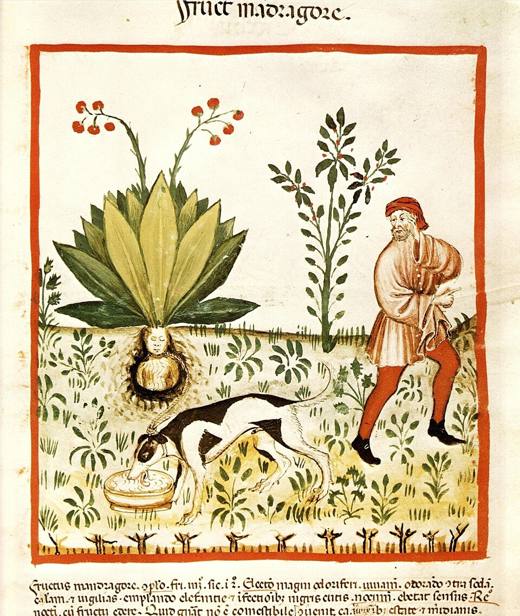
There were also dangerous “witches’ herbs”, such as deadly nightshade, henbane and thorn apple, which turn up in stories about flying ointments. Mandrake, with its human-like root, was said to scream when pulled from the ground.
Folk magic is cultural heritage. Appreciate it as a way in which people once understood their world.
The so-called witches’ herbs, such as deadly nightshade, henbane and thorn apple, are deadly poisonous. Never use them.
From the kitchen
There is no recipe from this tradition on the site yet. These recipes do use herbs it knows.
 Body careNourishing hair treatmentFour plant oils as an intensive treatment.Hair and scalpAvocado · Olive · WatermelonCentral America and the CaribbeanEuropeAfricaAsiaOceaniaAbout 235 ml · 5 minutes
 Body careBasic lotionA basic lotion you scent yourself.Skin careAlmond · Evening primrose · Garden angelicaAsiaNorth AmericaEuropeAfricaAbout 470 ml · 30 minutesBody careBody powderA soft powder of clay, arrowroot and rice.Skin careLavender · Arrowroot · Garden angelicaEuropeCentral America and the CaribbeanAfricaAsiaAbout 330 g · 5 minutes
Registry
CautionEurope · Herb · № 230
Potentilla reptans
The tannin-rich herb was used as a mouthwash and for diarrhoea. A medicinal effect has not been studied.
 Caution
Europe · Food · № 83
Linum usitatissimum
Ground flaxseed acts as a gentle bulk-forming fibre for constipation. NCCIH reports it may lower cholesterol slightly; evidence for other claims is unclear.
 Caution
Europe · Mushroom · № 910
Amanita muscaria
The well-known red mushroom with white spots. Contains ibotenic acid and muscimol, which act on the brain. Causes nausea, muscle twitching, confusion, a dreamlike state and sometimes deep sleep. Drying partly converts ibotenic acid into the stronger muscimol.
 Caution
Europe · Food · № 21
Sambucus nigra
Berries have a folk-use history for cold and flu symptoms; clinical evidence remains preliminary.
 Caution
Europe · Herb · № 94
Stellaria media
Traditionally used externally as a cooling ointment or compress for itching, eczema and minor skin irritation. There is hardly any clinical research.
 Caution
Europe · Food · № 80
Juglans regia
The nuts are a nutritious source of unsaturated fats. Leaf and green husk are astringent and were traditionally used for skin conditions and diarrhoea; clinical evidence is lacking.
 Caution
North America · Herb · № 169
Morella cerifera
The root bark was traditionally used for colds, sore throats and diarrhoea. There is no modern clinical evidence.
 Caution
Europe · Herb · № 86
Plantago major
The leaf is traditionally bruised and applied to insect bites, small wounds and grazes, and taken as tea for coughs. Clinical evidence is limited.
 Caution
North America · Herb · № 190
Thuja occidentalis
Traditionally attributed effects: expels worms, astringent, antimicrobial, anti-inflammatory, stimulates muscles, antiseptic.
 Caution
Africa · Herb · № 373
Boswellia sacra
The resin is mainly used as incense and fragrance. Extracts of related Boswellia species have been studied for osteoarthritis, with modest and variable results.
 Caution
Europe · Herb · № 242
Ruta graveolens
Traditionally attributed effects: antiseptic, stimulating, promotes menstruation, expectorant, antispasmodic, expels worms (children); strengthens capillaries (rutin); for hysteria, flatulence and colic, incipient paralysis, indigestion; oil diuretic and skin-irritant.
 Caution
Europe · Herb · № 194
Lonicera caprifolium, L. periclymenum
The sweet-scented flowers were used as tea or syrup for coughs. The berries are poisonous. In Chinese medicine the related Japanese honeysuckle (jin yin hua) is used for fever and sore throat.
 Caution
Europe · Herb · № 837
Atropa belladonna
A deadly poisonous plant. Its compound atropine is used in controlled form in modern medicine.
 Caution
Asia · Herb · № 18
Glycyrrhiza glabra
A root with long use in several traditions; high-quality evidence does not support most health claims.
 Caution
Europe · Herb · № 187
Quercus robur
The bark contains a lot of tannins and is astringent. It is used as a decoction for diarrhoea, as a mouthwash for inflamed gums and as a sitz bath for haemorrhoids.
 Caution
North America · Herb · № 209
Helianthus annuus
Sunflower seeds and oil are rich in vitamin E and linoleic acid. The oil is used for dry skin; claims about scars or skin ageing have not been shown.
 Caution
Asia · Herb · № 135
Piper nigrum
Important warming spices in Ayurveda, used for sluggish digestion and colds. Piperine from pepper increases the absorption of some substances, such as curcumin.