Skip to content
Herbs & Cultures

Cloister garden and manuscript

Europe

174 remedies · 7 traditions

European healing knowledge grew from several layers: classical texts, monastery gardens, and local traditions. Written records capture only part of what people learned from their surroundings.

Characteristic plants

History and today

Cultures and traditions

Dates refer to surviving sources or written records where possible. Much orally transmitted knowledge predates its first written record.

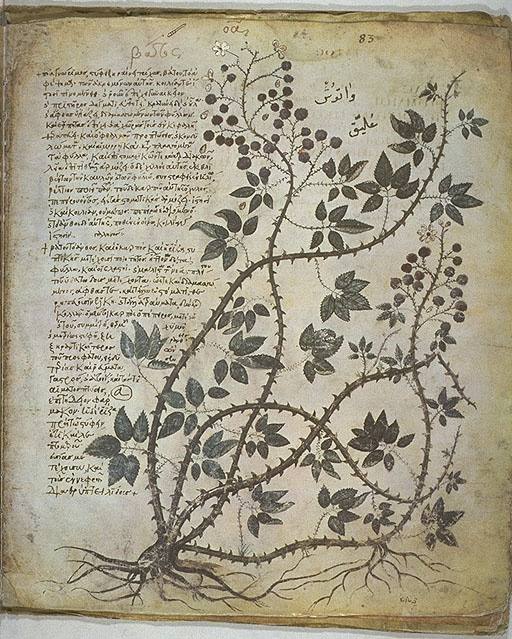
A plant from the Vienna Dioscurides, a copy of De materia medica from around 512.

Greece and the Roman Empire

Greco-Roman medicine

Written works from the 5th century BCE

Greek medicine began not with physicians but with gods. In sanctuaries of Asclepius, such as at Epidaurus and on the island of Kos, the sick slept a night in the temple, hoping the god would heal them or give advice in a dream. In the fifth century BCE a different approach arose on Kos, associated with the name of Hippocrates (c. 460–370 BCE). The so-called Hippocratic writings, some sixty texts by different authors, seek the cause of illness not with the gods, but in the body, diet, climate and way of life. Others later built on this. In the fourth century BCE Theophrastus wrote the first great work on plants. In the first century CE the Greek army physician Dioscorides described some six hundred plants and their uses in De materia medica. Galen (129–c. 216), a physician from Pergamon who worked in Rome, brought everything together in a vast body of work that would shape European and Islamic medicine for more than fifteen hundred years.

Herbs in this tradition (43)

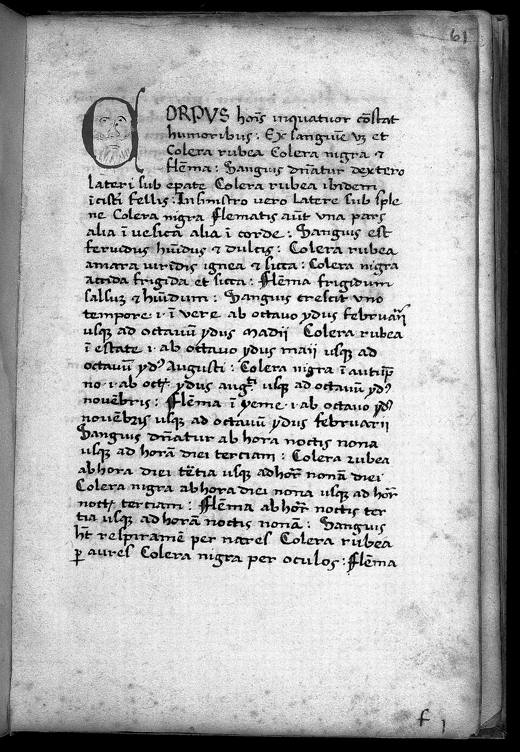
A page from Macer Floridus' De viribus herbarum, a herbal poem widely copied in medieval monasteries.

Monasteries of Western and Central Europe

Monastic and folk knowledge

Medieval records; older and continuing local practices

After the fall of the Western Roman Empire, monasteries in Europe became the keepers of learned knowledge, medicine included. Monks and nuns copied Latin and Greek medical texts so that they were preserved. The Rule of Benedict, from the sixth century, states in chapter 36 that care for the sick comes before everything. Monasteries therefore acquired an infirmary, a pharmacy and a herb garden. The famous Plan of Saint Gall, from around 820, shows a herb garden with sixteen beds next to the infirmary and the physician’s house. Secular rulers took an interest too. In the Capitulare de villis of around 800, Charlemagne laid down which plants were to grow on his estates: almost a hundred species, including many medicinal herbs. From the tenth century a famous medical school was active in Salerno in Italy. In the twelfth century a woman physician, Trota, also worked there; texts on women’s medicine were later named after her.

Hildegard receives an inspiration and passes it on to her scribe; miniature from the Rupertsberg codex of the Scivias.

Bingen am Rhein, Germany

Hildegard of Bingen

12th century (c. 1098–1179); the Physica was written between 1151 and 1158

Hildegard was born in 1098 in Bermersheim near Alzey, into a noble family. At the age of eight she was entrusted to the Benedictine monastery on the Disibodenberg, where she grew up in the care of Jutta of Sponheim. In 1115 she took her vows. After Jutta’s death, around 1136, she became magistra: the leader of the community of sisters. From 1141 she wrote down her visions in the Scivias. Around 1150 she founded her own convent with about twenty sisters on the Rupertsberg near Bingen, and in 1165 a second one in Eibingen, across the Rhine. She wrote theology, composed music, corresponded with popes and emperors and made preaching tours. For a woman in the twelfth century that was exceptional. In the same years her writings on nature and medicine came into being. Hildegard died on 17 September 1179. For centuries she was venerated as a saint without formal canonisation. That only followed in 2012, and on 7 October of that year Pope Benedict XVI proclaimed her a Doctor of the Church.

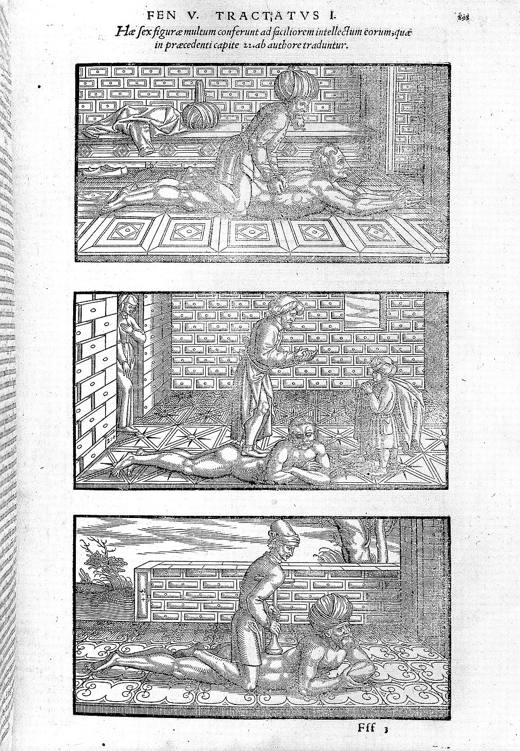
Woodcuts from a printed Latin edition of Avicenna's Canon, the textbook of Europe's medical faculties.

Universities of Paris, Montpellier, Padua and Bologna

Avicenna's Canon in European universities

Completed in 1025; used in Europe into the 18th century

Ibn Sina, known in Europe as Avicenna, was born in 980 near Bukhara, in present-day Uzbekistan. He was a prodigy: as a young man he was already working as a physician at court. He wrote on philosophy, mathematics, astronomy and medicine, and died in 1037 in Hamadan, in present-day Iran. Around 1025 he completed the Canon of Medicine, al-Qanun fi al-Tibb. In five books he brought together the Greek medicine of Hippocrates and Galen with Persian, Arab and Indian knowledge and with his own observations. In the twelfth century Gerard of Cremona translated the Canon into Latin in Toledo. From the thirteenth century European scholars used the work, and from the fourteenth century it was on the curriculum of universities. In 1472 the first printed Latin edition appeared, and in Padua the Canon was still taught in 1715.

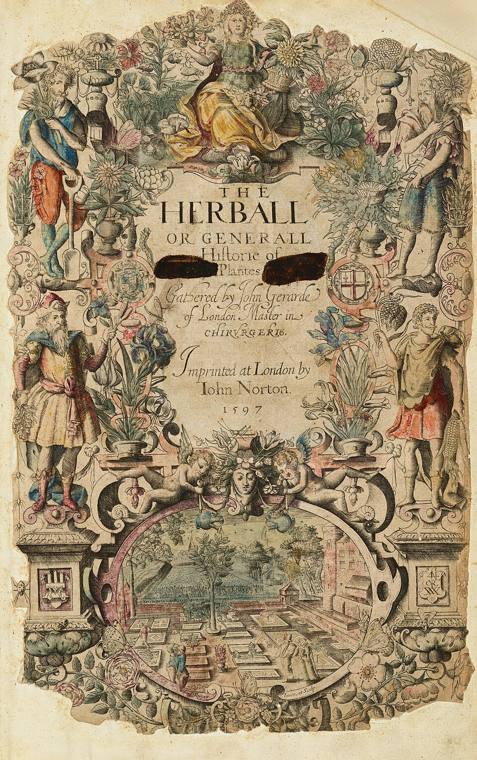
The title page of John Gerard's The Herball (London, 1597).

Across Europe and beyond

Western herbal medicine

From medieval herbals to present-day phytotherapy

With the invention of printing, the great herbals arrived in the fifteenth and sixteenth centuries. In 1485 the Gart der Gesundheit appeared in Mainz. In 1542 Leonhart Fuchs published De historia stirpium, with beautiful woodcuts drawn from nature. The Low Countries played a large role. The Mechelen physician Rembert Dodoens published his Cruydeboeck in Antwerp in 1554, one of the most important herbals of its time, which was translated into many languages. In England John Gerard’s Herball appeared in 1597, and in 1652 The English Physitian by Nicholas Culpeper, who made the knowledge accessible to ordinary people in English. From the eighteenth century science grew out of herbalism. In 1785 William Withering described how foxglove helped with dropsy caused by heart failure. In the nineteenth century chemists isolated active substances from plants, such as morphine from the opium poppy in 1804. In 1897 Bayer made aspirin, based on a substance also found in willow bark and meadowsweet.

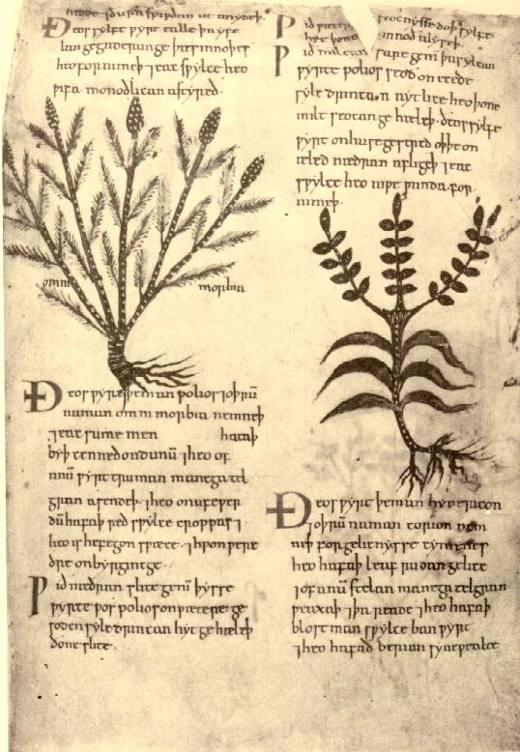
A page from the Old English Herbarium (Cotton Vitellius C.iii), 11th century.

England

Anglo-Saxon medicine

England, c. 900–1100

From Anglo-Saxon England, roughly from the fifth century to the Norman Conquest in 1066, a remarkable number of medical texts survive in the vernacular: Old English. That is exceptional in Europe, where learned texts were usually in Latin. The best-known work is Bald’s Leechbook, the “physician’s book of Bald”, from the middle of the tenth century. A note at the end says that Bald was the owner and that a scribe, Cild, wrote the book for him. It is kept in the British Library. Other sources are the Lacnunga, a collection of remedies and charms, and the Old English Herbarium, a translation of a late Latin herbal. Together they give a rich picture of care in early medieval England.

Herbs in this tradition (13)

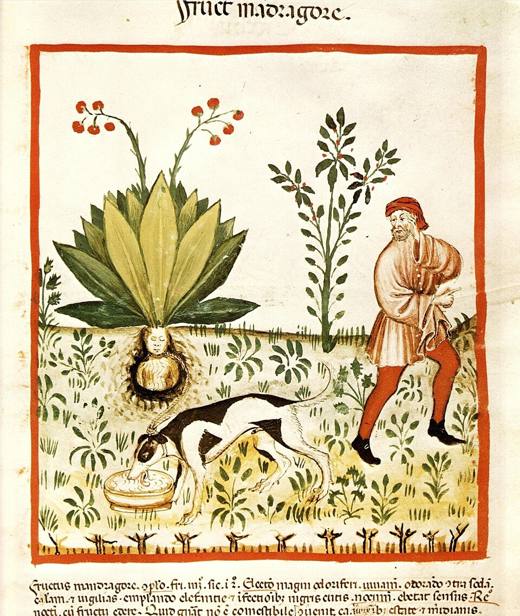
The mandrake is pulled from the ground by a dog, as legend required; Tacuinum sanitatis, c. 1390.

Across Europe

Folk magic and herbal magic

Centuries-old folk customs; present-day herbal magic mainly since the 20th century

All over Europe, folk belief gave plants special powers. They protected house and livestock, brought love, warded off thunderstorms and evil forces. These customs are often very old and were later linked to Christian feasts. A fine example from the Low Countries is the kruidwis, the herb bundle. On the Feast of the Assumption, 15 August, bundles of herbs and grains are blessed in Dutch and Belgian Limburg. The bundle, with mugwort and wormwood among other things, was kept at home and thrown on the fire during thunderstorms, as protection against lightning. Midsummer night, St John’s Eve on 24 June, was also a time for herbs. St John’s wort was picked and hung above the door against misfortune. In the nineteenth century folklorists collected such customs, and in the twentieth century a modern herbal magic arose, especially in pagan movements.

Herbs in this tradition (161)

From the kitchen

Recipes from Europe

All recipes (3) →

Registry

Herbs from Europe

Search herbs, spices and other natural ingredients by name, use, or tag. Traditional use is cultural and historical information, not medical advice.

174 results

  • Caution

    Herb · № 279

    Black horehound

    Ballota nigra

    Traditionally attributed effects: against vomiting, stimulating, antispasmodic.

    Western herbal medicine
  • Caution

    Herb · № 298

    Greater celandine

    Chelidonium majus

    Traditionally attributed effects: diuretic, cleansing, stimulates the liver, anti-inflammatory.

    Greco-Roman medicine+1
  • Caution

    Herb · № 236

    Heather

    Calluna vulgaris

    The flowering herb was drunk as tea for bladder complaints and sleeplessness. Heather honey is a prized, jelly-like honey. A medicinal effect has not been studied.

    Folk magic and herbal magicFolklore
  • Caution

    Herb · № 98

    Thyme

    Thymus vulgaris

    Traditionally used for coughs and bronchitis; thymol from the oil inhibits bacteria and fungi in the laboratory. There are some studies of thyme-based cough syrups.

    Greco-Roman medicine+4Folklore
  • Caution

    Herb · № 328

    Tormentil

    Potentilla erecta

    Traditionally attributed effects: astringent, especially for the intestinal wall.

    Western herbal medicine
  • Caution

    Herb · № 20

    Valerian

    Valeriana officinalis

    The root has a traditional association with sleep and calm. Research on insomnia is inconsistent and does not establish benefit.

    Western herbal medicine+1Folklore
  • Caution

    Herb · № 114

    Arnica

    Arnica montana

    Used externally for bruises and muscle aches. Studies give mixed results. Homeopathic arnica is so diluted that it contains no active substance.

    Western herbal medicine+1Folklore
  • Caution

    Herb · № 334

    Wood sage

    Teucrium scorodonia

    Traditionally attributed effects: astringent, induces sweating, antirheumatic, carminative, wound-healing, promotes bile.

    Western herbal medicine
  • Caution

    Herb · № 72

    Fennel

    Foeniculum vulgare

    The seed is traditionally used for wind, bloating and cramps. There are some small studies, but evidence is limited.

    Greco-Roman medicine+9Folklore
  • Caution

    Herb · № 230

    Cinquefoil

    Potentilla reptans

    The tannin-rich herb was used as a mouthwash and for diarrhoea. A medicinal effect has not been studied.

    Folk magic and herbal magicFolklore
  • Caution

    Herb · № 179

    Foxglove

    Digitalis purpurea

    Contains cardiac glycosides that slow the heart rate and strengthen its contractions. They gave rise to the drugs digoxin and digitoxin, still prescribed for certain heart rhythm disorders and heart failure. The margin between an effective and a toxic amount is very small.

    Monastic and folk knowledge+2
  • Caution

    Food · № 83

    Flax

    Linum usitatissimum

    Ground flaxseed acts as a gentle bulk-forming fibre for constipation. NCCIH reports it may lower cholesterol slightly; evidence for other claims is unclear.

    Western herbal medicine+3Folklore
  • Caution

    Mushroom · № 910

    Fly agaric

    Amanita muscaria

    The well-known red mushroom with white spots. Contains ibotenic acid and muscimol, which act on the brain. Causes nausea, muscle twitching, confusion, a dreamlike state and sometimes deep sleep. Drying partly converts ibotenic acid into the stronger muscimol.

    Folk magic and herbal magic
  • Caution

    Food · № 21

    Elderberry

    Sambucus nigra

    Berries have a folk-use history for cold and flu symptoms; clinical evidence remains preliminary.

    Monastic and folk knowledge+4Folklore
  • Caution

    Herb · № 94

    Chickweed

    Stellaria media

    Traditionally used externally as a cooling ointment or compress for itching, eczema and minor skin irritation. There is hardly any clinical research.

    Monastic and folk knowledge+3Folklore
  • Caution

    Herb · № 58

    Lady's mantle

    Alchemilla xanthochlora

    An astringent herb used in folk medicine mainly for heavy periods and diarrhoea. There is little clinical research.

    Monastic and folk knowledge+1
  • Caution

    Food · № 80

    Walnut

    Juglans regia

    The nuts are a nutritious source of unsaturated fats. Leaf and green husk are astringent and were traditionally used for skin conditions and diarrhoea; clinical evidence is lacking.

    Western herbal medicine+2Folklore
  • Caution

    Herb · № 106

    Bogbean

    Menyanthes trifoliata

    A strong bitter traditionally used to stimulate appetite and digestion and for rheumatic complaints. Clinical evidence is lacking.

    Western herbal medicine+1
  • Caution

    Food · № 654

    Watercress

    Nasturtium officinale

    Traditionally attributed effects: rich in vitamin C, beta-carotene and vitamin E; used to support detoxification, cool body heat and support the lungs.

    Kallawaya healing knowledge+1
  • Caution

    Herb · № 86

    Greater plantain

    Plantago major

    The leaf is traditionally bruised and applied to insect bites, small wounds and grazes, and taken as tea for coughs. Clinical evidence is limited.

    Monastic and folk knowledge+9Folklore
  • Caution

    Herb · № 242

    Rue

    Ruta graveolens

    Traditionally attributed effects: antiseptic, stimulating, promotes menstruation, expectorant, antispasmodic, expels worms (children); strengthens capillaries (rutin); for hysteria, flatulence and colic, incipient paralysis, indigestion; oil diuretic and skin-irritant.

    Greco-Roman medicine+6Folklore
  • Caution

    Herb · № 194

    European honeysuckle

    Lonicera caprifolium, L. periclymenum

    The sweet-scented flowers were used as tea or syrup for coughs. The berries are poisonous. In Chinese medicine the related Japanese honeysuckle (jin yin hua) is used for fever and sore throat.

    Folk magic and herbal magicFolklore
  • Caution

    Herb · № 838

    Wild thyme

    Thymus serpyllum

    An aromatic herb traditionally used for coughs and digestive complaints.

    Hildegard of Bingen
  • Caution

    Herb · № 331

    White deadnettle

    Lamium album

    Traditionally attributed effects: astringent, antispasmodic, tonic for the reproductive organs.

    Western herbal medicine
  • Caution

    Herb · № 330

    White bryony

    Bryonia alba

    Traditionally attributed effects: antirheumatic, laxative.

    Western herbal medicine
  • Caution

    Herb · № 301

    Horse chestnut

    Aesculus hippocastanum

    Traditionally attributed effects: anti-inflammatory, astringent.

    Western herbal medicine
  • Caution

    Herb · № 837

    Deadly nightshade (belladonna)

    Atropa belladonna

    A deadly poisonous plant. Its compound atropine is used in controlled form in modern medicine.

    Folk magic and herbal magic
  • Caution

    Herb · № 187

    English oak

    Quercus robur

    The bark contains a lot of tannins and is astringent. It is used as a decoction for diarrhoea, as a mouthwash for inflamed gums and as a sitz bath for haemorrhoids.

    Western herbal medicine+1Folklore
  • Caution

    Herb · № 108

    Barberry

    Berberis vulgaris

    Bark and root contain berberine, which is being studied for blood sugar and cholesterol. The berries are rich in vitamin C. Evidence for barberry itself is limited.

    Western herbal medicine
  • Caution

    Herb · № 554

    Black nightshade

    Solanum nigrum

    Traditionally attributed effects: cleansing, calming, induces sweating and urination, expectorant; for oedema, chronically enlarged liver, jaundice, chronic skin diseases, coughing up blood, haemorrhoids, kidney and bladder inflammation, gonorrhoea, eye diseases; pain-relieving wash.

    Greco-Roman medicine+2