Skip to content
Herbs & Cultures

Cloister garden and manuscript

Europe

174 remedies · 7 traditions

European healing knowledge grew from several layers: classical texts, monastery gardens, and local traditions. Written records capture only part of what people learned from their surroundings.

Characteristic plants

History and today

Cultures and traditions

Dates refer to surviving sources or written records where possible. Much orally transmitted knowledge predates its first written record.

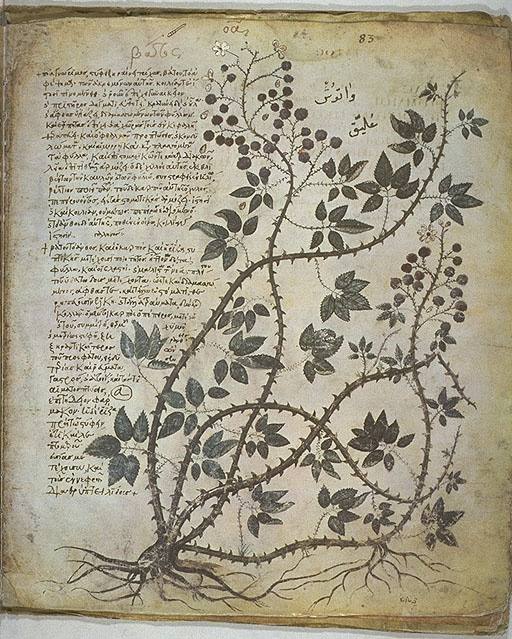
A plant from the Vienna Dioscurides, a copy of De materia medica from around 512.

Greece and the Roman Empire

Greco-Roman medicine

Written works from the 5th century BCE

Greek medicine began not with physicians but with gods. In sanctuaries of Asclepius, such as at Epidaurus and on the island of Kos, the sick slept a night in the temple, hoping the god would heal them or give advice in a dream. In the fifth century BCE a different approach arose on Kos, associated with the name of Hippocrates (c. 460–370 BCE). The so-called Hippocratic writings, some sixty texts by different authors, seek the cause of illness not with the gods, but in the body, diet, climate and way of life. Others later built on this. In the fourth century BCE Theophrastus wrote the first great work on plants. In the first century CE the Greek army physician Dioscorides described some six hundred plants and their uses in De materia medica. Galen (129–c. 216), a physician from Pergamon who worked in Rome, brought everything together in a vast body of work that would shape European and Islamic medicine for more than fifteen hundred years.

Herbs in this tradition (43)

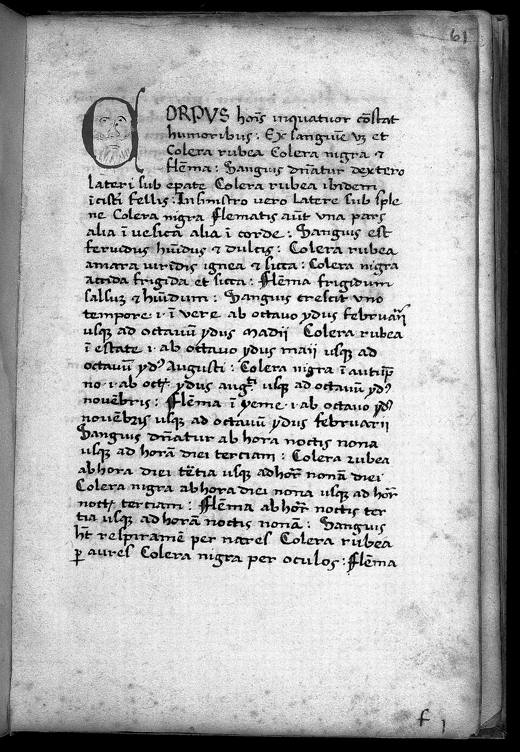
A page from Macer Floridus' De viribus herbarum, a herbal poem widely copied in medieval monasteries.

Monasteries of Western and Central Europe

Monastic and folk knowledge

Medieval records; older and continuing local practices

After the fall of the Western Roman Empire, monasteries in Europe became the keepers of learned knowledge, medicine included. Monks and nuns copied Latin and Greek medical texts so that they were preserved. The Rule of Benedict, from the sixth century, states in chapter 36 that care for the sick comes before everything. Monasteries therefore acquired an infirmary, a pharmacy and a herb garden. The famous Plan of Saint Gall, from around 820, shows a herb garden with sixteen beds next to the infirmary and the physician’s house. Secular rulers took an interest too. In the Capitulare de villis of around 800, Charlemagne laid down which plants were to grow on his estates: almost a hundred species, including many medicinal herbs. From the tenth century a famous medical school was active in Salerno in Italy. In the twelfth century a woman physician, Trota, also worked there; texts on women’s medicine were later named after her.

Hildegard receives an inspiration and passes it on to her scribe; miniature from the Rupertsberg codex of the Scivias.

Bingen am Rhein, Germany

Hildegard of Bingen

12th century (c. 1098–1179); the Physica was written between 1151 and 1158

Hildegard was born in 1098 in Bermersheim near Alzey, into a noble family. At the age of eight she was entrusted to the Benedictine monastery on the Disibodenberg, where she grew up in the care of Jutta of Sponheim. In 1115 she took her vows. After Jutta’s death, around 1136, she became magistra: the leader of the community of sisters. From 1141 she wrote down her visions in the Scivias. Around 1150 she founded her own convent with about twenty sisters on the Rupertsberg near Bingen, and in 1165 a second one in Eibingen, across the Rhine. She wrote theology, composed music, corresponded with popes and emperors and made preaching tours. For a woman in the twelfth century that was exceptional. In the same years her writings on nature and medicine came into being. Hildegard died on 17 September 1179. For centuries she was venerated as a saint without formal canonisation. That only followed in 2012, and on 7 October of that year Pope Benedict XVI proclaimed her a Doctor of the Church.

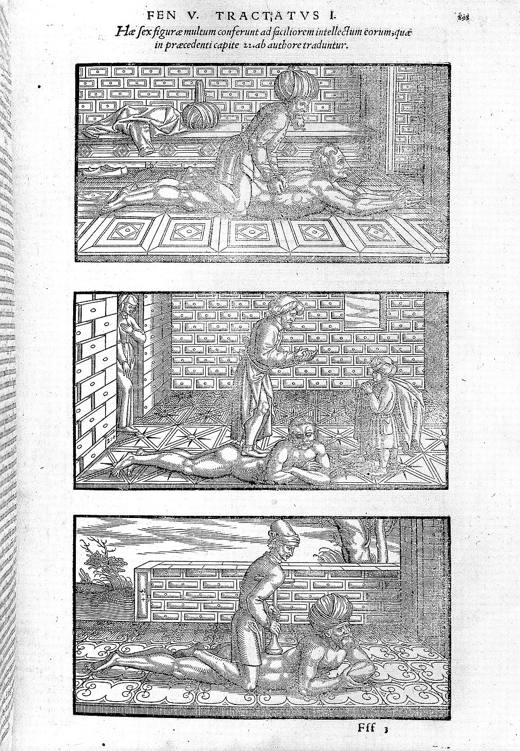
Woodcuts from a printed Latin edition of Avicenna's Canon, the textbook of Europe's medical faculties.

Universities of Paris, Montpellier, Padua and Bologna

Avicenna's Canon in European universities

Completed in 1025; used in Europe into the 18th century

Ibn Sina, known in Europe as Avicenna, was born in 980 near Bukhara, in present-day Uzbekistan. He was a prodigy: as a young man he was already working as a physician at court. He wrote on philosophy, mathematics, astronomy and medicine, and died in 1037 in Hamadan, in present-day Iran. Around 1025 he completed the Canon of Medicine, al-Qanun fi al-Tibb. In five books he brought together the Greek medicine of Hippocrates and Galen with Persian, Arab and Indian knowledge and with his own observations. In the twelfth century Gerard of Cremona translated the Canon into Latin in Toledo. From the thirteenth century European scholars used the work, and from the fourteenth century it was on the curriculum of universities. In 1472 the first printed Latin edition appeared, and in Padua the Canon was still taught in 1715.

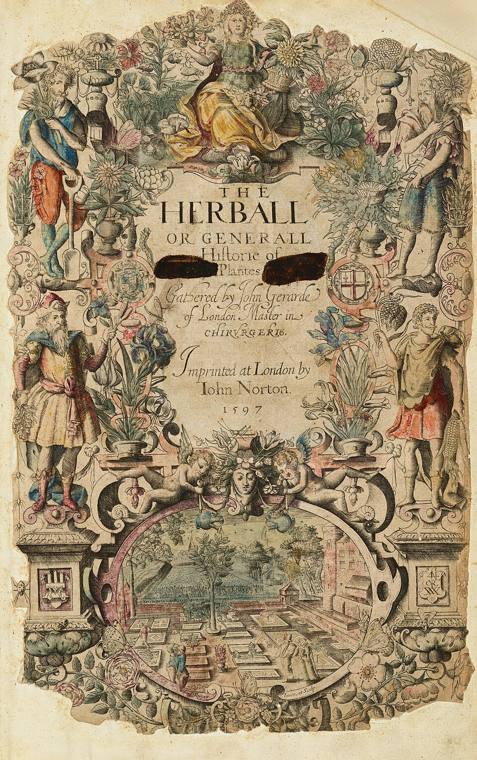
The title page of John Gerard's The Herball (London, 1597).

Across Europe and beyond

Western herbal medicine

From medieval herbals to present-day phytotherapy

With the invention of printing, the great herbals arrived in the fifteenth and sixteenth centuries. In 1485 the Gart der Gesundheit appeared in Mainz. In 1542 Leonhart Fuchs published De historia stirpium, with beautiful woodcuts drawn from nature. The Low Countries played a large role. The Mechelen physician Rembert Dodoens published his Cruydeboeck in Antwerp in 1554, one of the most important herbals of its time, which was translated into many languages. In England John Gerard’s Herball appeared in 1597, and in 1652 The English Physitian by Nicholas Culpeper, who made the knowledge accessible to ordinary people in English. From the eighteenth century science grew out of herbalism. In 1785 William Withering described how foxglove helped with dropsy caused by heart failure. In the nineteenth century chemists isolated active substances from plants, such as morphine from the opium poppy in 1804. In 1897 Bayer made aspirin, based on a substance also found in willow bark and meadowsweet.

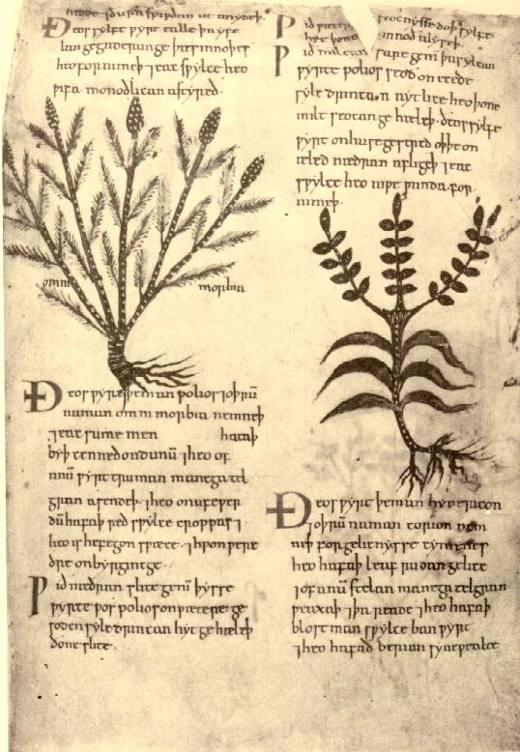
A page from the Old English Herbarium (Cotton Vitellius C.iii), 11th century.

England

Anglo-Saxon medicine

England, c. 900–1100

From Anglo-Saxon England, roughly from the fifth century to the Norman Conquest in 1066, a remarkable number of medical texts survive in the vernacular: Old English. That is exceptional in Europe, where learned texts were usually in Latin. The best-known work is Bald’s Leechbook, the “physician’s book of Bald”, from the middle of the tenth century. A note at the end says that Bald was the owner and that a scribe, Cild, wrote the book for him. It is kept in the British Library. Other sources are the Lacnunga, a collection of remedies and charms, and the Old English Herbarium, a translation of a late Latin herbal. Together they give a rich picture of care in early medieval England.

Herbs in this tradition (13)

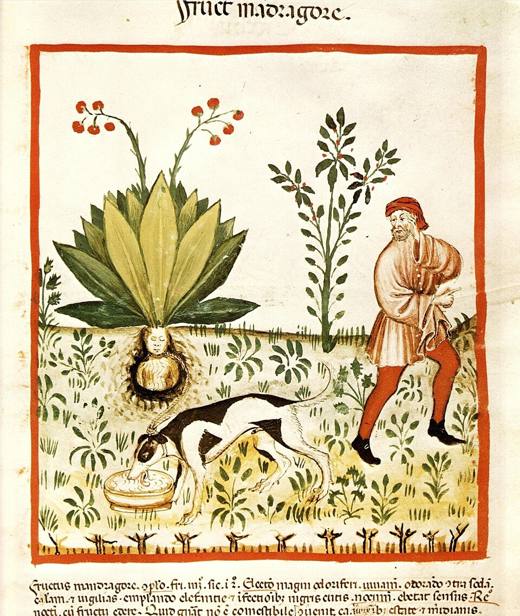
The mandrake is pulled from the ground by a dog, as legend required; Tacuinum sanitatis, c. 1390.

Across Europe

Folk magic and herbal magic

Centuries-old folk customs; present-day herbal magic mainly since the 20th century

All over Europe, folk belief gave plants special powers. They protected house and livestock, brought love, warded off thunderstorms and evil forces. These customs are often very old and were later linked to Christian feasts. A fine example from the Low Countries is the kruidwis, the herb bundle. On the Feast of the Assumption, 15 August, bundles of herbs and grains are blessed in Dutch and Belgian Limburg. The bundle, with mugwort and wormwood among other things, was kept at home and thrown on the fire during thunderstorms, as protection against lightning. Midsummer night, St John’s Eve on 24 June, was also a time for herbs. St John’s wort was picked and hung above the door against misfortune. In the nineteenth century folklorists collected such customs, and in the twentieth century a modern herbal magic arose, especially in pagan movements.

Herbs in this tradition (161)

From the kitchen

Recipes from Europe

All recipes (3) →

Registry

Herbs from Europe

Search herbs, spices and other natural ingredients by name, use, or tag. Traditional use is cultural and historical information, not medical advice.

174 results

  • Caution

    Herb · № 46

    Milk thistle

    Silybum marianum

    Promoted for liver disorders, but there is not enough high-quality evidence of effects in people.

    Western herbal medicine
  • Caution

    Herb · № 47

    Hawthorn

    Crataegus monogyna, C. laevigata (en C. pinnatifida)

    Studied for heart failure with conflicting results. For most conditions there is little or no good evidence.

    Monastic and folk knowledge+3Folklore
  • Caution

    Herb · № 96

    Feverfew

    Tanacetum parthenium

    Best known for preventing migraine. NCCIH notes the evidence is conflicting: some studies find a small effect, others do not.

    Western herbal medicine+2Folklore
  • Caution

    Herb · № 335

    Marsh woundwort

    Stachys palustris

    Traditionally attributed effects: antiseptic, antispasmodic, wound-healing.

    Western herbal medicine
  • Caution

    Herb · № 110

    Marsh cudweed

    Gnaphalium uliginosum

    An astringent herb traditionally used as a gargle for sore throats and inflamed upper airways. There is no clinical research.

    Monastic and folk knowledge+1
  • Caution

    Herb · № 71

    Meadowsweet

    Filipendula ulmaria

    Contains salicylates. Traditionally used for heartburn, an irritated stomach and joint pain. Clinical research is scarce.

    Western herbal medicine+2Folklore
  • Caution

    Herb · № 291

    Chaste tree

    Vitex agnus-castus

    Traditionally attributed effects: stimulates the pituitary gland and hormone production.

    Greco-Roman medicine+1
  • Caution

    Herb · № 314

    Mouse-ear hawkweed

    Pilosella officinarum (syn. Hieracium pilosella)

    Traditionally attributed effects: antispasmodic, expectorant, anticatarrhal, diuretic, wound-healing.

    Western herbal medicine
  • Caution

    Herb · № 3

    Mint

    Mentha × piperita

    Peppermint oil has been studied in irritable bowel syndrome and may reduce abdominal pain. The tea is used for a full stomach and nausea. With heartburn peppermint can make complaints worse.

    Greco-Roman medicine+4Folklore
  • Caution

    Herb · № 380

    Clary sage

    Salvia sclarea

    The essential oil is used in relaxing baths and massages. A small study pointed to a relaxing effect when inhaled; the evidence is limited.

    Western herbal medicine
  • Caution

    Herb · № 198

    Daffodil

    Narcissus spp.

    Daffodils are ornamental plants; the bulbs are poisonous and are sometimes mistaken for onions. Galantamine, a drug for Alzheimer's disease, is extracted from the related snowdrop and from daffodils.

    Folk magic and herbal magicFolklore
  • Caution

    Herb · № 235

    Eyebright

    Euphrasia officinalis

    Traditionally attributed effects: anticatarrhal, antiseptic, anti-inflammatory.

    Western herbal medicine+1Folklore
  • Caution

    Food · № 362

    Olive

    Olea europaea

    Olive oil is the basis of the Mediterranean diet, which is associated with a lower risk of cardiovascular disease. Olive leaf extract is sold as a remedy for infections and high blood pressure; the evidence for this is limited and there is no evidence that it treats flu or other viral infections.

    Greco-Roman medicine+1
  • Caution

    Herb · № 217

    Oregano

    Origanum vulgare

    A culinary herb with carvacrol and thymol, which inhibit bacteria and fungi in the laboratory. There is no good evidence that oregano oil treats infections in humans; undiluted oil irritates skin and mucous membranes.

    Folk magic and herbal magicFolklore
  • Caution

    Herb · № 97

    Dandelion

    Taraxacum officinale

    The leaf is mildly diuretic; the bitter root was used for the liver and digestion. NCCIH notes there is little human research.

    Avicenna's Canon in European universities+6Folklore
  • Caution

    Food · № 259

    Carrot

    Daucus carota

    Traditionally attributed effects: stimulating, diuretic, tonic, carminative; expels kidney and bladder stones, relieves lower back pain from the kidneys, reduces oedema, restores the bladder, stimulates digestion; seed traditionally as a contraceptive.

    Western herbal medicine+4Folklore
  • Caution

    Food · № 244

    Pear

    Pyrus communis

    A fibre-rich fruit with sorbitol, which is mildly laxative. In Chinese medicine pear (li) is cooked with rock sugar for a dry cough; no effect is described for other uses.

    Folk magic and herbal magic+1Folklore
  • Caution

    Herb · № 219

    Parsley

    Petroselinum crispum

    A culinary herb rich in vitamins C and K. Root and seed were used as a diuretic. Large amounts of seed or oil are toxic and can induce contractions.

    Greco-Roman medicine+1Folklore
  • Caution

    Herb · № 590

    Pennyroyal

    Mentha pulegium

    Traditionally attributed effects: stimulating, astringent, promotes menstruation, induces sweating; brings on delayed menstruation, calms the stomach, lowers sudden high fever.

    Greco-Roman medicine+2
  • Caution

    Food · № 264

    Leek

    Allium ampeloprasum var. porrum

    A vegetable with fibre, vitamin K and sulphur compounds, related to onion and garlic. Leek soup is an old home remedy for colds and hoarseness.

    Anglo-Saxon medicine+1Folklore
  • Caution

    Food · № 251

    Plum

    Prunus domestica

    Prunes contain fibre and sorbitol and help with constipation; there is some research on this.

    Folk magic and herbal magicFolklore
  • Caution

    Herb · № 299

    Herb Robert

    Geranium robertianum

    Traditionally attributed effects: astringent, stops bleeding.

    Western herbal medicine
  • Caution

    Herb · № 99

    Red clover

    Trifolium pratense

    Contains isoflavones (plant oestrogens) and is sold for menopausal symptoms. NCCIH concludes there is no convincing evidence that it reduces hot flushes.

    Western herbal medicine+2Folklore
  • Caution

    Herb · № 89

    Rose and rose hip

    Rosa spp.

    Rose hips are rich in vitamin C; a hip powder has been studied for osteoarthritis with modest results. Rose water and oil are used in skin care and as fragrance.

    Avicenna's Canon in European universities+6Folklore
  • Caution

    Herb · № 2

    Rosemary

    Salvia rosmarinus (syn. Rosmarinus officinalis)

    An aromatic culinary herb with carnosic acid and rosmarinic acid. A few small studies point to a slight effect of the scent on alertness; that it improves memory has not been shown. The leaf is used for digestive complaints.

    Monastic and folk knowledge+4Folklore
  • Caution

    Herb · № 366

    Rhodiola

    Rhodiola rosea

    Roseroot is sold as an adaptogen for tiredness and stress. Some studies find a small effect on stress-related fatigue, but they are small and of varying quality. There is no evidence that it prevents colds.

    Western herbal medicine+1
  • Caution

    Herb · № 45

    Sage

    Salvia officinalis

    A culinary herb. A few small studies suggest possible effects on memory and blood lipids, but evidence is limited.

    Monastic and folk knowledge+4Folklore
  • Caution

    Herb · № 595

    Sheep sorrel

    Rumex acetosella

    Traditionally attributed effects: induces sweating, diuretic, fever-reducing, stops bleeding; traditionally for cancer (ingredient of Essiac tea), relieves 'hot' conditions (fever, thirst, inflammation), boils, transient jaundice.

    Western herbal medicine+1
  • Caution

    Herb · № 91

    White willow

    Salix alba

    The bark contains salicin, which the body partly converts to salicylic acid. There are hints of a moderate effect on low back pain and joint pain.

    Greco-Roman medicine+3Folklore
  • Caution

    Food · № 61

    Celery

    Apium graveolens

    Vegetable and spice. The seed was traditionally used for gout, joint complaints and as a diuretic. Convincing clinical evidence is lacking.

    Western herbal medicine+3Folklore
  • Caution

    Herb · № 204

    Lilac

    Syringa vulgaris

    An ornamental shrub with fragrant flowers. The flowers are edible but bitter; the bark was once tried as a bitter remedy for fever.

    Folk magic and herbal magicFolklore
  • Caution

    Herb · № 43

    St. John's wort

    Hypericum perforatum

    Research suggests it may help mild to moderate depression; evidence for other uses is insufficient.

    Greco-Roman medicine+3Folklore
  • Caution

    Herb · № 95

    Comfrey

    Symphytum officinale

    Topical preparations have been studied for bruises, sprains and back pain and appear to reduce pain. It contains allantoin, which is thought to support tissue repair.

    Monastic and folk knowledge+3Folklore
  • Caution

    Herb · № 318

    Lesser celandine

    Ficaria verna (syn. Ranunculus ficaria)

    Traditionally attributed effects: astringent, used for haemorrhoids.

    Western herbal medicine
  • Caution

    Food · № 833

    Spelt

    Triticum spelta

    A grain for bread and porridge; nutritionally similar to wheat.

    Hildegard of Bingen
  • Caution

    Herb · № 577

    Alder buckthorn

    Frangula alnus

    Traditionally attributed effects: cleansing, laxative, antiparasitic, bitter; mild laxative without cramps, stops bleeding and helps with warts, mouthwash for gum problems, hair rinse for scalp irritation.

    Western herbal medicine