Skip to content
Herbs & Cultures

Forest, prairie and Rocky Mountains

North America

139 remedies · 8 traditions

From the eastern forests to the prairies, deserts and the Rocky Mountains, hundreds of First Nations and Native American peoples each hold their own knowledge of plants and healing. In the 19th century, Eclectic physicians built on it.

Characteristic plants

History and today

Cultures and traditions

Dates refer to surviving sources or written records where possible. Much orally transmitted knowledge predates its first written record.

Image of Goldenseal

Southern Appalachians

Cherokee medicine

In the southern Appalachians for centuries; a living tradition

The Cherokee call themselves Aniyvwiya, 'the real people', or Tsalagi. They lived in a large area of the southern Appalachians, in what are now North and South Carolina, Georgia, Tennessee, Alabama and Virginia. Their towns lay along rivers such as the Oconaluftee, the Tuckasegee and the Little Tennessee. The mother town was Kituwah, on the Tuckasegee, and one of the old names of the people is Ani-Kituwah, 'the people of Kituwah'. Around 1821 Sequoyah devised a writing system for Cherokee, and within a few years thousands of Cherokee could read and write. In 1828 the Cherokee Phoenix appeared, the first Indigenous newspaper in North America. Shortly afterwards, with the Indian Removal Act of 1830 and a treaty most Cherokee had never accepted, they were driven from their land. In 1838 and 1839 the US Army drove them to Indian Territory, present-day Oklahoma. On that Trail of Tears perhaps four thousand died, nearly a fifth of the people. A few hundred hid in the mountains or were allowed to stay; from them came the Eastern Band. At the end of the 1880s the ethnologist James Mooney worked among the Eastern Band. From the healer Ayunini, Swimmer, and others he received notebooks of sacred formulas, written in Sequoyah's syllabary. He published them in 1891 and the stories in 1900. A century later J. T. Garrett, himself a member of the Eastern Band and for years director of the Cherokee hospital, wrote down what elders had taught him about the plants.

Image of Goldenseal

Upstate New York and southern Ontario

Haudenosaunee medicine

The league of the Five Nations arose between 1400 and 1600; a living tradition

The Haudenosaunee, 'the people of the longhouse', are also known as the Iroquois. Originally they were five nations in what is now New York State. From east to west these were the Mohawk (Kanien'kehá:ka), the 'keepers of the eastern door', the Oneida, the Onondaga, the 'firekeepers' with whom the council met, the Cayuga and the Seneca, the 'keepers of the western door'. Early in the eighteenth century the Tuscarora from the south joined them, and since then people speak of the Six Nations. According to tradition, the Peacemaker and his spokesman Hiawatha brought the divided peoples to peace under the Great Law of Peace. The white pine became the symbol of the league: the Tree of Peace, under which the weapons were buried. Archaeologists date the founding of the league to somewhere between 1400 and 1600. The Haudenosaunee lived in villages of longhouses covered with the bark of the elm. Families were matrilineal: you belonged to your mother's clan, and the eldest women of a clan chose the chiefs and could also remove them. Women worked the fields of corn, beans and squash, the Three Sisters. Men hunted, fished and went to war. As early as the winter of 1535 to 1536, Jacques Cartier's crew near present-day Quebec recovered from scurvy with an infusion of annedda, an evergreen tree the Indigenous inhabitants showed them. Those inhabitants were St. Lawrence Iroquoians, related to the Five Nations but a different people, who later disappeared. In the seventeenth and eighteenth centuries the Haudenosaunee controlled a large territory and played the Dutch, French and English off against each other. In the American War of Independence most nations sided with the British. In 1779 the army of Sullivan and Clinton destroyed dozens of villages and fields. Many Haudenosaunee then moved to Canada, among other places to the Grand River in Ontario; others stayed on reservations in New York. Reservation life brought hard times, with drunkenness, quarrels and accusations of witchcraft. In 1799 the Seneca Handsome Lake had visions. His teaching, the Gaiwiio or Good Word, forbade alcohol, witchcraft, love medicines and abortion and gave the old ceremonies a new place. From it grew the Longhouse religion, which still exists.

Image of American licorice

Northern Plains, the Dakotas

Lakota medicine

On the northern plains since the eighteenth century; a living tradition

The Lakota are the westernmost people of the Oceti Sakowin, the Seven Council Fires, whom outsiders called the Sioux. Their eastern relatives are the Dakota and the Nakota. The Lakota themselves consist of seven groups, among them the Oglala, the Sičháŋǧu (Brulé) and the Hunkpapa. In English they are also called the Teton Sioux. According to the historical record their ancestors lived by the western Great Lakes and were pushed west by the Anishinaabe and the Cree in the seventeenth century. Around 1730 they acquired the horse, and the buffalo hunt became their livelihood. According to their own tradition the people once emerged from Wind Cave in the Black Hills, so their journey west was a return home. The Black Hills, Ȟe Sápa, became the centre of their land. In the stories White Buffalo Calf Woman brought the sacred pipe and taught the people the ceremonies. In the nineteenth century the Lakota made treaties with the United States, in 1851 and 1868, which promised them the Black Hills. When gold was found there, the government no longer kept to the treaty. After the Battle of the Little Bighorn in 1876 the groups were forced onto reservations. In 1890 Sitting Bull was killed at Standing Rock, and two weeks later the army killed more than 250 Lakota at Wounded Knee, many of them women and children. On the reservations the government banned the Sun Dance and other ceremonies. Around 1912 the ethnologist Frances Densmore wrote that healing with sacred stones and conjuring over the sick were forbidden, but that some old men were allowed to go on treating the sick with herbs.

Image of Maple

Around the Great Lakes

Anishinaabe medicine

Around the Great Lakes; the Midewiwin is centuries old and still alive

Anishinaabe is the name of a family of peoples around the Great Lakes: the Ojibwe, who in the United States are also called Chippewa, the Odawa, the Potawatomi, the Mississauga, the Nipissing and the Algonquin. The Ojibwe, Odawa and Potawatomi together formed the Council of Three Fires, in which the Ojibwe were the 'keepers of the faith'. According to tradition, which is also recorded on birch-bark scrolls, the Anishinaabeg once lived on the Atlantic coast, at the mouth of the St Lawrence. Seven prophets, the seven fires, foretold their future. A shell, the miigis, showed them the way west, to 'the place where food grows on the water'. They found that place at the lakes where wild rice grows. In the eighteenth and nineteenth centuries the Anishinaabeg made treaties with the British, Canadians and Americans. Many Potawatomi were driven west. Children had to go to boarding schools, where their language was forbidden.

Image of Skunk cabbage

Northern Vancouver Island, British Columbia

Kwakwaka'wakw medicine

On the northwest coast of Canada; recorded by George Hunt and Franz Boas, 1890–1930; a living tradition

The Kwakwaka'wakw are 'the people who speak Kwak'wala'. They live on northern Vancouver Island, on the islands nearby and on the coast of British Columbia opposite. The old name Kwakiutl comes from Kwagu'ł, a single community at Fort Rupert where Franz Boas did most of his work; the name was later wrongly applied to all Kwak'wala speakers and even to their neighbours. Each nation has its own clans, chiefs and stories. Families, the na'mima, have hereditary ranks, names, songs and dances, which are shown and confirmed at a potlatch. At such a feast the host gives away a great deal to the guests; whoever gives more gains more standing. Copper plates also had great value. After the first contact with Europeans in 1792 came the diseases. Between 1830 and 1880 the number of Kwakwaka'wakw fell by three quarters; the smallpox epidemic of 1862 alone killed more than half. In 1885 Canada banned the potlatch, on pain of prison. The feasts went on in secret. In enforcing the ban, hundreds of masks and other ceremonial objects were confiscated. Only in 1951 was the ban dropped. Children had to go to boarding schools, where Kwak'wala was forbidden.

Image of North American wild ginger

Hoopa Valley, northern California

Hupa medicine

In Hoopa Valley in northern California since around AD 1000; a living tradition

The Hupa call themselves Natinixwe, 'the people of the place where the trails return'. They live in Hoopa Valley on the Trinity, just above where it flows into the Klamath, in northwestern California. Their language is Athabaskan, related to languages in Alaska and Canada and to those of the Diné and the Apache. According to the historical record they came from the north around the year 1000. Their cedar-plank houses, their canoes and their basket hats resemble those of the northern peoples; the sweat house and acorn bread they took over from their Californian neighbours. Until the gold rush of 1849 the Hupa had little contact with outsiders. Then miners came into the valley. In 1864 the government signed a treaty recognising the land of the Hupa, and the Hoopa Valley Reservation was created. So the Hupa are among the few Californian peoples who were never driven from their land. The first being in their stories is Yimantuwinyai. He travelled through the world before there were people, and made many things as they are now. When a jealous man shot him in the mouth with a poisoned arrow, he rolled about in a frenzy until he came to his senses under a California bay laurel. On that spot a herb grew, Scouler's St John's wort, which he put in his mouth and made a medicine. Later he woke with a swollen belly, saw redwood sorrel growing, chewed it and was cured. 'This plant will be a medicine for the people,' he said. Then he went across the ocean to the north and said to his grandmother: 'I have made the medicines for the people.'

Image of Goldenseal

Across North America

Indigenous healing traditions of North America

Thousands of years; different for each people and place

North America is home to hundreds of Indigenous peoples, each with their own language, culture and knowledge of plants and healing. That knowledge is thousands of years old and was passed on mainly orally and through ceremony. Europeans learned a great deal from Indigenous healers. A well-known example is the winter of 1535 to 1536, when Jacques Cartier’s crew suffered from scurvy near present-day Quebec. They were cured with an infusion of a tree, the annedda, probably the eastern white cedar, on the advice of Domagaya, a son of the Iroquoian chief Donnacona. At the same time Indigenous traditions were heavily suppressed. In the United States the Code of Indian Offenses of 1883 banned many ceremonies. In Canada the potlatch was banned from 1884 to 1951. Only in 1978 did the American Indian Religious Freedom Act protect the right of Native Americans to practise their religion, including ceremonies and sacred plants.

Image of Goldenseal

United States, centred on Cincinnati

Eclectic medicine

United States, c. 1830–1939

The Eclectics were a movement of American physicians in the nineteenth and early twentieth centuries. They opposed the harsh medicine of their time, with bloodletting and poisonous remedies such as mercury. Instead they worked mainly with plants. The movement had roots in the folk medicine of the settlers and in the knowledge of Indigenous peoples. Samuel Thomson, a herbal healer from New Hampshire, patented his own system in 1813, with lobelia and cayenne pepper as its main remedies. Wooster Beach founded a school in New York and called his approach “reformed medicine”. From it grew Eclectic medicine. The Eclectic Medical Institute began in 1833 in Worthington, Ohio, and had students in Cincinnati from 1845 to 1939.

From the kitchen

Recipes from North America

All recipes (6) →

Registry

Herbs from North America

Search herbs, spices and other natural ingredients by name, use, or tag. Traditional use is cultural and historical information, not medical advice.

139 results

  • Caution

    Food · № 937

    Virginia strawberry

    Fragaria virginiana

    A wild strawberry with small, very tasty fruits. Its cross with the Chilean strawberry gave rise to the garden strawberry in eighteenth-century Europe.

    Haudenosaunee medicine+1
  • Caution

    Herb · № 581

    Culver's root

    Veronicastrum virginicum

    Traditionally attributed effects: laxative, stimulating, supports the liver, promotes bile; decongests liver and gallbladder, for gallbladder pain and jaundice.

    Indigenous healing traditions of North America+3
  • Caution

    Herb · № 285

    Bugleweed

    Lycopus virginicus

    Traditionally attributed effects: calming, astringent, tonic, vasoconstricting, cough-suppressing, stops bleeding.

    Eclectic medicine+1
  • Caution

    Herb · № 586

    Lady's slipper

    Cypripedium parviflorum (syn. C. pubescens)

    Traditionally attributed effects: strengthens the nerves, antispasmodic, tonic, relaxing, diuretic; for menstrual pain and irregular menstruation, overstimulated nerves and insomnia from stress, pain-relieving.

    Indigenous healing traditions of North America+4
  • Caution

    Herb · № 329

    True unicorn root

    Aletris farinosa

    Traditionally attributed effects: oestrogenic, tonic, stimulates digestion, calming.

    Indigenous healing traditions of North America+2
  • Caution

    Herb · № 169

    Wax myrtle (bayberry)

    Morella cerifera

    The root bark was traditionally used for colds, sore throats and diarrhoea. There is no modern clinical evidence.

    Eclectic medicine+2Folklore
  • Caution

    Herb · № 969

    Western hemlock

    Tsuga heterophylla

    A large conifer with a drooping top and short, flat needles. The bark is very rich in tannins; the young needles contain vitamin C.

    Kwakwaka'wakw medicine
  • Caution

    Herb · № 968

    Western dock

    Rumex occidentalis (syn. R. aquaticus var. fenestratus)

    A large dock with broad leaves and a yellow root. The root contains tannins and anthraquinones, which are mildly laxative.

    Kwakwaka'wakw medicine
  • Caution

    Herb · № 587

    Western larch

    Larix occidentalis

    Traditionally attributed effects: stimulating, prebiotic; improves digestion and gut flora, strengthens the immune system, studied in tumours, helps with middle ear infections in children.

    Indigenous healing traditions of North America+1
  • Caution

    Herb · № 190

    Arborvitae

    Thuja occidentalis

    Traditionally attributed effects: expels worms, astringent, antimicrobial, anti-inflammatory, stimulates muscles, antiseptic.

    Indigenous healing traditions of North America+4Folklore
  • Caution

    Herb · № 977

    Incense root

    Lomatium californicum (syn. Leptotaenia californica)

    An umbellifer with large, blue-green, celery-like leaves and a strongly scented root. Related to oshá; little studied.

    Hupa medicine
  • Caution

    Herb · № 961

    Wild bergamot

    Monarda fistulosa

    A mint with lilac flowers and strongly scented leaves, related to Oswego tea. The volatile oil is rich in carvacrol and thymol, which are antiseptic.

    Lakota medicine+1
  • Caution

    Herb · № 332

    Wild indigo

    Baptisia tinctoria

    Traditionally attributed effects: antiseptic, antibacterial, fever-reducing, laxative.

    Indigenous healing traditions of North America+3
  • Caution

    Herb · № 156

    Wild black cherry

    Prunus serotina

    The dried bark was long used in cough syrups to calm irritating coughs. Modern clinical evidence is lacking.

    Indigenous healing traditions of North America+4
  • Caution

    Herb · № 957

    Wild four-o'clock

    Mirabilis nyctaginea (syn. Allionia nyctaginea)

    Related to the marvel of Peru (Mirabilis jalapa), with a thick taproot and small pink flowers that open in the afternoon. Taken internally the root is strongly laxative.

    Lakota medicine
  • Caution

    Food · № 965

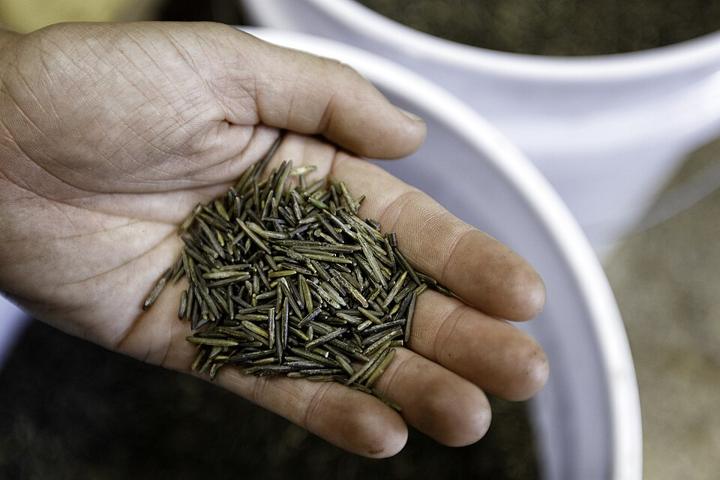
    Wild rice

    Zizania palustris (en Z. aquatica)

    An aquatic grass, not true rice. The long, dark grain contains more protein and fibre than white rice.

    Anishinaabe medicine
  • Caution

    Herb · № 952

    Wild sarsaparilla

    Aralia nudicaulis

    A low plant of the ivy family with a long, creeping, aromatic root; related to ginseng and no relative of true sarsaparilla (Smilax).

    Haudenosaunee medicine
  • Caution

    Herb · № 159

    Wild yam

    Dioscorea villosa

    Traditionally used for abdominal and uterine cramps. Wild yam cream is sold as 'natural progesterone', but the body cannot convert diosgenin into hormones; only a laboratory can.

    Curanderismo+2
  • Caution

    Herb · № 634

    Wintergreen

    Gaultheria procumbens

    Traditionally attributed effects: expels wind and dampness and cools heat in hot, swollen joints and muscle pain, drains damp heat in the urinary tract and moves stagnant qi and blood in pain.

    Haudenosaunee medicine+3
  • Caution

    Herb · № 598

    White oak

    Quercus alba

    Traditionally attributed effects: strongly astringent; strengthens lax tissue (diarrhoea, inflamed gums, chronic nasal congestion, weak bladder), stops bleeding (nosebleeds, internal bleeding).

    Indigenous healing traditions of North America+2
  • Caution

    Herb · № 823

    White sage

    Salvia apiana

    An aromatic sage burned in ceremonies by Indigenous peoples of California.

    Indigenous healing traditions of North America
  • Caution

    Herb · № 986

    Yellowroot

    Xanthorhiza simplicissima

    A low shrub of the buttercup family, one of the few woody species in that family. Root and stem are bright yellow from berberine, a bitter substance also found in goldenseal and barberry that inhibits bacteria and fungi.

    Cherokee medicine
  • Caution

    Herb · № 35

    Saw palmetto

    Serenoa repens

    Promoted for urinary symptoms of an enlarged prostate, but NCCIH concludes it probably does not help for this.

    Indigenous healing traditions of North America
  • Caution

    Herb · № 973

    Salmonberry

    Rubus spectabilis

    A bramble with pink flowers and yellow-orange to red berries. Leaves and bark contain tannins and are astringent.

    Kwakwaka'wakw medicine
  • Caution

    Herb · № 150

    Black cohosh

    Actaea racemosa

    Mainly sold for menopausal symptoms such as hot flushes. NCCIH reports that study results are mixed and there is not enough evidence that it helps.

    Indigenous healing traditions of North America+4
  • Caution

    Mineral · № 365

    Zinc

    An essential mineral. Zinc lozenges may make a cold slightly shorter if taken at the very first symptoms; for herpes, ADHD or other conditions the evidence is weak or absent.

    Western herbal medicine
  • Caution

    Herb · № 209

    Sunflower

    Helianthus annuus

    Sunflower seeds and oil are rich in vitamin E and linoleic acid. The oil is used for dry skin; claims about scars or skin ageing have not been shown.

    Indigenous healing traditions of North America+3Folklore
  • Caution

    Herb · № 933

    Black ash

    Fraxinus nigra

    An ash of wet ground. The wood has hardly any fibre between the growth rings, so after pounding it splits into thin strips. Medicinal effects have not been studied.

    Haudenosaunee medicine
  • Caution

    Herb · № 575

    Black haw

    Viburnum prunifolium

    Traditionally attributed effect: antispasmodic and relaxing, especially for menstrual and uterine cramps. Clinical research is lacking; that it can prevent miscarriage has not been shown.

    Eclectic medicine+2
  • Caution

    Herb · № 971

    Black twinberry

    Lonicera involucrata

    A honeysuckle with yellow flowers in pairs, which later form two shiny black berries in red bracts. Effects not studied.

    Kwakwaka'wakw medicine
  • Caution

    Herb · № 576

    Black walnut

    Juglans nigra

    Traditionally attributed effects: cleansing, laxative, astringent, antibacterial, antiparasitic, antifungal; cleanses and strengthens the large intestine, for skin problems, traveller's diarrhoea, sinusitis, underactive thyroid.

    Indigenous healing traditions of North America+3