Skip to content
Herbs & Cultures

Forest, prairie and Rocky Mountains

North America

139 remedies · 8 traditions

From the eastern forests to the prairies, deserts and the Rocky Mountains, hundreds of First Nations and Native American peoples each hold their own knowledge of plants and healing. In the 19th century, Eclectic physicians built on it.

Characteristic plants

History and today

Cultures and traditions

Dates refer to surviving sources or written records where possible. Much orally transmitted knowledge predates its first written record.

Image of Goldenseal

Southern Appalachians

Cherokee medicine

In the southern Appalachians for centuries; a living tradition

The Cherokee call themselves Aniyvwiya, 'the real people', or Tsalagi. They lived in a large area of the southern Appalachians, in what are now North and South Carolina, Georgia, Tennessee, Alabama and Virginia. Their towns lay along rivers such as the Oconaluftee, the Tuckasegee and the Little Tennessee. The mother town was Kituwah, on the Tuckasegee, and one of the old names of the people is Ani-Kituwah, 'the people of Kituwah'. Around 1821 Sequoyah devised a writing system for Cherokee, and within a few years thousands of Cherokee could read and write. In 1828 the Cherokee Phoenix appeared, the first Indigenous newspaper in North America. Shortly afterwards, with the Indian Removal Act of 1830 and a treaty most Cherokee had never accepted, they were driven from their land. In 1838 and 1839 the US Army drove them to Indian Territory, present-day Oklahoma. On that Trail of Tears perhaps four thousand died, nearly a fifth of the people. A few hundred hid in the mountains or were allowed to stay; from them came the Eastern Band. At the end of the 1880s the ethnologist James Mooney worked among the Eastern Band. From the healer Ayunini, Swimmer, and others he received notebooks of sacred formulas, written in Sequoyah's syllabary. He published them in 1891 and the stories in 1900. A century later J. T. Garrett, himself a member of the Eastern Band and for years director of the Cherokee hospital, wrote down what elders had taught him about the plants.

Image of Goldenseal

Upstate New York and southern Ontario

Haudenosaunee medicine

The league of the Five Nations arose between 1400 and 1600; a living tradition

The Haudenosaunee, 'the people of the longhouse', are also known as the Iroquois. Originally they were five nations in what is now New York State. From east to west these were the Mohawk (Kanien'kehá:ka), the 'keepers of the eastern door', the Oneida, the Onondaga, the 'firekeepers' with whom the council met, the Cayuga and the Seneca, the 'keepers of the western door'. Early in the eighteenth century the Tuscarora from the south joined them, and since then people speak of the Six Nations. According to tradition, the Peacemaker and his spokesman Hiawatha brought the divided peoples to peace under the Great Law of Peace. The white pine became the symbol of the league: the Tree of Peace, under which the weapons were buried. Archaeologists date the founding of the league to somewhere between 1400 and 1600. The Haudenosaunee lived in villages of longhouses covered with the bark of the elm. Families were matrilineal: you belonged to your mother's clan, and the eldest women of a clan chose the chiefs and could also remove them. Women worked the fields of corn, beans and squash, the Three Sisters. Men hunted, fished and went to war. As early as the winter of 1535 to 1536, Jacques Cartier's crew near present-day Quebec recovered from scurvy with an infusion of annedda, an evergreen tree the Indigenous inhabitants showed them. Those inhabitants were St. Lawrence Iroquoians, related to the Five Nations but a different people, who later disappeared. In the seventeenth and eighteenth centuries the Haudenosaunee controlled a large territory and played the Dutch, French and English off against each other. In the American War of Independence most nations sided with the British. In 1779 the army of Sullivan and Clinton destroyed dozens of villages and fields. Many Haudenosaunee then moved to Canada, among other places to the Grand River in Ontario; others stayed on reservations in New York. Reservation life brought hard times, with drunkenness, quarrels and accusations of witchcraft. In 1799 the Seneca Handsome Lake had visions. His teaching, the Gaiwiio or Good Word, forbade alcohol, witchcraft, love medicines and abortion and gave the old ceremonies a new place. From it grew the Longhouse religion, which still exists.

Image of American licorice

Northern Plains, the Dakotas

Lakota medicine

On the northern plains since the eighteenth century; a living tradition

The Lakota are the westernmost people of the Oceti Sakowin, the Seven Council Fires, whom outsiders called the Sioux. Their eastern relatives are the Dakota and the Nakota. The Lakota themselves consist of seven groups, among them the Oglala, the Sičháŋǧu (Brulé) and the Hunkpapa. In English they are also called the Teton Sioux. According to the historical record their ancestors lived by the western Great Lakes and were pushed west by the Anishinaabe and the Cree in the seventeenth century. Around 1730 they acquired the horse, and the buffalo hunt became their livelihood. According to their own tradition the people once emerged from Wind Cave in the Black Hills, so their journey west was a return home. The Black Hills, Ȟe Sápa, became the centre of their land. In the stories White Buffalo Calf Woman brought the sacred pipe and taught the people the ceremonies. In the nineteenth century the Lakota made treaties with the United States, in 1851 and 1868, which promised them the Black Hills. When gold was found there, the government no longer kept to the treaty. After the Battle of the Little Bighorn in 1876 the groups were forced onto reservations. In 1890 Sitting Bull was killed at Standing Rock, and two weeks later the army killed more than 250 Lakota at Wounded Knee, many of them women and children. On the reservations the government banned the Sun Dance and other ceremonies. Around 1912 the ethnologist Frances Densmore wrote that healing with sacred stones and conjuring over the sick were forbidden, but that some old men were allowed to go on treating the sick with herbs.

Image of Maple

Around the Great Lakes

Anishinaabe medicine

Around the Great Lakes; the Midewiwin is centuries old and still alive

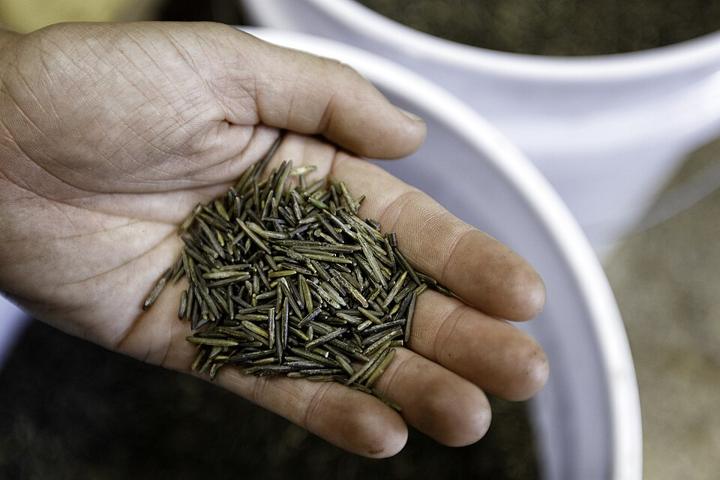
Anishinaabe is the name of a family of peoples around the Great Lakes: the Ojibwe, who in the United States are also called Chippewa, the Odawa, the Potawatomi, the Mississauga, the Nipissing and the Algonquin. The Ojibwe, Odawa and Potawatomi together formed the Council of Three Fires, in which the Ojibwe were the 'keepers of the faith'. According to tradition, which is also recorded on birch-bark scrolls, the Anishinaabeg once lived on the Atlantic coast, at the mouth of the St Lawrence. Seven prophets, the seven fires, foretold their future. A shell, the miigis, showed them the way west, to 'the place where food grows on the water'. They found that place at the lakes where wild rice grows. In the eighteenth and nineteenth centuries the Anishinaabeg made treaties with the British, Canadians and Americans. Many Potawatomi were driven west. Children had to go to boarding schools, where their language was forbidden.

Image of Skunk cabbage

Northern Vancouver Island, British Columbia

Kwakwaka'wakw medicine

On the northwest coast of Canada; recorded by George Hunt and Franz Boas, 1890–1930; a living tradition

The Kwakwaka'wakw are 'the people who speak Kwak'wala'. They live on northern Vancouver Island, on the islands nearby and on the coast of British Columbia opposite. The old name Kwakiutl comes from Kwagu'ł, a single community at Fort Rupert where Franz Boas did most of his work; the name was later wrongly applied to all Kwak'wala speakers and even to their neighbours. Each nation has its own clans, chiefs and stories. Families, the na'mima, have hereditary ranks, names, songs and dances, which are shown and confirmed at a potlatch. At such a feast the host gives away a great deal to the guests; whoever gives more gains more standing. Copper plates also had great value. After the first contact with Europeans in 1792 came the diseases. Between 1830 and 1880 the number of Kwakwaka'wakw fell by three quarters; the smallpox epidemic of 1862 alone killed more than half. In 1885 Canada banned the potlatch, on pain of prison. The feasts went on in secret. In enforcing the ban, hundreds of masks and other ceremonial objects were confiscated. Only in 1951 was the ban dropped. Children had to go to boarding schools, where Kwak'wala was forbidden.

Image of North American wild ginger

Hoopa Valley, northern California

Hupa medicine

In Hoopa Valley in northern California since around AD 1000; a living tradition

The Hupa call themselves Natinixwe, 'the people of the place where the trails return'. They live in Hoopa Valley on the Trinity, just above where it flows into the Klamath, in northwestern California. Their language is Athabaskan, related to languages in Alaska and Canada and to those of the Diné and the Apache. According to the historical record they came from the north around the year 1000. Their cedar-plank houses, their canoes and their basket hats resemble those of the northern peoples; the sweat house and acorn bread they took over from their Californian neighbours. Until the gold rush of 1849 the Hupa had little contact with outsiders. Then miners came into the valley. In 1864 the government signed a treaty recognising the land of the Hupa, and the Hoopa Valley Reservation was created. So the Hupa are among the few Californian peoples who were never driven from their land. The first being in their stories is Yimantuwinyai. He travelled through the world before there were people, and made many things as they are now. When a jealous man shot him in the mouth with a poisoned arrow, he rolled about in a frenzy until he came to his senses under a California bay laurel. On that spot a herb grew, Scouler's St John's wort, which he put in his mouth and made a medicine. Later he woke with a swollen belly, saw redwood sorrel growing, chewed it and was cured. 'This plant will be a medicine for the people,' he said. Then he went across the ocean to the north and said to his grandmother: 'I have made the medicines for the people.'

Image of Goldenseal

Across North America

Indigenous healing traditions of North America

Thousands of years; different for each people and place

North America is home to hundreds of Indigenous peoples, each with their own language, culture and knowledge of plants and healing. That knowledge is thousands of years old and was passed on mainly orally and through ceremony. Europeans learned a great deal from Indigenous healers. A well-known example is the winter of 1535 to 1536, when Jacques Cartier’s crew suffered from scurvy near present-day Quebec. They were cured with an infusion of a tree, the annedda, probably the eastern white cedar, on the advice of Domagaya, a son of the Iroquoian chief Donnacona. At the same time Indigenous traditions were heavily suppressed. In the United States the Code of Indian Offenses of 1883 banned many ceremonies. In Canada the potlatch was banned from 1884 to 1951. Only in 1978 did the American Indian Religious Freedom Act protect the right of Native Americans to practise their religion, including ceremonies and sacred plants.

Image of Goldenseal

United States, centred on Cincinnati

Eclectic medicine

United States, c. 1830–1939

The Eclectics were a movement of American physicians in the nineteenth and early twentieth centuries. They opposed the harsh medicine of their time, with bloodletting and poisonous remedies such as mercury. Instead they worked mainly with plants. The movement had roots in the folk medicine of the settlers and in the knowledge of Indigenous peoples. Samuel Thomson, a herbal healer from New Hampshire, patented his own system in 1813, with lobelia and cayenne pepper as its main remedies. Wooster Beach founded a school in New York and called his approach “reformed medicine”. From it grew Eclectic medicine. The Eclectic Medical Institute began in 1833 in Worthington, Ohio, and had students in Cincinnati from 1845 to 1939.

From the kitchen

Recipes from North America

All recipes (6) →

Registry

Herbs from North America

Search herbs, spices and other natural ingredients by name, use, or tag. Traditional use is cultural and historical information, not medical advice.

139 results

  • Caution

    Herb · № 326

    Partridge berry

    Mitchella repens

    Traditionally attributed effects: stimulates the uterus, tonic, restorative, astringent, diuretic.

    Indigenous healing traditions of North America+3
  • Caution

    Herb · № 903

    Peyote

    Lophophora williamsii

    A small, spineless, blue-green cactus with a long taproot. Contains mescaline and over thirty other alkaloids. After a few hours mescaline brings colourful visions that last up to half a day, often after a phase of nausea and vomiting.

    Indigenous healing traditions of North America
  • Caution

    Herb · № 946

    Pipsissewa

    Chimaphila umbellata

    A low, evergreen dwarf shrub with leathery leaves and pink nodding flowers. Contains arbutin and related compounds, like bearberry.

    Haudenosaunee medicine
  • Caution

    Herb · № 192

    Aspen

    Populus tremuloides

    Traditionally attributed effects: astringent, fever-reducing, tonic, anti-inflammatory, pain-relieving (salicylates); restores the sensitive bladder (incontinence), calms the bowels in stress diarrhoea, heals wounds, lowers fever, relieves headache.

    Indigenous healing traditions of North America+4Folklore
  • Caution

    Herb · № 956

    Fringed sage

    Artemisia frigida

    A low, silver-grey, strongly scented wormwood shrub. Contains a volatile oil with camphor and cineole and, like other wormwoods, thujone.

    Lakota medicine+1
  • Caution

    Herb · № 960

    Fringed puccoon

    Lithospermum incisum (syn. L. linearifolium)

    A member of the borage family with yellow trumpet-shaped flowers and a red root, related to Chinese gromwell (zi cao). Effects not studied.

    Lakota medicine
  • Caution

    Herb · № 958

    Prairie coneflower

    Ratibida columnifera (syn. R. columnaris)

    A member of the daisy family with drooping yellow or red-brown ray flowers around a long, columnar centre that smells when bruised. Effects not studied.

    Lakota medicine
  • Caution

    Herb · № 954

    American pasqueflower

    Pulsatilla nuttalliana (syn. P. patens subsp. multifida)

    A low plant of the buttercup family with hairy purple flowers that appear before the leaves. Like other pasqueflowers, the fresh plant contains protoanemonin, which strongly irritates skin and mucous membranes and raises blisters.

    Lakota medicine
  • Caution

    Herb · № 584

    Gravel root

    Eutrochium purpureum (syn. Eupatorium purpureum)

    Traditionally attributed effects: diuretic, strengthens the nerves, astringent, stimulating, antiseptic; dissolves kidney and bladder stones, removes mineral deposits in joints, traditionally to prevent miscarriage and to prepare for childbirth.

    Indigenous healing traditions of North America+1
  • Caution

    Herb · № 941

    Purple-stem angelica

    Angelica atropurpurea

    A tall umbellifer with a purple stem, related to European garden angelica. Contains essential oil and furanocoumarins, which make the skin sensitive to sunlight.

    Haudenosaunee medicine
  • Caution

    Herb · № 989

    Rabbit tobacco

    Pseudognaphalium obtusifolium (syn. Gnaphalium obtusifolium)

    An annual, grey-felted herb of the daisy family, with straw-coloured flower heads that keep their shape when dried. The dried herb smells sweet. Flavonoids and essential oil have been found in it; its effect is little studied.

    Cherokee medicine
  • Caution

    Food · № 936

    Ramps

    Allium tricoccum

    A wild leek with broad leaves and a small bulb, related to European wild garlic. Leaves and bulb taste of onion and garlic.

    Haudenosaunee medicine+1
  • Caution

    Herb · № 967

    Red alder

    Alnus rubra

    A fast-growing alder with smooth grey bark that turns red after cutting. The bark is rich in tannins and astringent.

    Kwakwaka'wakw medicine
  • Caution

    Herb · № 323

    Slippery elm

    Ulmus rubra (syn. U. fulva)

    Traditionally attributed effects: soothing, nourishing, astringent.

    Indigenous healing traditions of North America+3
  • Caution

    Herb · № 368

    Red root

    Ceanothus americanus

    Traditionally attributed effects: astringent, antispasmodic, expectorant, calming; for a swollen spleen (e.g. after glandular fever), cools and constricts blood vessels in bleeding and congestion of the uterus, liver and lymph.

    Indigenous healing traditions of North America+3
  • Caution

    Herb · № 975

    Redwood sorrel

    Oxalis oregana

    A low wood sorrel with large clover-like leaves and white or pink flowers, forming carpets under the trees. The leaf tastes sour from oxalic acid.

    Hupa medicine
  • Caution

    Herb · № 594

    Solomon's seal

    Polygonatum biflorum

    Traditionally attributed effects: tonic, astringent, relaxing; strengthens and lubricates tendons, ligaments and joints, helps with prolapse of the uterus and bladder, calms the heart rhythm, moistens dry conditions (dry skin, stool, airways).

    Indigenous healing traditions of North America+2
  • Caution

    Herb · № 633

    Sassafras

    Sassafras albidum

    Traditionally attributed effects: expels wind, dampness and cold in joint complaints, also when heat is involved, moves the blood in stasis after trauma or in absent menstruation, and is used for itchy skin.

    Indigenous healing traditions of North America+4
  • Caution

    Herb · № 976

    Scouler's St John's wort

    Hypericum scouleri (syn. H. formosum var. scouleri)

    A native St John's wort with yellow, black-dotted flowers, related to common St John's wort. Like it, it contains hypericin and hyperforin.

    Hupa medicine
  • Caution

    Herb · № 964

    Seneca snakeroot

    Polygala senega (syn. Senega officinalis)

    A low milkwort with white flower spikes. The root contains saponins that loosen phlegm and promote coughing; it is in the European Pharmacopoeia as a cough remedy.

    Anishinaabe medicine+1
  • Caution

    Food · № 935

    Shagbark hickory

    Carya ovata

    A nut tree of the walnut family, with bark that peels away in long strips. The nuts are rich and sweet.

    Haudenosaunee medicine
  • Caution

    Herb · № 943

    Skunk cabbage

    Symplocarpus foetidus

    A marsh arum that flowers in late winter and makes its own heat, melting its way through the snow. It smells of carrion and contains calcium oxalate.

    Haudenosaunee medicine
  • Caution

    Herb · № 286

    California poppy

    Eschscholzia californica

    Traditionally attributed effects: pain-relieving, sleep-inducing, calming.

    Indigenous healing traditions of North America+1
  • Caution

    Herb · № 295

    Fringe tree

    Chionanthus virginicus

    Traditionally attributed effects: promotes bile, stimulates the liver, tonic, diuretic.

    Eclectic medicine+1
  • Caution

    Herb · № 998

    Sourwood

    Oxydendrum arboreum

    A tree of the heath family with drooping sprays of white, bell-shaped flowers in summer and fiery red autumn leaves. The leaves taste sour, hence the name. From the flowers bees make a light, much-prized honey.

    Cherokee medicine
  • Caution

    Herb · № 953

    Stoneroot

    Collinsonia canadensis

    A perennial of the mint family with lemon-scented leaves and a very hard, knobbly root. Eclectic physicians used it for piles and varicose veins; research is lacking.

    Haudenosaunee medicine+1
  • Caution

    Herb · № 168

    Northern prickly ash

    Zanthoxylum americanum

    Bark and berries give a tingling, numbing feeling in the mouth; they were traditionally used for toothache, poor circulation and rheumatism. Clinical research is lacking.

    Indigenous healing traditions of North America+4
  • Caution

    Food · № 979

    Tanoak

    Notholithocarpus densiflorus

    An evergreen tree of the beech family, between oak and chestnut. The acorns are nourishing but bitter with tannins, which must first be leached out.

    Hupa medicine
  • Caution

    Herb · № 171

    Evening primrose

    Oenothera biennis

    The seed oil contains gamma-linolenic acid and is sold for eczema, premenstrual symptoms and hot flushes. NCCIH reports it does not help eczema and that evidence for other conditions is insufficient.

    Indigenous healing traditions of North America+4
  • Caution

    Herb · № 152

    Witch hazel

    Hamamelis virginiana

    Strongly astringent due to tannins. Witch hazel water and ointment are used externally for minor skin irritation, bruises and haemorrhoids; there is limited but reasonably supportive evidence.

    Indigenous healing traditions of North America+4Folklore
  • Caution

    Herb · № 947

    Trailing arbutus

    Epigaea repens

    A creeping, evergreen dwarf shrub of the heath family with fragrant pink to white flowers in early spring. Contains arbutin.

    Haudenosaunee medicine+1
  • Caution

    Herb · № 938

    Trillium

    Trillium spp. (o.a. Trillium erectum en T. grandiflorum)

    Spring flowers with three leaves, three sepals and three petals. The rhizome contains saponins. Clinical research is lacking.

    Haudenosaunee medicine+1
  • Caution

    Herb · № 945

    Purple pitcher plant

    Sarracenia purpurea

    A carnivorous plant with pitcher-shaped leaves that hold rainwater, in which insects drown. Little research exists on effects in people.

    Haudenosaunee medicine
  • Caution

    Herb · № 993

    Tulip tree

    Liriodendron tulipifera

    The tallest broadleaf tree of eastern America, up to almost sixty metres, of the magnolia family, with tulip-shaped greenish-yellow flowers with an orange patch. The bark is bitter and contains the alkaloid liriodenine and sesquiterpenes that inhibit bacteria and fungi; it was formerly used as a tonic and quinine substitute. The flowers give much nectar for a dark honey.

    Cherokee medicine
  • Caution

    Herb · № 294

    False unicorn root

    Chamaelirium luteum

    Traditionally attributed effects: diuretic, uterine tonic, emetic.

    Indigenous healing traditions of North America+2
  • Caution

    Herb · № 824

    Sweetgrass

    Hierochloe odorata

    A sweet-scented grass that is burned in ceremonies.

    Indigenous healing traditions of North America+2