Skip to content
Herbs & Cultures

Tradition in Asia

Chinese medical traditions

Classical writings from the early centuries BCE and CE

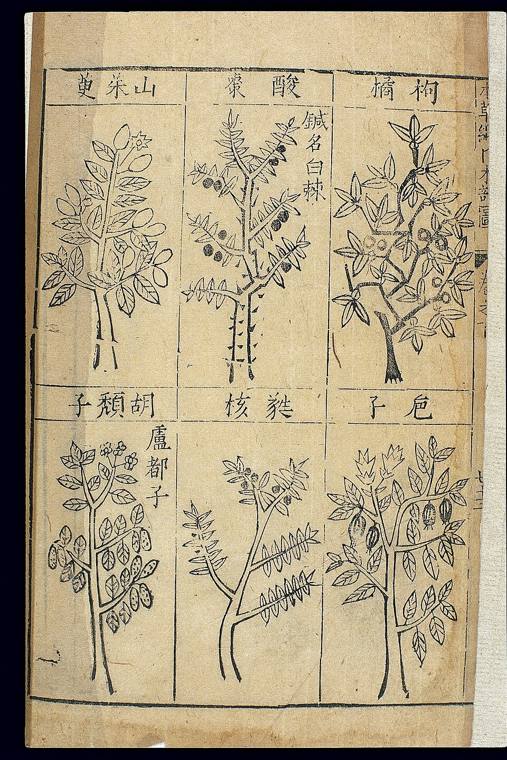
Plants from Li Shizhen's Bencao Gangmu, the great Chinese materia medica of the Ming period.
Plants from Li Shizhen's Bencao Gangmu, the great Chinese materia medica of the Ming period. Wellcome Collection · CC BY 4.0

History

Chinese medicine is one of the oldest continuous healing traditions in the world. In a tomb at Mawangdui, sealed in 168 BCE, archaeologists found silk manuscripts with recipes against fifty-two ailments. They show how old the knowledge already was.

The classical foundation lies in a few great works. The Huangdi Neijing, the “Inner Classic of the Yellow Emperor”, took shape in the last centuries BCE. The Shennong Bencao Jing, the herbal classic of the mythical farmer-emperor Shennong, describes 365 remedies. Around 200 CE Zhang Zhongjing wrote the Shanghan Lun, on febrile diseases, with formulas still in use today.

Over the centuries the knowledge kept growing. In 1578 Li Shizhen completed the Bencao Gangmu, a huge encyclopaedia with almost two thousand remedies. In the twentieth century the tradition was reformed and standardised in China into what the West now calls “traditional Chinese medicine”.

Key ideas

Chinese medicine sees the body as a coherent whole, connected with nature and the seasons. Central are yin and yang, two opposing but complementary forces, such as cold and warm, rest and movement. Health is their balance.

Qi is the life energy that flows through the body, along pathways called meridians. The five phases, wood, fire, earth, metal and water, describe how organs, seasons, tastes and emotions influence one another.

A physician diagnoses not only a disease, but above all a pattern: a picture of what is out of balance in the whole body. To do so he looks at the tongue, feels the pulse and asks many questions. Two people with the same complaint can thus receive very different treatment.
Knowledge and its transmission

For a long time knowledge was passed on within families or from teacher to pupil. Physicians studied the classics, wrote commentaries and collected their own recipes.

There were also imperial medical institutes, from the Tang dynasty onwards, with examinations and training. Alongside the learned physicians there was broad folk knowledge of herbs, as well as itinerant healers and herb sellers.

Today universities of Chinese medicine in China train physicians in a programme of five years or longer, with Western medicine also on the curriculum.

Texts and figures

The Huangdi Neijing and the Bencao Gangmu have been on UNESCO’s Memory of the World register since 2011. The Shennong Bencao Jing and the Shanghan Lun are the other great classics.

A remarkable story belongs to a fourth-century book by the scholar Ge Hong. He described how to soak sweet wormwood in cold water against fever. In the 1970s the Chinese researcher Tu Youyou read that text and so discovered artemisinin, a drug against malaria. In 2015 she received the Nobel Prize for it.

In 2010 UNESCO recognised acupuncture and moxibustion as intangible heritage.

Today

In China traditional medicine works alongside Western medicine, with its own hospitals, pharmacies and training. It is also important in Taiwan, Hong Kong and Singapore, and there are practitioners worldwide.

Since 2019 the WHO’s International Classification of Diseases, ICD-11, has had a separate chapter with diagnoses from the traditional medicine of China, Japan and Korea.

The scientific support differs greatly by use. Some remedies are well researched; for many others evidence is lacking.

Nature in the tradition

Chinese remedies are almost always combined in formulas. Every formula has a principal remedy and helpers. Well-known herbs are ginseng, astragalus, dang gui, liquorice, which brings many formulas into balance, ginger, cinnamon and Chinese dates.

Goji, rehmannia, peony root and the mushroom poria also belong to the basics.

According to the tradition every remedy has its own nature (warm or cold), a taste and a direction in the body. Besides plants, minerals and animal products are also used.

Approaching it with respect

Some Chinese remedies can be harmful. Herbs containing aristolochic acid caused serious kidney damage in Belgium in the 1990s among users of a slimming regimen. Ephedra can strain the heart. Buy only controlled products and consult a doctor.

Do not use remedies from endangered animals, such as the pangolin or the tiger. That trade threatens these species with extinction.

From the kitchen

Recipes from this tradition

Registry

Herbs in this tradition

  • Caution

    Asia · Herb · № 345

    Saffron

    Crocus sativus

    Traditionally attributed effects: stimulating, aphrodisiac, stomachic, pain-relieving, antispasmodic, calming, promotes menstruation; for absent menstruation, fever, hysteria, melancholy, leucorrhoea, haemorrhoids; paste for bruises, nerve and rheumatic pain.

    Ayurveda+4
  • Caution

    Europe · Herb · № 45

    Sage

    Salvia officinalis

    A culinary herb. A few small studies suggest possible effects on memory and blood lipids, but evidence is limited.

    Monastic and folk knowledge+4Folklore
  • Caution

    Asia · Herb · № 140

    Sandalwood

    Santalum album

    Used in Ayurveda as a 'cooling' remedy for skin irritation and urinary complaints; the oil is used in aromatherapy. Clinical evidence is limited.

    Ayurveda+6Folklore
  • Caution

    Asia · Herb · № 650

    Saposhnikovia root (fang feng)

    Saposhnikovia divaricata

    Traditionally attributed effects: expels wind; for muscle pain, painful diarrhoea, rheumatic complaints and cramps.

    Chinese medical traditions+2
  • Caution

    Asia · Herb · № 745

    Sappan wood (su mu)

    Biancaea sappan (syn. Caesalpinia sappan)

    Traditionally attributed effects: lets the blood flow in menstrual pain and injury.

    Chinese medical traditions+1
  • Caution

    Asia · Herb · № 719

    Sargassum (hai zao)

    Sargassum pallidum (en S. fusiforme)

    Traditionally attributed effects: softens hardenings from phlegm-fire such as goitre and swollen glands; drains fluid.

    Chinese medical traditions
  • Caution

    North America · Herb · № 633

    Sassafras

    Sassafras albidum

    Traditionally attributed effects: expels wind, dampness and cold in joint complaints, also when heat is involved, moves the blood in stasis after trauma or in absent menstruation, and is used for itchy skin.

    Indigenous healing traditions of North America+4
  • Caution

    Asia · Herb · № 666

    Scouring rush (mu zei)

    Equisetum hyemale

    Traditionally attributed effects: expels wind-heat around the eyes, stops bleeding and is diuretic.

    Chinese medical traditions+1
  • Caution

    Asia · Herb · № 592

    Schisandra

    Schisandra chinensis

    Traditionally attributed effects: tonic, astringent, stimulating, adaptogen; supports exhausted adrenals (fatigue), promotes sleep and well-being, protects the liver.

    Chinese medical traditions+3
  • Caution

    Asia · Herb · № 657

    Schizonepeta (jing jie)

    Schizonepeta tenuifolia

    Traditionally attributed effects: opens the surface in colds (warm or cool, depending on the combination), helps rashes come out and, charred, stops bleeding.

    Chinese medical traditions+1
  • Caution

    Africa · Herb · № 117

    Senna

    Senna alexandrina

    Leaves and pods contain sennosides, a stimulant laxative that works for short-term constipation. It is used in modern over-the-counter laxatives.

    Ancient Egyptian medicine+5
  • Caution

    Africa · Food · № 356

    Sesame

    Sesamum indicum

    Traditionally attributed effects: soothing, softens the skin, diuretic, promotes menstruation and milk flow, laxative; leaves for respiratory complaints, diarrhoea and dysentery in children, bladder catarrh; seeds for bleeding haemorrhoids, absent or painful menstruation.

    Ancient Egyptian medicine+3Folklore
  • Caution

    Asia · Mushroom · № 145

    Shiitake

    Lentinula edodes

    An edible mushroom. Lentinan from shiitake is researched and used in oncology in Japan; there is little evidence for ordinary shiitake as an 'immune booster'.

    Chinese medical traditions+3
  • Caution

    Asia · Herb · № 367

    Siberian ginseng

    Eleutherococcus senticosus

    Traditionally attributed effects: adaptogen, increases interferon production; especially for herpes simplex, strengthens the immune system against colds and flu; further for high blood pressure, kidney disease, diabetes, insomnia, arthritis.

    Chinese medical traditions+1
  • Caution

    Asia · Herb · № 749

    Siberian Solomon's seal (huang jing)

    Polygonatum sibiricum

    Traditionally attributed effects: strengthens spleen and kidneys, moistens the lungs and replenishes the essence.

    Chinese medical traditions+1
  • Caution

    Asia · Herb · № 644

    Szechuan lovage (chuan xiong)

    Ligusticum chuanxiong (syn. L. striatum)

    Traditionally attributed effects: promotes circulation, helps with menstrual complaints and as a restorative tonic after childbirth, and is said to lower high blood pressure; warming.

    Chinese medical traditions+2
  • Caution

    Asia · Food · № 220

    Orange

    Citrus sinensis

    Traditionally attributed effects: against dandruff; sweet oranges good for skin and hair.

    Ayurveda+2Folklore
  • Caution

    Asia · Herb · № 180

    Opium poppy

    Papaver somniferum

    The latex of the unripe seed capsule (opium) contains morphine, codeine and other alkaloids. Morphine and related opioids are indispensable painkillers in modern medicine, but highly addictive. The seeds (poppy seeds) are an ordinary food.

    Ayurveda+4
  • Caution

    Asia · Herb · № 313

    Dwarf lilyturf (mai men dong)

    Ophiopogon japonicus

    Traditionally attributed effects: promotes the secretion of body fluids, tonic, calming, cough-suppressing, lowers blood sugar, antibacterial.

    Chinese medical traditions+3
  • Caution

    Europe · Herb · № 95

    Comfrey

    Symphytum officinale

    Topical preparations have been studied for bruises, sprains and back pain and appear to reduce pain. It contains allantoin, which is thought to support tissue repair.

    Monastic and folk knowledge+3Folklore
  • Caution

    Asia · Food · № 390

    Soy

    Glycine max

    Traditionally attributed effects: base for a gentle cleanser.

    Chinese medical traditions+1
  • Caution

    Asia · Herb · № 680

    Sophora root (ku shen)

    Sophora flavescens

    Traditionally attributed effects: drains damp heat in itchy skin, discharge and dysentery; externally as a wash.

    Chinese medical traditions+1
  • Caution

    Asia · Herb · № 742

    Spatholobus stem (ji xue teng)

    Spatholobus suberectus (syn. Millettia reticulata)

    Traditionally attributed effects: both moves and nourishes the blood; for weakness, numbness and painful joints.

    Chinese medical traditions
  • Caution

    Asia · Food · № 519

    Sponge gourd

    Luffa cylindrica

    Traditionally attributed effects: seeds emetic, laxative, diuretic; fruit cooling, soothing, stimulates appetite, diuretic, promotes milk flow; oil for skin conditions.

    Ayurveda+1
  • Caution

    Asia · Mineral · № 794

    Stalactite (e guan shi)

    Stalactitum (calciumcarbonaat)

    Traditionally attributed effects: makes lung energy descend in asthma and chronic bronchitis and promotes milk flow.

    Chinese medical traditions
  • Caution

    Asia · Herb · № 716

    Cocklebur fruit (cang er zi)

    Xanthium strumarium (syn. X. sibiricum)

    Traditionally attributed effects: opens the nose in sinusitis and expels wind and dampness in pain and itching.

    Chinese medical traditions
  • Caution

    Asia · Herb · № 676

    Stellaria root (yin chai hu)

    Stellaria dichotoma var. lanceolata

    Traditionally attributed effects: cools heat from yin deficiency, fever after an illness and heat in malnourished children.

    Chinese medical traditions
  • Caution

    Asia · Herb · № 724

    Stemona root (bai bu)

    Stemona sessilifolia (en S. japonica)

    Traditionally attributed effects: moistens the lungs in acute and chronic cough; externally against lice and fleas.

    Chinese medical traditions
  • Caution

    Asia · Herb · № 709

    Stephania root (han fang ji)

    Stephania tetrandra

    Traditionally attributed effects: diuretic in oedema (especially of the legs) and pain-relieving in hot, swollen joints.

    Chinese medical traditions+1
  • Caution

    Central America and the Caribbean · Herb · № 456

    Sickle senna

    Cassia tora

    Traditionally attributed effects: mildly laxative, cleansing; intestinal complaints and fever when teething, compress for gout, sciatica and joint pain; seeds for ringworm, scabies and eczema; root for snake bites.

    Ayurveda+1
  • Caution

    Asia · Herb · № 664

    Beach vitex fruit (man jing zi)

    Vitex rotundifolia (syn. V. trifolia)

    Traditionally attributed effects: expels wind-heat in headache and eye pain, and relieves cramps and heaviness in the limbs.

    Chinese medical traditions
  • Caution

    Asia · Mineral · № 702

    Talc (hua shi)

    Talcum (hydromagnesiumsilicaat)

    Traditionally attributed effects: cooling and soothing in painful urination and summer heat; externally drying on weeping skin.

    Chinese medical traditions
  • Caution

    Asia · Food · № 268

    Wheat

    Triticum aestivum

    Traditionally attributed effects: strengthens, rejuvenates, soothes ulcers, stimulates appetite, promotes healing of fractures, gives stability, healthy complexion; mildly aphrodisiac; anti-stress breakfast.

    Ayurveda+2Folklore
  • Caution

    Asia · Herb · № 722

    Tatarian aster root (zi wan)

    Aster tataricus

    Traditionally attributed effects: dissolves phlegm and stops cough in cough from cold with much phlegm.

    Chinese medical traditions
  • Caution

    Europe · Herb · № 98

    Thyme

    Thymus vulgaris

    Traditionally used for coughs and bronchitis; thymol from the oil inhibits bacteria and fungi in the laboratory. There are some studies of thyme-based cough syrups.

    Greco-Roman medicine+4Folklore
  • Caution

    Asia · Herb · № 691

    Tonkin sophora root (shan dou gen)

    Sophora tonkinensis

    Traditionally attributed effects: cools fire in the upper body in a swollen, painful throat and gums.

    Chinese medical traditions