Skip to content
Herbs & Cultures

Tradition in Asia

Chinese medical traditions

Classical writings from the early centuries BCE and CE

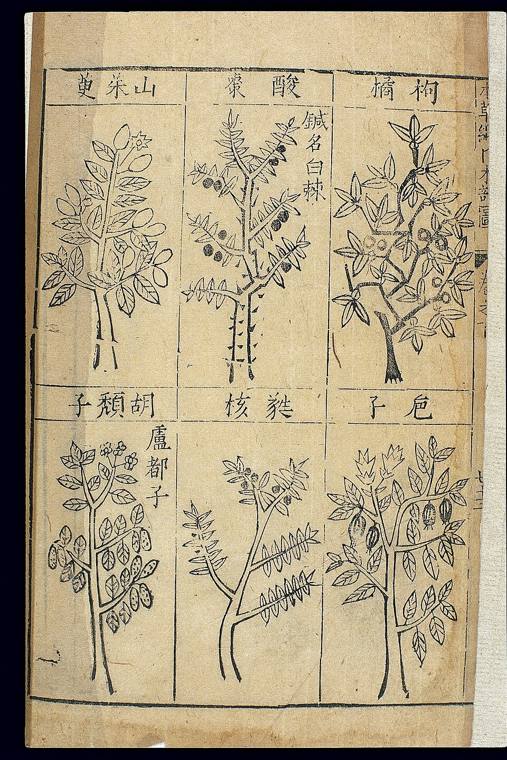
Plants from Li Shizhen's Bencao Gangmu, the great Chinese materia medica of the Ming period.
Plants from Li Shizhen's Bencao Gangmu, the great Chinese materia medica of the Ming period. Wellcome Collection · CC BY 4.0

History

Chinese medicine is one of the oldest continuous healing traditions in the world. In a tomb at Mawangdui, sealed in 168 BCE, archaeologists found silk manuscripts with recipes against fifty-two ailments. They show how old the knowledge already was.

The classical foundation lies in a few great works. The Huangdi Neijing, the “Inner Classic of the Yellow Emperor”, took shape in the last centuries BCE. The Shennong Bencao Jing, the herbal classic of the mythical farmer-emperor Shennong, describes 365 remedies. Around 200 CE Zhang Zhongjing wrote the Shanghan Lun, on febrile diseases, with formulas still in use today.

Over the centuries the knowledge kept growing. In 1578 Li Shizhen completed the Bencao Gangmu, a huge encyclopaedia with almost two thousand remedies. In the twentieth century the tradition was reformed and standardised in China into what the West now calls “traditional Chinese medicine”.

Key ideas

Chinese medicine sees the body as a coherent whole, connected with nature and the seasons. Central are yin and yang, two opposing but complementary forces, such as cold and warm, rest and movement. Health is their balance.

Qi is the life energy that flows through the body, along pathways called meridians. The five phases, wood, fire, earth, metal and water, describe how organs, seasons, tastes and emotions influence one another.

A physician diagnoses not only a disease, but above all a pattern: a picture of what is out of balance in the whole body. To do so he looks at the tongue, feels the pulse and asks many questions. Two people with the same complaint can thus receive very different treatment.
Knowledge and its transmission

For a long time knowledge was passed on within families or from teacher to pupil. Physicians studied the classics, wrote commentaries and collected their own recipes.

There were also imperial medical institutes, from the Tang dynasty onwards, with examinations and training. Alongside the learned physicians there was broad folk knowledge of herbs, as well as itinerant healers and herb sellers.

Today universities of Chinese medicine in China train physicians in a programme of five years or longer, with Western medicine also on the curriculum.

Texts and figures

The Huangdi Neijing and the Bencao Gangmu have been on UNESCO’s Memory of the World register since 2011. The Shennong Bencao Jing and the Shanghan Lun are the other great classics.

A remarkable story belongs to a fourth-century book by the scholar Ge Hong. He described how to soak sweet wormwood in cold water against fever. In the 1970s the Chinese researcher Tu Youyou read that text and so discovered artemisinin, a drug against malaria. In 2015 she received the Nobel Prize for it.

In 2010 UNESCO recognised acupuncture and moxibustion as intangible heritage.

Today

In China traditional medicine works alongside Western medicine, with its own hospitals, pharmacies and training. It is also important in Taiwan, Hong Kong and Singapore, and there are practitioners worldwide.

Since 2019 the WHO’s International Classification of Diseases, ICD-11, has had a separate chapter with diagnoses from the traditional medicine of China, Japan and Korea.

The scientific support differs greatly by use. Some remedies are well researched; for many others evidence is lacking.

Nature in the tradition

Chinese remedies are almost always combined in formulas. Every formula has a principal remedy and helpers. Well-known herbs are ginseng, astragalus, dang gui, liquorice, which brings many formulas into balance, ginger, cinnamon and Chinese dates.

Goji, rehmannia, peony root and the mushroom poria also belong to the basics.

According to the tradition every remedy has its own nature (warm or cold), a taste and a direction in the body. Besides plants, minerals and animal products are also used.

Approaching it with respect

Some Chinese remedies can be harmful. Herbs containing aristolochic acid caused serious kidney damage in Belgium in the 1990s among users of a slimming regimen. Ephedra can strain the heart. Buy only controlled products and consult a doctor.

Do not use remedies from endangered animals, such as the pangolin or the tiger. That trade threatens these species with extinction.

From the kitchen

Recipes from this tradition

Registry

Herbs in this tradition

  • Caution

    North America · Herb · № 153

    Osha

    Ligusticum porteri, L. sinense en L. wallichii

    The root is traditionally used for sore throats, coughs and early colds. There is virtually no clinical research.

    Indigenous healing traditions of North America+3
  • Caution

    Europe · Herb · № 97

    Dandelion

    Taraxacum officinale

    The leaf is mildly diuretic; the bitter root was used for the liver and digestion. NCCIH notes there is little human research.

    Avicenna's Canon in European universities+6Folklore
  • Caution

    Asia · Herb · № 674

    Purple gromwell (zi cao)

    Lithospermum erythrorhizon (en Arnebia euchroma)

    Traditionally attributed effects: cools and moves the blood in dark rashes; externally for burns and eczema.

    Chinese medical traditions+1
  • Caution

    Central America and the Caribbean · Food · № 452

    Papaya

    Carica papaya

    Traditionally attributed effects: aids digestion, expels worms, stomachic, promotes menstruation; ripe fruit mildly laxative; leaves against amoebic dysentery and fever; seeds against roundworms; promotes milk flow; unripe fruit abortifacient.

    Herbal knowledge of the Caribbean+2
  • Caution

    Asia · Herb · № 241

    Patchouli

    Pogostemon cablin

    Traditionally attributed effects: inhibits sebum production, draws oil from the skin, fights acne bacteria; against dandruff.

    Chinese medical traditions+2Folklore
  • Caution

    Asia · Herb · № 522

    Chinaberry

    Melia azedarach

    Traditionally attributed effects: astringent, tonic, antipyretic, expels worms; fruit laxative; oil insecticidal and antiseptic.

    Ayurveda+1
  • Caution

    Asia · Herb · № 685

    Patrinia (bai jiang cao)

    Patrinia scabiosifolia (en P. villosa)

    Traditionally attributed effects: detoxifies, drains pus and moves the blood in pain with heat.

    Chinese medical traditions
  • Caution

    Europe · Food · № 259

    Carrot

    Daucus carota

    Traditionally attributed effects: stimulating, diuretic, tonic, carminative; expels kidney and bladder stones, relieves lower back pain from the kidneys, reduces oedema, restores the bladder, stimulates digestion; seed traditionally as a contraceptive.

    Western herbal medicine+4Folklore
  • Caution

    Europe · Food · № 244

    Pear

    Pyrus communis

    A fibre-rich fruit with sorbitol, which is mildly laxative. In Chinese medicine pear (li) is cooked with rock sugar for a dry cough; no effect is described for other uses.

    Folk magic and herbal magic+1Folklore
  • Caution

    Asia · Herb · № 656

    Perilla

    Perilla frutescens

    Traditionally attributed effects: warms in colds from cold, helps digestion and soothes cough with phlegm.

    Chinese medical traditions+2
  • Caution

    Asia · Food · № 249

    Peach

    Prunus persica

    A juicy summer fruit. In Chinese medicine the kernels (tao ren) are used to move the blood; raw they are poisonous because of amygdalin.

    Chinese medical traditions+2Folklore
  • Caution

    Asia · Herb · № 769

    Persian silk tree (he huan pi)

    Albizia julibrissin

    Traditionally attributed effects: calms the mind in anger and low mood and lets the blood flow in pain and swelling.

    Chinese medical traditions
  • Caution

    Asia · Herb · № 787

    Birthwort fruit (ma dou ling)

    Aristolochia debilis

    Traditionally attributed effects: was used for cough with a lot of phlegm and high blood pressure; banned because of kidney damage.

    Chinese medical traditions
  • Caution

    Asia · Herb · № 786

    Aristolochia root (guang fang ji)

    Aristolochia fangchi

    Traditionally attributed effects: was used for hot, painful joints and oedema; banned because of kidney damage.

    Chinese medical traditions
  • Caution

    Oceania · Herb · № 178

    Asthma weed

    Euphorbia hirta

    Traditionally used for asthma and bronchitis (the name asthma weed comes from Queensland), for diarrhoea and externally for warts. There is laboratory research but no good clinical evidence.

    Aboriginal and Torres Strait Islander knowledge+4
  • Caution

    Asia · Herb · № 275

    Pinellia (ban xia)

    Pinellia ternata

    Traditionally attributed effects: cough-suppressing, expectorant, against vomiting, anticatarrhal.

    Chinese medical traditions+3
  • Caution

    Asia · Herb · № 132

    Chinese peony (bai shao)

    Paeonia lactiflora en P. suffruticosa

    The peeled root (bai shao, white peony) is used in Chinese medicine for cramps, period pain and muscle pain. There are studies of combination formulas but few of peony alone.

    Chinese medical traditions+3
  • Caution

    Asia · Herb · № 704

    Soft rush pith (deng xin cao)

    Juncus effusus

    Traditionally attributed effects: cools the heart and promotes urination in cystitis and restlessness.

    Chinese medical traditions
  • Caution

    Central America and the Caribbean · Food · № 263

    Squash

    Cucurbita moschata

    Traditionally attributed effects: heart-warming and nourishing for body, mind and soul; good for skin and hair.

    Maya healing knowledge+6Folklore
  • Caution

    Asia · Mushroom · № 146

    Poria (fu ling)

    Wolfiporia cocos

    One of the most widely used remedies in Chinese medicine, for fluid retention, poor digestion and restless sleep. Clinical research on fu ling alone is scarce.

    Chinese medical traditions+4
  • Caution

    Asia · Food · № 689

    Purslane (ma chi xian)

    Portulaca oleracea

    Traditionally attributed effects: cools the blood in dysentery and painful urination; externally for ulcers and insect bites.

    Chinese medical traditions+2
  • Caution

    Asia · Herb · № 748

    Pseudostellaria root (tai zi shen)

    Pseudostellaria heterophylla

    Traditionally attributed effects: a mild qi tonic that also replenishes body fluids.

    Chinese medical traditions
  • Caution

    Asia · Mineral · № 784

    Pumice (fu hai shi)

    Pumex

    Traditionally attributed effects: cools hot phlegm in the lungs, softens lumps and promotes urination.

    Chinese medical traditions
  • Caution

    Asia · Mineral · № 791

    Pyrite (zi ran tong)

    Pyritum (ijzersulfide)

    Traditionally attributed effects: resolves blood stagnation and helps fractures and ligaments recover.

    Chinese medical traditions
  • Caution

    Asia · Food · № 545

    Radish

    Raphanus sativus

    Traditionally attributed effects: seeds and leaves diuretic, laxative, dissolve stones; juice against scurvy; for painful and difficult urination, stones, urinary diseases, haemorrhoids, stomach ache; syrup for hoarseness, whooping cough and chest complaints.

    Ayurveda+2
  • Caution

    Asia · Herb · № 775

    Rangoon creeper (shi jun zi)

    Combretum indicum (syn. Quisqualis indica)

    Traditionally attributed effects: was used against roundworms and for poor digestion in children.

    Chinese medical traditions
  • Caution

    Asia · Mineral · № 799

    Realgar (xiong huang)

    Realgar (arseensulfide)

    Traditionally attributed effects: was used externally against parasites, itching and sores; contains arsenic.

    Chinese medical traditions
  • Caution

    Asia · Herb · № 673

    Rehmannia

    Rehmannia glutinosa

    Traditionally attributed effects: raw it cools the blood and nourishes yin; prepared (steamed with wine) it nourishes the blood and the kidney yin.

    Chinese medical traditions+2
  • Caution

    Asia · Mushroom · № 690

    Puffball (ma bo)

    Calvatia gigantea (en Lasiosphaera fenzlii)

    Traditionally attributed effects: cools lung fire in sore throat and hoarseness; the spore powder stops bleeding externally.

    Chinese medical traditions
  • Caution

    Asia · Herb · № 696

    Rhaponticum root (lou lu)

    Rhaponticum uniflorum

    Traditionally attributed effects: reduces hot swellings, especially in the breast, and promotes milk flow.

    Chinese medical traditions
  • Caution

    Asia · Herb · № 669

    Reed rhizome (lu gen)

    Phragmites australis (syn. P. communis)

    Traditionally attributed effects: cools heat and moistens in thirst, cough with yellow phlegm, vomiting from stomach heat and painful urination.

    Chinese medical traditions
  • Caution

    Asia · Food · № 267

    Rice

    Oryza sativa

    Traditionally attributed effects: easily digestible, the basis of healing food; good for skin and hair.

    Ayurveda+4Folklore
  • Caution

    Asia · Herb · № 442

    Silk cotton tree

    Bombax ceiba

    Traditionally attributed effects: gum astringent and stops bleeding; root and bark soothing, diuretic, aphrodisiac; for abnormal uterine bleeding, diarrhoea, dysentery, coughing up blood, heavy menstruation, bladder and kidney stones, boils, itching.

    Ayurveda+2
  • Caution

    Europe · Herb · № 89

    Rose and rose hip

    Rosa spp.

    Rose hips are rich in vitamin C; a hip powder has been studied for osteoarthritis with modest results. Rose water and oil are used in skin care and as fragrance.

    Avicenna's Canon in European universities+6Folklore
  • Caution

    Africa · Herb · № 399

    Prickly chaff flower

    Achyranthes aspera

    Traditionally attributed effects: astringent, diuretic, cleansing, antipyretic, laxative; for oedema from the kidneys, bronchial complaints, leprosy, stomach ache, haemorrhoids, boils, incipient diarrhoea; abortifacient in high doses.

    Ayurveda+1
  • Caution

    Asia · Herb · № 321

    Safflower

    Carthamus tinctorius

    Traditionally attributed effects: laxative, diuretic, anti-inflammatory.

    Ayurveda+3