Asia · Herb · № 232
Cumin
Cuminum cyminum
Traditionally attributed effects: carminative, aromatic, stomachic, stimulating, astringent, cooling; for gonorrhoea, chronic diarrhoea, indigestion, hoarseness; oil as a source of thymol against hookworms.
Tradition in Europe
Centuries-old folk customs; present-day herbal magic mainly since the 20th century

All over Europe, folk belief gave plants special powers. They protected house and livestock, brought love, warded off thunderstorms and evil forces. These customs are often very old and were later linked to Christian feasts.
A fine example from the Low Countries is the kruidwis, the herb bundle. On the Feast of the Assumption, 15 August, bundles of herbs and grains are blessed in Dutch and Belgian Limburg. The bundle, with mugwort and wormwood among other things, was kept at home and thrown on the fire during thunderstorms, as protection against lightning.
Midsummer night, St John’s Eve on 24 June, was also a time for herbs. St John’s wort was picked and hung above the door against misfortune. In the nineteenth century folklorists collected such customs, and in the twentieth century a modern herbal magic arose, especially in pagan movements.
In folk belief plants have a power of their own, which you can use if you know how. What matters is the moment of picking, such as on a holy day or at full moon, the right words, and the purpose.
Plants protect: rowan above the stable door against witches, garlic against evil, mistletoe as a bringer of luck. They can also bring love or foretell the future.
There is a thin line between folk medicine and folk magic. The same herb could help against coughs and against witches.
The knowledge was passed on orally, in families, by elders and by people known for their knowledge: herb women, wise women and men, and sometimes the village priest.
A persistent image is that the witch hunts of the fifteenth to seventeenth centuries mainly burned herb women. Historians see it more subtly: most of the accused were ordinary people, often poor or living alone, and not healers.
Today herbal magic lives on in modern pagan and Wiccan traditions, and in a broad interest in folklore.
Nineteenth-century folklorists such as Jacob Grimm, in his Deutsche Mythologie of 1835, collected much folk belief about plants.
In the Netherlands the physician M.A. van Andel described folk medicine in the Netherlands in 1909, with many examples of magical and practical customs.
As early as the first century, Pliny the Elder described how Celtic druids cut mistletoe from the oak with a golden sickle.
Many customs live on. The blessing of the herb bundle is still held every year in Limburg and in Elen in Belgian Limburg. Mistletoe hangs in Christmas decorations, and people kiss beneath it.
Modern herbal magic is popular, with books, rituals and shops.
Folklorists and historians study these traditions as valuable intangible heritage.
Well-known plants of folk magic are St John’s wort, mugwort, vervain (verbena), elder, rowan, mistletoe, rosemary and rue.
Many stories surrounded the elder: a spirit lived in the elder, and anyone who wanted to cut a branch had to ask first.
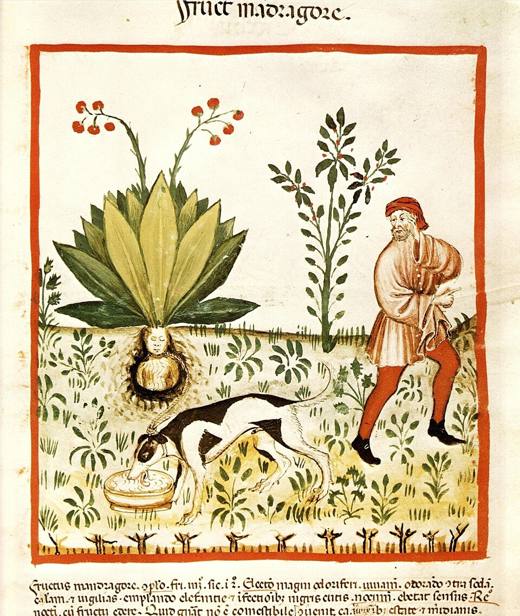
There were also dangerous “witches’ herbs”, such as deadly nightshade, henbane and thorn apple, which turn up in stories about flying ointments. Mandrake, with its human-like root, was said to scream when pulled from the ground.
Folk magic is cultural heritage. Appreciate it as a way in which people once understood their world.
The so-called witches’ herbs, such as deadly nightshade, henbane and thorn apple, are deadly poisonous. Never use them.
From the kitchen
There is no recipe from this tradition on the site yet. These recipes do use herbs it knows.
Registry
Asia · Herb · № 232
Cuminum cyminum
Traditionally attributed effects: carminative, aromatic, stomachic, stimulating, astringent, cooling; for gonorrhoea, chronic diarrhoea, indigestion, hoarseness; oil as a source of thymol against hookworms.
Asia · Food · № 261
Cucumis sativus
Traditionally attributed effects: fruit nourishing and soothing; seeds cooling, diuretic, tonic; for throat complaints, strongly diuretic with sugar, in fever.
Europe · Food · № 68
Brassica oleracea
A vegetable rich in vitamin C and fibre. In folk medicine cold cabbage leaves are placed on engorged breasts or painful joints; small studies give mixed results.
Europe · Herb · № 231
Coriandrum sativum
Traditionally attributed effects: aromatic, stimulating, carminative, stomachic, cooling, tonic, diuretic; for flatulence, colic, rheumatism, nerve pain, sore throat, indigestion, vomiting, colds, bile complaints.
Asia · Food · № 42
Syzygium aromaticum
A spice. Clove oil containing eugenol may help with toothache; other claims are unproven.
Asia · Herb · № 5
Curcuma longa
A traditional culinary spice containing curcumin; laboratory findings do not establish a cure for disease.
Europe · Herb · № 213
Laurus nobilis
Bay leaf is a culinary herb containing cineole and eugenol. The oil of the berries was used externally for muscle pain; a medicinal effect has hardly been studied.
Europe · Herb · № 44
Lavandula angustifolia
A fragrant plant used in bath products, perfume, and aromatherapy. Evidence for medical effects is preliminary.
Europe · Herb · № 208
Antirrhinum majus
An ornamental plant. In folk medicine leaves were laid as a poultice on sores and haemorrhoids; a medicinal effect has not been studied.
Asia · Herb · № 205
Lilium spp.
The bulb scales of some lilies (bai he) are used in Chinese medicine for dry cough, restlessness and sleeplessness after fever. Lilies are deadly poisonous to cats.
Europe · Herb · № 206
Convallaria majalis
Traditionally attributed effects: heart tonic, diuretic, laxative, emetic.
Europe · Herb · № 191
Sorbus aucuparia
The orange berries are rich in vitamin C and are eaten cooked; raw they contain parasorbic acid, which irritates the stomach and bowel. A medicinal effect has hardly been studied.
Asia · Food · № 238
Citrus aurantiifolia
A sour citrus fruit rich in vitamin C. The juice was given against scurvy and is used in Asia with honey or salt for coughs and sore throat.
Asia · Food · № 131
Nelumbo nucifera
Almost every part is used: seeds for diarrhoea and restlessness, rhizome as food, leaf for 'summer heat'. Scientific evidence is mostly laboratory research.
Europe · Herb · № 211
Viola odorata
Traditionally attributed effects: V. odorata anti-inflammatory, expectorant, diuretic, antitumour; V. tricolor expectorant, anti-inflammatory, diuretic, antirheumatic, laxative, strengthens capillaries.
Central America and the Caribbean · Food · № 266
Zea mays
Traditionally attributed effects: diuretic, heals the urinary tract lining, tonic, soothing.
Europe · Herb · № 113
Marrubium vulgare
A bitter herb traditionally used for coughs with sticky phlegm and bronchitis. In Europe it is recognised as a traditional herbal medicine; clinical evidence is limited.
Asia · Food · № 248
Mangifera indica
Traditionally attributed effects: cooling herb, prevents a burning feeling and keeps you cool in the heat; aids digestion; good for skin and hair.
Europe · Herb · № 239
Viscum album
Traditionally attributed effects: slows the heart rate, lowers blood pressure, antitumour.
Europe · Herb · № 199
Leucanthemum vulgare
Young leaves are edible. In folk medicine a tea of the flowers was used for coughs and as a wash; a medicinal effect has not been studied.
Asia · Herb · № 216
Origanum majorana
A mildly aromatic culinary herb related to oregano. It was drunk as tea for bloating, colds and restlessness; studies in humans are scarce.
Europe · Herb · № 47
Crataegus monogyna, C. laevigata (en C. pinnatifida)
Studied for heart failure with conflicting results. For most conditions there is little or no good evidence.
Africa · Food · № 252
Cucumis melo
A sweet, juicy fruit. In Chinese medicine the dried stalk (gua di) was used to induce vomiting; no medicinal effect is described for the fruit itself.
Africa · Other · № 28
Commiphora myrrha
A gum resin with a long history in medicine, ritual, perfume, and incense. Modern treatment claims are not established.
Europe · Herb · № 96
Tanacetum parthenium
Best known for preventing migraine. NCCIH notes the evidence is conflicting: some studies find a small effect, others do not.
Europe · Herb · № 71
Filipendula ulmaria
Contains salicylates. Traditionally used for heartburn, an irritated stomach and joint pain. Clinical research is scarce.
Europe · Herb · № 3
Mentha × piperita
Peppermint oil has been studied in irritable bowel syndrome and may reduce abdominal pain. The tea is used for a full stomach and nausea. With heartburn peppermint can make complaints worse.
Europe · Herb · № 198
Narcissus spp.
Daffodils are ornamental plants; the bulbs are poisonous and are sometimes mistaken for onions. Galantamine, a drug for Alzheimer's disease, is extracted from the related snowdrop and from daffodils.
Asia · Herb · № 129
Myristica fragrans
A spice used in small amounts in Ayurveda and Arabic medicine for diarrhoea, nausea and insomnia. There is no good clinical evidence.
Europe · Herb · № 235
Euphrasia officinalis
Traditionally attributed effects: anticatarrhal, antiseptic, anti-inflammatory.
South America · Herb · № 227
Tropaeolum majus
Leaves and flowers taste sharp because of mustard oil glycosides. In Germany a combination with horseradish is approved as a remedy for bladder and respiratory infections; there is little research on the plant alone.
Europe · Herb · № 217
Origanum vulgare
A culinary herb with carvacrol and thymol, which inhibit bacteria and fungi in the laboratory. There is no good evidence that oregano oil treats infections in humans; undiluted oil irritates skin and mucous membranes.
Europe · Herb · № 97
Taraxacum officinale
The leaf is mildly diuretic; the bitter root was used for the liver and digestion. NCCIH notes there is little human research.
North America · Herb · № 154
Passiflora incarnata
Used for anxiety and sleep problems. NCCIH notes some indications of an effect on anxiety but limited evidence.
Asia · Herb · № 241
Pogostemon cablin
Traditionally attributed effects: inhibits sebum production, draws oil from the skin, fights acne bacteria; against dandruff.
Europe · Food · № 259
Daucus carota
Traditionally attributed effects: stimulating, diuretic, tonic, carminative; expels kidney and bladder stones, relieves lower back pain from the kidneys, reduces oedema, restores the bladder, stimulates digestion; seed traditionally as a contraceptive.