Skip to content
Herbs & Cultures

Tradition in Europe

Folk magic and herbal magic

Centuries-old folk customs; present-day herbal magic mainly since the 20th century

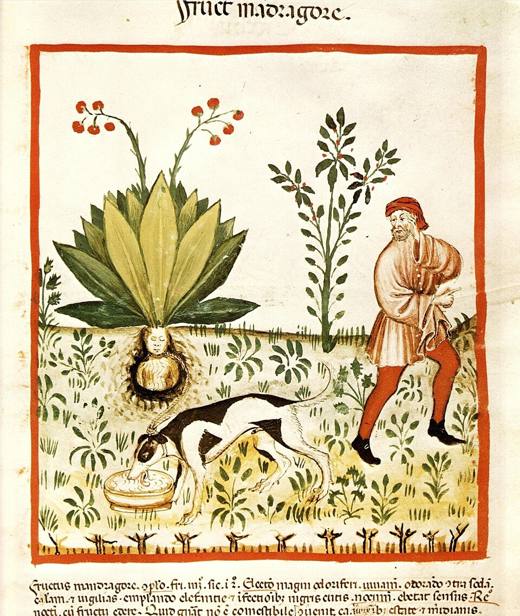
The mandrake is pulled from the ground by a dog, as legend required; Tacuinum sanitatis, c. 1390.
The mandrake is pulled from the ground by a dog, as legend required; Tacuinum sanitatis, c. 1390. public domain

History

All over Europe, folk belief gave plants special powers. They protected house and livestock, brought love, warded off thunderstorms and evil forces. These customs are often very old and were later linked to Christian feasts.

A fine example from the Low Countries is the kruidwis, the herb bundle. On the Feast of the Assumption, 15 August, bundles of herbs and grains are blessed in Dutch and Belgian Limburg. The bundle, with mugwort and wormwood among other things, was kept at home and thrown on the fire during thunderstorms, as protection against lightning.

Midsummer night, St John’s Eve on 24 June, was also a time for herbs. St John’s wort was picked and hung above the door against misfortune. In the nineteenth century folklorists collected such customs, and in the twentieth century a modern herbal magic arose, especially in pagan movements.
Key ideas

In folk belief plants have a power of their own, which you can use if you know how. What matters is the moment of picking, such as on a holy day or at full moon, the right words, and the purpose.

Plants protect: rowan above the stable door against witches, garlic against evil, mistletoe as a bringer of luck. They can also bring love or foretell the future.

There is a thin line between folk medicine and folk magic. The same herb could help against coughs and against witches.

Knowledge and its transmission

The knowledge was passed on orally, in families, by elders and by people known for their knowledge: herb women, wise women and men, and sometimes the village priest.

A persistent image is that the witch hunts of the fifteenth to seventeenth centuries mainly burned herb women. Historians see it more subtly: most of the accused were ordinary people, often poor or living alone, and not healers.

Today herbal magic lives on in modern pagan and Wiccan traditions, and in a broad interest in folklore.

Texts and figures

Nineteenth-century folklorists such as Jacob Grimm, in his Deutsche Mythologie of 1835, collected much folk belief about plants.

In the Netherlands the physician M.A. van Andel described folk medicine in the Netherlands in 1909, with many examples of magical and practical customs.

As early as the first century, Pliny the Elder described how Celtic druids cut mistletoe from the oak with a golden sickle.

Today

Many customs live on. The blessing of the herb bundle is still held every year in Limburg and in Elen in Belgian Limburg. Mistletoe hangs in Christmas decorations, and people kiss beneath it.

Modern herbal magic is popular, with books, rituals and shops.

Folklorists and historians study these traditions as valuable intangible heritage.

Nature in the tradition

Well-known plants of folk magic are St John’s wort, mugwort, vervain (verbena), elder, rowan, mistletoe, rosemary and rue.

Many stories surrounded the elder: a spirit lived in the elder, and anyone who wanted to cut a branch had to ask first.

There were also dangerous “witches’ herbs”, such as deadly nightshade, henbane and thorn apple, which turn up in stories about flying ointments. Mandrake, with its human-like root, was said to scream when pulled from the ground.

Approaching it with respect

Folk magic is cultural heritage. Appreciate it as a way in which people once understood their world.

The so-called witches’ herbs, such as deadly nightshade, henbane and thorn apple, are deadly poisonous. Never use them.

From the kitchen

Recipes with herbs from this tradition

There is no recipe from this tradition on the site yet. These recipes do use herbs it knows.

Registry

Herbs in this tradition

  • Caution

    Asia · Herb · № 243

    Tarragon

    Artemisia dracunculus

    A culinary herb with an aniseed-like taste. The fresh leaf slightly numbs the tongue and was formerly chewed for toothache and used to stimulate the appetite. It contains estragole; large amounts are not recommended.

    Western herbal medicine+1Folklore
  • Caution

    Europe · Herb · № 105

    Heartsease

    Viola tricolor

    Traditionally used for skin conditions such as eczema and cradle cap, and for coughs. There is little clinical research.

    Monastic and folk knowledge+1Folklore
  • Caution

    Europe · Food · № 245

    Grape

    Vitis vinifera

    Traditionally attributed effects: soothing, laxative, cooling, stomachic, diuretic; for bilious indigestion, bleeding, painful urination, chronic bronchitis, heart disease, gout; juice for constipation in children.

    Folk magic and herbal magic+3Folklore
  • Caution

    Europe · Herb · № 56

    Yarrow

    Achillea millefolium

    Traditionally used to stop bleeding from minor wounds, for fevers and colds, and as a digestive bitter. Clinical evidence is limited.

    Greco-Roman medicine+6Folklore
  • Caution

    Europe · Other · № 377

    Dulse

    Palmaria palmata

    A red seaweed with protein, iodine and minerals. It is eaten as food and worked into scrubs; a medicinal effect has not been shown.

    Folk magic and herbal magicFolklore
  • Caution

    North America · Herb · № 14

    Echinacea

    Echinacea purpurea

    Studied for colds and respiratory infections. It may slightly reduce the chance of catching a cold; effects on duration and other conditions are uncertain.

    Indigenous healing traditions of North America+5Folklore
  • Caution

    Asia · Food · № 260

    Peas

    Pisum sativum

    A legume rich in protein and fibre. In Chinese medicine (wan dou) the pea is regarded as a mild remedy for the spleen and for mild diarrhoea.

    Folk magic and herbal magicFolklore
  • Caution

    Europe · Herb · № 193

    Ash

    Fraxinus excelsior

    The leaf was used as a mild diuretic and laxative and for gout. There is little research; a medicinal effect has not been shown.

    Folk magic and herbal magicFolklore
  • Caution

    North America · Herb · № 188

    Maple

    Acer spp.

    Maple syrup is the boiled-down sap of the sugar maple. It consists mainly of sugar and some minerals, such as manganese; it is a sweetener, not a medicine.

    Indigenous healing traditions of North America+3Folklore
  • Caution

    Oceania · Herb · № 172

    Eucalyptus

    Eucalyptus globulus

    Eucalyptus oil is used for coughs and blocked noses with colds and externally for muscle pain; the European Medicines Agency recognises these as traditional uses. Strong clinical evidence is limited.

    Aboriginal and Torres Strait Islander knowledge+4Folklore
  • Caution

    Africa · Herb · № 118

    Fenugreek

    Trigonella foenum-graecum

    The seed has been studied for blood sugar and for increasing breast milk. NCCIH reports there is not enough strong evidence for these uses.

    Ancient Egyptian medicine+5Folklore
  • Caution

    Europe · Food · № 90

    Raspberry

    Rubus idaeus

    The fruit is a nutritious berry. Raspberry leaf has been used in folk medicine in late pregnancy to ease labour; convincing evidence is lacking.

    Monastic and folk knowledge+3Folklore
  • Caution

    Asia · Herb · № 200

    Gardenia (zhi zi)

    Gardenia jasminoides

    Traditionally attributed effects: fever-reducing, calming, lowers blood pressure, antibacterial, promotes bile.

    Chinese medical traditions+3Folklore
  • Caution

    Asia · Herb · № 1

    Ginger

    Zingiber officinale

    Traditionally used for nausea and digestive discomfort; it has a warming flavor.

    Ayurveda+6Folklore
  • Caution

    Asia · Food · № 269

    Barley

    Hordeum vulgare

    Traditionally attributed effects: astringent, light; good for skin and hair.

    Ayurveda+4Folklore
  • Caution

    Europe · Herb · № 49

    Pot marigold (calendula)

    Calendula officinalis

    An edible flower historically used as medicine and dye. Its oil is widely used in skin products.

    Monastic and folk knowledge+2Folklore
  • Caution

    Europe · Herb · № 218

    Spearmint

    Mentha spicata

    The classic culinary mint, with the milder carvone instead of menthol. It is drunk as tea for a full stomach and nausea; studies on concentration are small and inconclusive.

    Folk magic and herbal magic+1Folklore
  • Caution

    Europe · Herb · № 60

    Garden angelica

    Angelica archangelica

    An aromatic bitter traditionally used for bloating, poor appetite and colds. Clinical evidence is limited.

    Monastic and folk knowledge+2Folklore
  • Caution

    Europe · Food · № 196

    Hazel

    Corylus avellana

    The nuts are nourishing and rich in unsaturated fats and vitamin E. Hazelnut oil is a light oil for the skin; a medicinal effect has not been shown.

    Folk magic and herbal magicFolklore
  • Caution

    Europe · Herb · № 59

    Marshmallow

    Althaea officinalis

    Root and leaf are rich in mucilage that forms a soothing layer; used for dry coughs, throat irritation and an irritated stomach. Evidence is modest.

    Greco-Roman medicine+3Folklore
  • Caution

    South America · Herb · № 237

    Heliotrope

    Heliotropium arborescens

    An ornamental plant with strongly vanilla-scented flowers. It contains pyrrolizidine alkaloids and is poisonous if swallowed; it is grown only for its scent.

    Folk magic and herbal magicFolklore
  • Caution

    Europe · Herb · № 77

    Hops

    Humulus lupulus

    The cones are traditionally used for restlessness and sleep problems, often with valerian. There are hints of a mild sedative effect, but evidence is limited.

    Monastic and folk knowledge+2Folklore
  • Caution

    Europe · Herb · № 202

    Grape hyacinth and bluebell

    Muscari racemosum, Hyacinthoides non-scripta

    Hyacinths and grape hyacinths are ornamental plants. The bulbs are poisonous and can cause itching on contact ('hyacinth itch' among bulb peelers).

    Folk magic and herbal magicFolklore
  • Caution

    Europe · Herb · № 78

    Hyssop

    Hyssopus officinalis

    Traditionally used for coughs, colds and congestion. Clinical evidence is lacking.

    Western herbal medicine+2Folklore
  • Caution

    Europe · Herb · № 234

    Elm

    Ulmus spp.

    The inner bark of the European elm is, like that of the American slippery elm, mucilaginous and was used for skin complaints and diarrhoea. There is little research.

    Folk magic and herbal magic+1Folklore
  • Caution

    Europe · Herb · № 103

    Vervain

    Verbena officinalis

    Traditionally used for nervousness, exhaustion and as a digestive bitter. Scientific evidence is largely lacking.

    Greco-Roman medicine+3Folklore
  • Caution

    Europe · Herb · № 203

    Orris root

    Iris florentina (I. germanica 'Florentina')

    The dried root (orris root) smells of violets and is a fixative in perfume and potpourri. Medicinally it was used for coughs and for teething children; it can cause allergies.

    Greco-Roman medicine+1Folklore
  • Caution

    Asia · Herb · № 126

    Jasmine

    Jasminum officinale / J. grandiflorum

    Best known as a fragrance and in jasmine tea; jasmine aromatherapy is used for relaxation. Medical claims are unproven.

    Ayurveda+4Folklore
  • Caution

    Europe · Herb · № 81

    Juniper

    Juniperus communis

    The berries are traditionally used as a diuretic, for digestive complaints and externally for joint pain. Clinical evidence is limited.

    Western herbal medicine+5Folklore
  • Caution

    Europe · Herb · № 19

    Chamomile

    Matricaria chamomilla (Duitse kamille)

    Flowers are used in teas and topical or oral products. Reliable evidence is insufficient for most claimed conditions.

    Monastic and folk knowledge+7Folklore
  • Caution

    Asia · Food · № 38

    Cinnamon

    Cinnamomum verum

    A spice made from inner bark. Research on health effects is preliminary; cinnamon is not a treatment.

    Ayurveda+8Folklore
  • Caution

    Europe · Herb · № 214

    Caraway

    Carum carvi

    Traditionally attributed effects: carminative, aromatic, stomachic, stimulating, promotes milk flow; for flatulence and intestinal cramps, corrects nausea-inducing medicines, scabies.

    Folk magic and herbal magic+1Folklore
  • Caution

    Europe · Herb · № 109

    Catnip

    Nepeta cataria

    Traditionally used as a mild tea for colds, fevers, restlessness and colic. Nepetalactone from the plant is being researched as an insect repellent.

    Western herbal medicine+2Folklore
  • Caution

    Asia · Food · № 246

    Kiwifruit

    Actinidia deliciosa

    A fruit rich in vitamin C and fibre. Small studies point to a slightly beneficial effect on constipation, and also on sleep; the enzyme actinidin tenderises meat.

    Chinese medical traditions+1Folklore
  • Caution

    Europe · Herb · № 207

    Corn poppy

    Papaver rhoeas

    Traditionally attributed effects: mildly narcotic in large amounts; Papaver somniferum (source of opium) is poisonous.

    Folk magic and herbal magicFolklore
  • Caution

    Africa · Food · № 12

    Garlic

    Allium sativum

    A food with a long history of use. Supplement research suggests only limited effects and does not establish a treatment.

    Ancient Egyptian medicine+7Folklore