Skip to content
Herbs & Cultures

Tradition in Asia

Chinese medical traditions

Classical writings from the early centuries BCE and CE

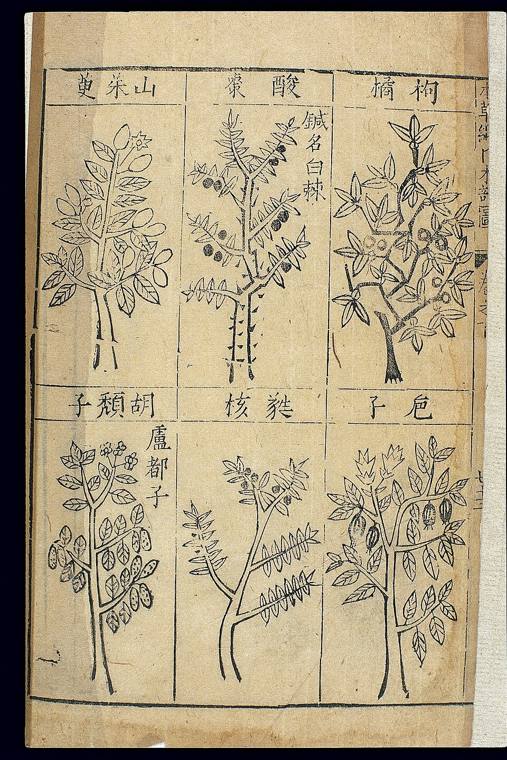
Plants from Li Shizhen's Bencao Gangmu, the great Chinese materia medica of the Ming period.
Plants from Li Shizhen's Bencao Gangmu, the great Chinese materia medica of the Ming period. Wellcome Collection · CC BY 4.0

History

Chinese medicine is one of the oldest continuous healing traditions in the world. In a tomb at Mawangdui, sealed in 168 BCE, archaeologists found silk manuscripts with recipes against fifty-two ailments. They show how old the knowledge already was.

The classical foundation lies in a few great works. The Huangdi Neijing, the “Inner Classic of the Yellow Emperor”, took shape in the last centuries BCE. The Shennong Bencao Jing, the herbal classic of the mythical farmer-emperor Shennong, describes 365 remedies. Around 200 CE Zhang Zhongjing wrote the Shanghan Lun, on febrile diseases, with formulas still in use today.

Over the centuries the knowledge kept growing. In 1578 Li Shizhen completed the Bencao Gangmu, a huge encyclopaedia with almost two thousand remedies. In the twentieth century the tradition was reformed and standardised in China into what the West now calls “traditional Chinese medicine”.

Key ideas

Chinese medicine sees the body as a coherent whole, connected with nature and the seasons. Central are yin and yang, two opposing but complementary forces, such as cold and warm, rest and movement. Health is their balance.

Qi is the life energy that flows through the body, along pathways called meridians. The five phases, wood, fire, earth, metal and water, describe how organs, seasons, tastes and emotions influence one another.

A physician diagnoses not only a disease, but above all a pattern: a picture of what is out of balance in the whole body. To do so he looks at the tongue, feels the pulse and asks many questions. Two people with the same complaint can thus receive very different treatment.
Knowledge and its transmission

For a long time knowledge was passed on within families or from teacher to pupil. Physicians studied the classics, wrote commentaries and collected their own recipes.

There were also imperial medical institutes, from the Tang dynasty onwards, with examinations and training. Alongside the learned physicians there was broad folk knowledge of herbs, as well as itinerant healers and herb sellers.

Today universities of Chinese medicine in China train physicians in a programme of five years or longer, with Western medicine also on the curriculum.

Texts and figures

The Huangdi Neijing and the Bencao Gangmu have been on UNESCO’s Memory of the World register since 2011. The Shennong Bencao Jing and the Shanghan Lun are the other great classics.

A remarkable story belongs to a fourth-century book by the scholar Ge Hong. He described how to soak sweet wormwood in cold water against fever. In the 1970s the Chinese researcher Tu Youyou read that text and so discovered artemisinin, a drug against malaria. In 2015 she received the Nobel Prize for it.

In 2010 UNESCO recognised acupuncture and moxibustion as intangible heritage.

Today

In China traditional medicine works alongside Western medicine, with its own hospitals, pharmacies and training. It is also important in Taiwan, Hong Kong and Singapore, and there are practitioners worldwide.

Since 2019 the WHO’s International Classification of Diseases, ICD-11, has had a separate chapter with diagnoses from the traditional medicine of China, Japan and Korea.

The scientific support differs greatly by use. Some remedies are well researched; for many others evidence is lacking.

Nature in the tradition

Chinese remedies are almost always combined in formulas. Every formula has a principal remedy and helpers. Well-known herbs are ginseng, astragalus, dang gui, liquorice, which brings many formulas into balance, ginger, cinnamon and Chinese dates.

Goji, rehmannia, peony root and the mushroom poria also belong to the basics.

According to the tradition every remedy has its own nature (warm or cold), a taste and a direction in the body. Besides plants, minerals and animal products are also used.

Approaching it with respect

Some Chinese remedies can be harmful. Herbs containing aristolochic acid caused serious kidney damage in Belgium in the 1990s among users of a slimming regimen. Ephedra can strain the heart. Buy only controlled products and consult a doctor.

Do not use remedies from endangered animals, such as the pangolin or the tiger. That trade threatens these species with extinction.

From the kitchen

Recipes from this tradition

Registry

Herbs in this tradition

  • Caution

    Asia · Herb · № 127

    Japanese honeysuckle

    Lonicera japonica en L. periclymenum

    The flower buds (jin yin hua) are an important 'cooling' herb in Chinese medicine for fever, sore throats and colds. There is plenty of laboratory research but few good clinical studies.

    Chinese medical traditions+3
  • Caution

    Asia · Herb · № 687

    Japanese climbing fern (jin sha teng)

    Lygodium japonicum

    Traditionally attributed effects: diuretic in cystitis and stones; also for sore throat and mumps.

    Chinese medical traditions
  • Caution

    Asia · Herb · № 322

    Asiatic dogwood fruit (shan zhu yu)

    Cornus officinalis

    Traditionally attributed effects: tonic, diuretic, lowers blood pressure, antimicrobial.

    Chinese medical traditions+3
  • Caution

    Asia · Herb · № 715

    Chinese quince (mu gua)

    Chaenomeles speciosa

    Traditionally attributed effects: relaxes tendons and muscles in cramps and rheumatic pain and drives dampness from the stomach.

    Chinese medical traditions
  • Caution

    Asia · Herb · № 723

    Loquat leaf (pi pa ye)

    Eriobotrya japonica

    Traditionally attributed effects: cools hot phlegm in the lungs and makes rebellious lung and stomach energy descend.

    Chinese medical traditions+2
  • Caution

    Asia · Herb · № 785

    Bush cherry pit (yu li ren)

    Prunus japonica

    Traditionally attributed effects: moistens the bowel in constipation with stagnation and promotes urination in oedema.

    Chinese medical traditions+1
  • Caution

    Central America and the Caribbean · Herb · № 514

    Japanese morning glory

    Ipomoea nil

    Traditionally attributed effects: strongly laxative, expels worms; for constipation, substitute for jalap root.

    Ayurveda+2
  • Caution

    Asia · Herb · № 126

    Jasmine

    Jasminum officinale / J. grandiflorum

    Best known as a fragrance and in jasmine tea; jasmine aromatherapy is used for relaxation. Medical claims are unproven.

    Ayurveda+4Folklore
  • Caution

    Asia · Food · № 645

    Job's tears (coix seed)

    Coix lacryma-jobi

    Traditionally attributed effects: nourishing grain that drives dampness from the body; for arthritis and rheumatism, diuretic, and to relieve a full chest and stomach ulcers.

    Chinese medical traditions+2
  • Caution

    Asia · Herb · № 752

    Teasel root (xu duan)

    Dipsacus asper

    Traditionally attributed effects: strengthens liver and kidneys, helps fractures heal and calms the foetus.

    Chinese medical traditions
  • Caution

    Asia · Food · № 733

    Persimmon calyx (shi di)

    Diospyros kaki

    Traditionally attributed effects: the calyx makes the stomach energy descend in hiccups and belching.

    Chinese medical traditions+1
  • Caution

    Asia · Herb · № 695

    Glabrous greenbrier (tu fu ling)

    Smilax glabra

    Traditionally attributed effects: drains damp heat, especially via the skin and in joint complaints.

    Chinese medical traditions
  • Caution

    Asia · Herb · № 686

    Houttuynia (yu xing cao)

    Houttuynia cordata

    Traditionally attributed effects: detoxifies and drains pus, especially in lung infections; diuretic.

    Chinese medical traditions+2
  • Caution

    Asia · Other · № 141

    Camphor

    Cinnamomum camphora

    Used externally in rubs for muscle pain, itching and blocked noses; it gives a cooling, numbing feeling. There is some evidence of short-term relief.

    Ayurveda+3
  • Caution

    Asia · Food · № 38

    Cinnamon

    Cinnamomum verum

    A spice made from inner bark. Research on health effects is preliminary; cinnamon is not a treatment.

    Ayurveda+8Folklore
  • Caution

    Asia · Herb · № 699

    Kansui root (gan sui)

    Euphorbia kansui

    Traditionally attributed effects: was used as a very strong fluid-draining purgative for fluid in chest and abdomen.

    Chinese medical traditions
  • Caution

    North America · Herb · № 155

    Pokeweed

    Phytolacca americana

    Formerly used for swollen glands, tonsillitis and rheumatism. Because of its toxicity it is not a safe herb; there is no evidence of benefits that outweigh the risks.

    Indigenous healing traditions of North America+5
  • Caution

    Asia · Herb · № 143

    Kutki

    Picrorhiza kurroa

    A very bitter herb used in Ayurveda and Tibetan medicine for liver complaints, fever and digestive problems. Research is mainly in animals.

    Ayurveda+3
  • Caution

    Europe · Other · № 382

    Kelp

    Laminaria spp. / Ascophyllum nodosum

    Brown seaweeds are rich in iodine and alginate. They are used in scrubs and as food supplements; too much iodine can disrupt the thyroid.

    Chinese medical traditions
  • Caution

    Asia · Herb · № 830

    Kencur (aromatic ginger)

    Kaempferia galanga

    An aromatic rhizome used in jamu for coughs, tiredness and muscle pain.

    Chinese medical traditions+1
  • Caution

    Asia · Herb · № 647

    Fritillaria bulb (bei mu)

    Fritillaria cirrhosa

    Traditionally attributed effects: dissolves phlegm and clears congested lungs; together with pear for dry airways and a heated chest.

    Chinese medical traditions
  • Caution

    Asia · Food · № 246

    Kiwifruit

    Actinidia deliciosa

    A fruit rich in vitamin C and fibre. Small studies point to a slightly beneficial effect on constipation, and also on sleep; the enzyme actinidin tenderises meat.

    Chinese medical traditions+1Folklore
  • Caution

    Europe · Herb · № 100

    Coltsfoot

    Tussilago farfara

    One of the oldest cough herbs; the leaf contains soothing mucilage. Because of its toxic alkaloids it is now advised against.

    Greco-Roman medicine+3
  • Caution

    Asia · Herb · № 832

    Lesser galangal

    Alpinia officinarum

    An aromatic rhizome traditionally used for digestive complaints.

    Chinese medical traditions+3
  • Caution

    Europe · Herb · № 565

    Puncture vine

    Tribulus terrestris

    Traditionally attributed effects: cooling, soothing, diuretic, tonic, aphrodisiac.

    Ayurveda+2
  • Caution

    Africa · Food · № 12

    Garlic

    Allium sativum

    A food with a long history of use. Supplement research suggests only limited effects and does not establish a treatment.
    Ancient Egyptian medicine+7Folklore
  • Caution

    Asia · Food · № 758

    Garlic chives (jiu zi)

    Allium tuberosum

    Traditionally attributed effects: the seed strengthens kidney yang and warms stomach and spleen.

    Chinese medical traditions+1
  • Caution

    Africa · Herb · № 337

    Nut grass

    Cyperus rotundus

    Traditionally attributed effects: carminative, pain-relieving, antispasmodic for the uterus, promotes the flow of qi.

    Ancient Egyptian medicine+4
  • Caution

    Europe · Herb · № 92

    Figwort

    Scrophularia nodosa (en S. ningpoensis)

    Used in Western herbalism for skin conditions such as eczema and psoriasis and for swollen glands. There is no good clinical evidence.

    Monastic and folk knowledge+2
  • Caution

    Asia · Herb · № 746

    Vaccaria seed (wang bu liu xing)

    Gypsophila vaccaria (syn. Vaccaria segetalis)

    Traditionally attributed effects: lets the blood flow, promotes menstruation and milk flow and reduces painful swellings.

    Chinese medical traditions
  • Caution

    Asia · Herb · № 725

    Korean mint (huo xiang)

    Agastache rugosa (ook Pogostemon cablin)

    Traditionally attributed effects: transforms dampness blocking spleen and stomach and curbs nausea, also in summer colds.

    Chinese medical traditions+1
  • Caution

    Europe · Herb · № 231

    Coriander

    Coriandrum sativum

    Traditionally attributed effects: aromatic, stimulating, carminative, stomachic, cooling, tonic, diuretic; for flatulence, colic, rheumatism, nerve pain, sore throat, indigestion, vomiting, colds, bile complaints.

    Greco-Roman medicine+5Folklore
  • Caution

    Asia · Herb · № 711

    Mallow seed (dong kui zi)

    Malva verticillata (ook Abutilon theophrasti)

    Traditionally attributed effects: soothing and diuretic in painful urination and stones; promotes milk flow.

    Chinese medical traditions
  • Caution

    Asia · Food · № 42

    Clove

    Syzygium aromaticum

    A spice. Clove oil containing eugenol may help with toothache; other claims are unproven.

    Ayurveda+5Folklore
  • Caution

    Asia · Herb · № 136

    Kudzu

    Pueraria montana var. lobata

    The root (ge gen) is used in Chinese medicine for fever, stiff neck and thirst. Small studies have looked at kudzu for reducing alcohol use, with mixed results.

    Chinese medical traditions+3
  • Caution

    Asia · Herb · № 5

    Turmeric

    Curcuma longa

    A traditional culinary spice containing curcumin; laboratory findings do not establish a cure for disease.

    Ayurveda+5Folklore